










































Addressing Gender-Based Violence Through USAID's Health Programs: A Guide for Health Sector Program Officers (Second Edition)

From the preface of this guide written by the Interagency Gender Working Group (IGWG): "The present guide [updating the July 2006 version] is intended to help USAID [United States Agency for International Development] program officers integrate gender-based violence (GBV) activities into their health sector portfolio during project design, implementation, and evaluation. The guide focuses on what the health sector can do, keeping in mind that preventing and responding to gender-based violence requires a multisectoral approach. For each type of health program - from community mobilization to health policy - the guide explores reasons why these programs should address gender-based violence and how to support GBV activities based on what is known about promising approaches from literature reviews, (e.g. Heise et al., 1999; Guedes, 2004; Bott et al., 2005), the opinions of leading experts, and feedback from USAID and cooperating agency staff."
As stated in the document, research demonstrates that gender-based violence has implications for almost every aspect of health policy and programming, from primary care to reproductive health programmes, because it not only results in injury and death of its victims, but also it can contribute to the spread of HIV. Reducing violence and coercion is among five high-priority gender strategies of the President’s Emergency Plan for AIDS Relief (PEPFAR). "Forms of gender-based violence include: physical, sexual, and psychological/emotional violence within the family; child sexual abuse; dowry-related violence; rape and sexual abuse; marital rape; sexual harassment in the workplace and educational institutions; forced prostitution; trafficking of girls and women; and female genital cutting. However, to limit the scope of this document, the guidelines that follow focus on two common forms of gender-based violence: intimate partner violence (physical, sexual, and emotional) and sexual violence by any perpetrator. [Editor's note: For links to further information on female genital cutting and trafficking, see page 4 of the document.] Although men can also be victims of intimate partner and sexual violence, this type of violence affects women disproportionately."
Global statistics are given suggesting that 10 - 69 percent of women report being hit or physically harmed by an intimate partner. Nearly 25 percent of women report sexual violence by an intimate partner, and rates of "forced" sexual début range from 7 - 46 percent.
Examples of factors associated with high levels of violence against women at the community level include:
● Traditional gender norms that support male superiority and entitlement
● Gender norms that tolerate or even justify violence against women
● Weak community sanctions against perpetrators
● Poverty
● High levels of crime and conflict in society more generally
Examples of individual factors associated with a higher risk of becoming a perpetrator include:
● Alcohol or drug use
● Low income or academic achievement
● Witnessing/experiencing violence as a child
● Attitudes that justify violence against women
Examples of individual factors associated with a higher risk of experiencing GBV include:
● Consumption of alcohol or drugs
● Previous history of abuse
● Becoming empowered through education or economic advancement, in traditional settings
● Poverty (especially for sexual violence)
Other findings show that violence against women may increase in communities where women break from traditional norms. Crime and armed conflict are causally linked to gender violence. The document suggests that: "From a public health perspective, community-level risk factors may be the most helpful for identifying promising ways to reduce violence against women. Focusing too much on individual risk factors may obscure the fact that violence against women tends to occur throughout society and across all demographic and socio-economic groups and appears to be heavily influenced by community norms and responses."
Guiding principles in GBV programming are summarised as:
● Ensure that all activities respect survivors’ safety and autonomy first and foremost
● Ensure the relevance and appropriateness of interventions to the local setting
● Employ both a public health and a human rights perspective
● Encourage multi-sectoral interventions at multiple levels
● Invest in evaluation both for the sake of assessing results and for protecting survivors’ safety
More specifically related to communication, the document presents strategies - by programme type - suggesting what programmes should and should not do. For example, community mobilization programmes should not: launch campaigns to encourage women to seek assistance before community resources are in place to ensure an adequate response to survivors; impose solutions without community participation and input; or use strategies that rely solely on shame, rather than on positive messages about gender equity and healthy relationships. They should employ multiple strategies to change community norms, including local media and advocacy, local activism, training, and communication materials, which should include engaging men as allies.
Communication for Social and Behaviour Change (CSBC) programmes should support long-term efforts to link communication activities with other types of GBV activities, such as combining mass media communication strategies to include helping their audiences find services in the community and build support for policy change. They should integrate GBV messages into existing public health communication programmes, ensuring that images and messages are empowering and that they do not reinforce stereotypes, such as women as “victims” and men as “aggressors.” They can also support programmes that use many different types of media channels and formats, including “edutainment”, and focus not only on men and women, adolescents and adults, but also on teachers, the police, and the justice system. They should prioritise monitoring and evaluation for both donor information and for focusing sustained programmes. CSBC programmes should not: ignore formative research needs; expect profound change from short-term campaigns; underestimate the effort needed for linking multiple issues and building relationships to coordinate with various organisations and social actors; or use a single set of messages for different populations when messages need to be specifically tailored.
Health service delivery programmes should support long-term training and sensitisation on GBV, including in schools of medicine and nursing, particularly ensuring that providers acknowledge and listen to women’s experiences with GBV in a non-judgemental and compassionate way. This requires experienced and committed trainers. Regarding the possible risks involved in encouraging women's disclosure of GBV, the document emphasises the systems approach to health service delivery (detailed on page 28 and 29) in order to ensure that the benefits of screening will outweigh the risks, even where legal systems are weak and not all personnel are adequately trained for responding appropriately.
Health policy programmes should: advocate for changes in the criminal and civil code as a way of supporting improved public health and improving policies of publicly-funded agencies like the police, the judiciary, and ministries of health; educate key groups and the broader population about GBV as a public health problem; and advocate for funding, particularly of new laws and policies on GBV. Their work should be inclusive of stakeholders such as survivors and community groups, as well as health professionals.
Youth programmes should: empower girls with self-esteem, negotiation skills, and economic opportunities and promote institutional structures to support girls; require reproductive health programmes for youth to address GBV, particularly sexual violence; and work with families, peers, communities, schools, and universities on attitudes about gender norms and non-violence. Youth programmes should not: focus on negative messages, particularly about men; assume that all sexual behaviour is voluntary; work exclusively with girls, ignoring the need to influence attitudes and behaviours of other populations; or ignore the need for staff training on GBV.
Humanitarian programmes should: promote the use of key guidelines and compliance with established standards for prevention and response to GBV in humanitarian emergencies, as well as train those within all responding agencies in the area of GBV; address the safety of women and girls; and prioritise helping survivors to overcome stigmatisation. They should not neglect existing international standards or allow service gaps or insecure situations for survivors. They should not neglect the need for adjustment counselling of returning military, or neglect training staff and implementing zero tolerance of GBV by staff.
The document concludes with a chart of objectives and indicators with which to monitor and evaluate USAID programmes in the area of GBV (pages 42 - 43).
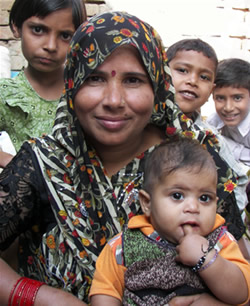
USAID Health Policy Initiative website on July 29 2009. Photo credit: Suneeta Sharma, USAID, Health Policy Initiative TO1.
- Log in to post comments