










































Coast-to-Coast Polio Drive
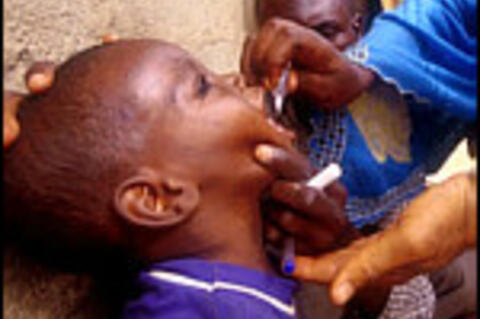
Communication strategies have been developed to help community members appreciate the importance of participating in the polio drive. These strategies include: media communication to raise awareness, political advocacy to secure engagement of influential leaders/organisations, and community mobilisation to build trust and promote health-seeking behaviour amongst families. Messages are designed to address misunderstandings and to alleviate fears about the vaccine. The guiding principles of these behaviour change communications are participation, negotiation, and debate, rather than instruction.
In an effort to make communications targeted and specific, country teams cross-reference epidemiological data with relevant social and cultural indicators to develop detailed messages for each local area. Institutional "resource maps" are used to find the most suitable information networks and channels that speak directly to households. Examples of these strategies include:
- Advocacy and outreach to community influencers (religious and traditional leaders, community-based organisations, teachers, traditional birth attendants, and health workers)
- Alliances with local media and information networks
- Sustained activities at the community level, such as health camps, school classes, market debates, radio shows, and public performances. These activities reflect programme convergence in key areas, such as education and water and sanitation
- Direct interventions (home visits and conversations) with mothers and families who have concerns about polio vaccine.
Community members themselves took the lead in most of these activities. Training vaccinators and community mobilisers in interpersonal communication was a strategy for increasing coverage.
Polio is spread by faecal-oral contact and can be prevented by an oral vaccine; as part of this campaign, vaccinators travelled from house to house delivering vitamin A drops with the polio vaccine (an immunity-boosting strategy).
Immunisation & Vaccines, Children.
Organisers explain that immunity gaps exist within politically marginalised social groups. This marginalisation can be tribal, cultural, social, or economic. In India and Nigeria, the two countries with the highest polio case-count, poor children from Muslim communities are the most affected and least protected. Amongst these communities, estrangement from the central government led to suspicions about the polio-programme (seen to be a government or "outside" programme with dubious motives), coupled with resentment about the frequency of polio immunisations in the absence of other health support, followed by an increase in resistance to immunisation and an explosion of cases. Special strategies had to be put in place rebuild trust within these communities by forming alliances with influential religious/community-based groups and taking account of their wider health concerns.
Polio eradication is a global campaign, and house-to-house immunisation activities are regularly held across Africa and Asia to stop transmission in the remaining 6 endemic countries (Nigeria, Niger, Egypt, India, Pakistan, and Afghanistan). The goal is to contain a spreading outbreak in Africa and protect neigbouring polio-free countries. Organisers of the coast-to-coast polio drive claim that, in India, communication activities undertaken as part of the global effort "led to a dramatic reduction in polio transmission. The virus is more geographically contained there than ever - a massive achievement in such a densely populated country." Vitamin A drops have saved an estimated 1.2 million lives worldwide over 12 years.
World Health Organization (WHO), Rotary International, US Centers for Disease Control & Prevention (CDC), and UNICEF.
Email from Claire Hajaj to The Communication Initiative on March 1 2005; and "Coast-to-coast Polio Drive to Counter Epidemic in Africa", Medical News Today, February 26 2005.
- Log in to post comments