










































Connect with Respect: Preventing Gender-Based Violence in Schools
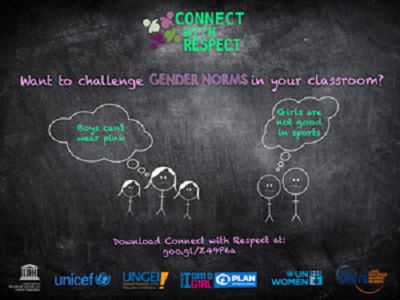
"As a teacher, you can play an important role in preventing the expression of gender-based violence in the school setting. Teachers, school principals and the broader education system can provide positive role models, empower children and youth to have healthy and respectful relationships, and deliver a violence prevention programme within their curriculum."
This tool has been created to help teachers, school principals, and the broader education sector provide positive role models, empower children and youth to have healthy and respectful relationships, and deliver a violence prevention programme within their curriculum in Asia and the Pacific. It is the result of a collaborative effort among partners in the East Asia and Pacific United Nations Girls Education Initiative (UNGEI) School-Related Gender-Based Violence (SRGBV) working group. This includes: Plan International, UN Women, the United Nations Children's Fund (UNICEF), and the United Nations Educational, Scientific and Cultural Organization (UNESCO).
According to the publishers, a comprehensive school response to prevention of school-related gender-based violence (SRGBV) includes the provision of a classroom programme that explicitly teaches about gender justice and violence prevention. As a curriculum tool to assist teachers, Connect with Respect draws on the scientific literature around violence prevention and gender norms change, as well as the programmatic experience of school-based interventions in the region and beyond. For example: "Evidence from effective health education and life-skills programmes show that it is important to use participatory learning activities to develop social skills, and to include practical and relevant learning activities within which students can rehearse positive communication strategies." Having in the first part offered a series of guidance notes for teachers and school leadership on key concepts and issues related to preventing SRGBV, the second part provides a structured teaching programme for teachers working with students in early secondary school. It includes detailed instructions for delivering the learning activities in 7 key topic areas (e.g., communication skills for respectful relationships). Connect with Respect includes a learning tool for teachers to build their own knowledge and awareness on related topics, as well as more than 30 learning activities teachers can use to increase knowledge, positive attitudes, and skills among students.
Designed for lower secondary school learners (aged 11 to 14), activities can be integrated a range of subjects, including literacy, social studies, civics/citizenship education, health, life skills, and sexuality education. It could also be used with other age ranges with further adaptation to ensure age-appropriateness. The learning activities are designed for use in the formal school system; however, they can be modified for use in non-formal education settings, including through community learning or literacy programmes. In addition, while this resource has been prepared for use in schools in the Asia-Pacific region, it is presumed that teachers will play an active role in adapting it to meet the needs of their class, school, and country context. This resource is a living document that will be updated regularly based on feedback on its use, particularly in the Asia-Pacific region.
Currently available in English, the tool is being translated into Chinese, Khmer, and Myanmar languages and - as an open-resource publication - could be further translated into other languages. Guidance is provided within the tool on how countries and schools could modify the classroom programme to ensure relevance to different social and cultural contexts.
120
Plan website and UNESCO website - both accessed on January 30 2017.
- Log in to post comments