










































Enhancing Social Norms Programs: An Invitation to Rethink "Scaling Up" From a Feminist Perspective
"How does the concept of scaling and 'scaling up,' prevalent in 'development' sectors, fit with social norms change?"
Social norms are often taken for granted: Those who conform to them may not even notice they exist, let alone question them. Feminists thus work to identify and name patriarchy as an ideology supporting a social system that has spawned inequitable gender norms and practices around the world. The Community for Understanding Scale Up (CUSP), a group of organisations whose methodologies are designed to align with feminist principles, have found that these principles are frequently lost when others take them to scale - namely, as the focus shifts to numbers, geographies, and efficiencies. This thought piece summarises CUSP's 2020-2021 deliberations on "feminist scale": how to proactively achieve effective, ethical, sustainable adaptation and expansion of the group's respective programmatic materials and paedagogic approaches when scaled up. The purpose is to promote broader discourse in circles seeking to scale gendered social norms change.
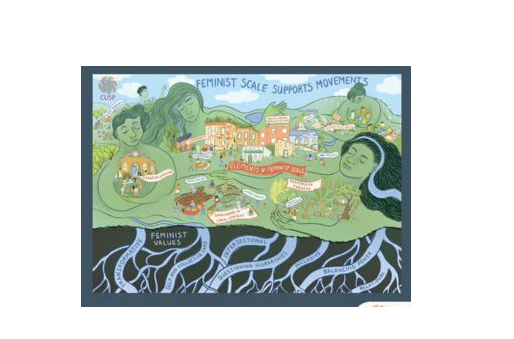
The eight organisations that form CUSP have experience in scaling gender-based social norm change methodologies in various contexts around the world. They include the Center for Domestic Violence Prevention (CEDOVIP), Intervention with Microfinance for AIDS and Gender Equity (IMAGE), the Institute for Reproductive Health at Georgetown University, Center on Gender Equity and Health (GEH) at University of California San Diego, Oxfam GB, Raising Voices, Salamander Trust, and Tostan. In all CUSP fora, these organisations have emphasised basic principles of engagement, based on their collective shared experiences - as seen in the below diagram.

CUSP organisations' respective programmes, such as GREAT, IMAGE, SASA!, Stepping Stones, Tostan, and We Can, have sought to enable women and men to reflect on, challenge, and revise the assumptions that have underpinned the power of patriarchal systems over women's lives, especially. These programmes have supported people's efforts to start to question the existing status quo and to construct a new world order based on more equitable principles of mutual sharing, respect, empathy, and understanding of the structural forces at play in everyone's lives.
Part of that process of questioning involves interrogating the concept or metaphor of "scaling up" itself. The traditional way of understanding growth and expansion emphasises hierarchical organisational structures, quantification, objectification through language, business models of success, and transplanting or transporting something from one site to another. CUSP suggests that the scaling-up metaphor, which directly impacts how norms change programmes are designed, adapted, and implemented, fails to capture the principles and processes that are fundamental to the transformation of gender-based social norms. In the conversations that informed this report, the group explored how other frameworks, such as those based on ecosystems, might better inform expansion efforts (or scaling up) of organisations working to shift social norms.
Namely, with the ecosystem metaphor for scale, the outsider does not provide a solution or expert knowledge but, rather, finds the promising conditions that already exist, and through dialogue and with respect, strengthens or awakens them. The consideration here is how to grow one's work from within, in partnership, noting the links between activists, their relationships with others, their material resources, the organisations within the community, and the legal, religious, health, business, governmental, and educational systems in which they live and work. Ideally, one then provides sustained engagement and support (including funding) to enable those linkages to develop and strengthen - recognising and working with dynamic material, environmental, and relationship contexts and honouring history.
CUSP holds that the transformation of inequitable gender-based social norms grounded in movements that are guided by such ecological models have harnessed dynamic energy from within to create change. These social movements, many of them feminist, often scale by word of mouth and centre the voices, needs, priorities, and actions of marginalised communities with a shared vision of gender equity. They are grounded in organising that emphasises relationships, solidarity, shared analysis and vision, deliberation, and debate. Led by those most affected by the issue, these movements are nimble and evolving, emphasise learning, and look beyond project-oriented time frames and activities to move toward social justice. They are decentralised, participatory, and rooted in local community, and they disrupt and redistribute power.
There are many examples where gendered social norms change has happened from within empowered communities and moved to legal, policy, institutional, and societal levels. For example, successful movements have been initiated to ensure women's right to vote in almost all countries that hold elections, to increase proportions of seats held by women in parliaments around the world, to increase proportions of women in senior management roles globally, and to spark a growing global recognition that violence against women is wrong and must be outlawed (e.g., the #metoo movement).
CUSP notes that ecological-based approaches stand in sharp contrast to a Western linear growth model that sees humans as separated from and "superior" to the world around us; instead, there is recognition of our deep interconnectedness with and dependence on the health of the world around us. Policies that would derive from scale-up understood through the ecological lens could include: more resources channeled into strengthening a community's ability to monitor, evaluate, and strengthen its own health and well-being, to set its own goals for change, and to hold duty bearers to account; appreciation for both quantitative and qualitative, formal and participatory, approaches to learning and evaluation; investment in capacity exchanges; respect for practice-based learning; and more.
Thus, CUSP proposes that social norms change can be achieved by "feminist scale" in alignment with the "growth in an ecosystem" metaphor. The feminist scale includes these key elements:
- Effective, in-depth pre-programme consultation with all those who are and will be affected;
- Commitment to a sustained, safe process defined by collaboration, mutual respect, and balanced power (with an adequate budget to support such processes);
- Culturally sensitive approaches to adaptation, with emphasis on learning and responsiveness;
- High-quality, in-depth, ongoing training and mentoring;
- Accountability to communities, with an emphasis on those most affected;
- Facilitation of connections with local governing bodies; and
- Political in nature.
CUSP's discussion explored ways in which its eight organisations could, through their future work, better connect with and support women's rights activists in existing or emerging movements. They especially encourage investment and strengthening of local ownership and leadership on gender equality to ensure that what is already happening is nurtured and flourishes. This involves something that is, per CUSP, essential but rarely done: asking networks to identify their own priority visions and challenges, as they see them, rather than assuming their "needs" from outside. For example, CUSP could offer links to like-minded organisations that could provide training in organisational capacity-strengthening (such as financial management, human resources skills, etc.), but only if networks themselves would choose this. CUSP could also include diversity/rights awareness training in their own programmes, seeking network members' insights as to how to make adaptations as relevant and context-specific as possible.
Feminist monitoring and evaluation (M&E) of scale could involve M&E systems that enable communities and organisations to gauge their own progress and enable them to hold service providers, programme implementers, and donors to account, while tracking unintended consequences and programme backlash. Investing in and celebrating mutual appreciation and shared learning across continents could enable communities in the Global North to learn from those in the Global South.
With regard to global investment in feminist scale, CUSP suggests: embracing complex adaptive systems theory and the value of complexity theory in tracking effective social norms change; promoting systems-level work to create a supportive environment for social norms change; funding women's rights organisations and feminist movements grounded in communities; and providing core funding for longer-term programming that fosters deeper partnerships with communities at the onset of programmes, aligned with their visions, aspirations, and abilities.
CUSP concludes: "Our call for feminist scale aligns with - and is dependent upon - a wider global call for equitable transformation of existing economic and political systems to ensure women's health, safety, well-being, prosperity and rights....We are learning how best to make movements toward gender equity and equality happen more, to make them happen better and to support more of them to happen. Part of that, we now think, involves engaging others in the meaning of 'scaling up.'"
Editor's note: A CUSP webinar on this report was held on March 30 2022. View the webinar video by clicking below, and click here for the PowerPoint slides in PDF format (22 pages).
Click here for the feminist scale infographic brief (4 pages, PDF).
"Enhancing Social Norms Programs: An Invitation to Rethink Scaling Up' from a Feminist Perspective", a blog by Rebecka Lundgren for CUSP Sexual Violence Research Initiative (SVRI) website, March 7 2022; and posting from Alice Welbourn to the IBP Network, April 4 2022. Image credit: CUSP
- Log in to post comments