










































Girls' Holistic Development (GHD) Programme
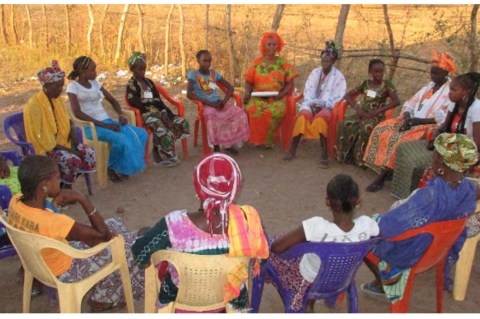
"...a holistic approach for systemic change related to girls' education, child marriage, teen pregnancy and FGM/C..."
Launched in the Velingara area of Senegal in 2008, the Grandmother Project (GMP) - Change through Culture's Girls' Holistic Development (GHD) programme is a community development, participatory communication and social network intervention that aims to strengthen community capacity to promote change in social norms related to girls' education, child marriage, teen pregnancy, and female genital mutilation/cutting (FGM/C). To achieve these objectives, the project uses a dialogue-based, participatory approach involving the entire community, with a focus on grandmothers - thereby building on positive cultural roles, values, and traditions.
The GHD programme works to create an enabling environment around girls so they can flourish. This is achieved by directly supporting girls while at the same time encouraging community-wide consensus-building for adoption of social norms and attitudes that are more supportive of girls, recognising that:
- Norms are embedded in cultural systems.
- Social norms rooted in tradition are defined and perpetuated by elders.
- Social norms related to GHD are collectively supported.
- Within social networks, the leaders of three generations and both sexes strongly influence their peers and also those in the wider society.
- Changing social norms requires an inclusive process that involves all categories of community members who influence the target issue/s, including the cultural authorities on those issues.
- A participatory process based on genuine dialogue is required to lead to collective consensus for change.
- The dialogical process must elicit critical reflection on both past norms, practices, and attitudes and on new information/attitudes.
In Velingara, traditional leaders and local Imams share overarching responsibility for ensuring the well-being of their communities. For any effort to promote community-wide change, it is critical that these locally recognised authorities be involved in order to create a bridge between "traditional" cultural and religious values and more "modern" ideas related to various aspects of GHD, including girls' education and FGM/C. In each community where the GHD programme has been launched, the GMP team first identified and established rapport with local formal and informal leaders.
Recognising the importance of building on community values and concerns, at the outset of the GHD programme, a rapid listening study was conducted using a qualitative and participatory methodology involving small, in-depth group interviews with: traditional community male leaders; religious leaders; grandmothers; men; women; local authorities; health workers; and non-governmental organisation (NGO) staff working in Velingara. Three main themes emerged from this participatory exercise: concerns about the breakdown in communication between elders, parents, and children; the resulting decrease in the transmission of moral, cultural, and religious values and traditions to children, e.g. showing respect for elders and storytelling; and children's attitudes and behavior that do not reflect priority family and cultural values.
Next, a series of two-day dialogue-forums were held to discuss the results of the assessment with community actors. The first day dealt with communities' expectations and concerns regarding girls' education and development; the second day focused on FGM/C and on community ideas on how to catalyse discussion of this issue within the wider community. On both days, community members formulated recommendations for actions to be taken by families, community leaders, teachers, and NGO partners.
The resulting GHD programme reflects a Change through Culture approach that works to strengthen social connectedness by strengthening relationships and fostering...:
- ...between change agents/development workers and communities; and
- between community actors: between three generations (elders, adults, adolescents) and between the sexes.
To that end, a series of dialogical activities involve different categories and combinations of community actors, of three generations, of both sexes, traditional and religious leaders, teachers, and local health workers. In all of these activities, grandmothers are key actors. Along with other community members, they participate in dialogue and debate, and their involvement strengthens their capacity and commitment to lead positive change. Specific activities include:
- Intergenerational forums: The two-day forums build solidarity between participants through a series of small- and large-group exercises - all involving dialogue, problem-solving, and consensus-building. Key topics addressed include both priority GHD issues and priority community concerns related to weakened intergenerational communication and the loss of cultural values and identity.
- Grandmother leadership training: Initial discussions with grandmother groups led to the identification of five natural grandmother leaders in each community to participate in under-the-tree training, intended to: increase their knowledge of adolescence; improve their communication with girls; and empower them to act collectively to promote and protect girls, building on their status and authority at family and community levels.
- Days of Praise of Grandmothers: Participants in these one-day gatherings include grandmother leaders from 8 surrounding communities, traditional and religious leaders, local musicians, local elected officials, and teachers. Songs of Praise of Grandmothers are a highlight of these events.
- Teacher workshops on the Integrating Positive Cultural Values into Schools (IPCVS) strategy: The workshop goal is to increase teachers' commitment to developing children's knowledge of cultural values and traditions in addition to the "modern" knowledge inscribed in the official curriculum, as well as to strengthen their relationships with communities.
- Grandmother-teacher workshops: An important component of the IPCVS strategy, and one outcome of the workshops, is the participation of grandmothers in classrooms to facilitate values education sessions with children. This action further contributes to strengthening relationships between schools and communities.
- Under-the-tree participatory learning sessions with grandmothers, mothers, and girls: A variety of activities using stories, songs, games, and discussion pictures are used to elicit dialogue and increase understanding between the generations.
- All-women forums: Participatory exercises during these two-day gatherings encourage girls to express their feelings, concerns, and ambitions related to school and life beyond, and to encourage mothers and grandmothers to listen to, empathise with, and encourage girls.
- Days of Dialogue and Solidarity: The purpose of this activity is to elicit reflection by community elders, including traditional and religious leaders, from several adjacent communities on the role they can play to promote GHD. Participants articulate their plans for actions they can take in their respective communities.
Girls, Education, Child Marriage, Teen Pregnancy, FGM/C.
The structure and dynamics of non-western collectivist cultures:
- There is a hierarchy of authority.
- Respect for elders is the dominant value.
- Role of elders is to define and enforce social norms.
- Individual attitudes and behaviour are strongly influenced by social norms.
- Social networks are structured by gender and age.
- Gender- and age-specific roles are dictated by culture.
- Interconnectedness and interdependency are valued more than autonomy.
- Intergenerational relations are valued.
- There is collective decision-making on issues related to well-being of family members.
Characteristics of non-western, collectivist cultures that influence girls' rights and development:
- Girls are not isolated and can rarely make decisions on their own.
- Girls are embedded in family, community, and cultural systems.
- The traditional communication style with children is directive - using lectures and scolding, not listening.
- Various family members are involved in decisions regarding girls' welfare and options in life.
- Senior women/grandmothers have considerable influence in those decisions.
- Grandmothers play a central role in socialisation of adolescent girls.
- Fathers' attitudes related to daughters/young girls are strongly influenced by those of their mothers, aunts, and older sisters.
Specifically:
- With regard to girls' education: Families decide if they will send their girls to school, and how long they will stay in school. These decisions are a product of a collective decision-making process, in which elders have great influence. Sending girls to school beyond puberty is a big risk for families. Yet, most grandmothers want girls to go and to stay in school as long as possible.
- With regard to child marriage: Fathers are officially responsible for giving their daughters away in marriage. In fact, the timing and choice of spouse are based on collective decision-making in families. Senior women (grandmothers, aunts, etc.) have a big influence on their sons and nephews as regards the timing of girls' marriage. It is difficult for fathers to go against the wishes/advice of their mothers/sisters.
- With regard to teen pregnancy: Adolescent girls need to be supported with accurate information and support.
- With regard to FGM: Grandmothers/senior women are culturally responsible for perpetuating the tradition, yet older women are more open to abandonment than younger ones. Girls do not have authority to change this cultural norm.
Among the project's lessons learned:
- To bring about change in community norms, a systems approach is needed in which various categories of community actors are involved, in addition to the risk group - i.e., girls.
- Grandmothers constitute an abundant and underutilised resource for girls, given their status within the family, their proximity, their experience, and their commitment to girls' well-being.
- Communities are supportive of strategies that recognise and value critical aspects of their culture - for example, the grandmothers.
- Communities are not comfortable with programmes that only focus on changing certain "negative" aspects of their culture.
- Communities are more engaged when using a holistic approach that addresses various aspects of girls’ education and development rather than only a single issue.
- Grandmothers are open to change when an approach based on respect and dialogue is used with them.
- A critical step in promoting normative change is to identity and involve those the norm setters.
- In all communities, there are leaders within social networks of grandmothers who influence their peers and others in the wider community. In GHD programmes, partnerships should be developed with them in order to harness their influence for the well-being of all girls.
For evaluation and impact data, see Related Summaries, below, but here is one illustrative quotation: "In the past we married girls off when they were 13 or 14 and we didn't ask them if they agreed with our choice of husband. Since Grandmother Project started working in our area there have been many discussions between the grandmothers, and also with other community members. After much discussion we came to an agreement that we should change our approach. Now we know that we should let our girls stay in school and wait until they are 18 to give them away in marriage. We have decided that the traditional approach is not the best. We need to change our ideas, we need to change with the times." - Coumbayel, Grandmother Leader
Ministry of Education (MOE)
"Strengthening Communication Relationships to Promote Girls' Holistic Development" [PPT], Nov 7 2019; "A Grandmother-Inclusive Approach to Promote Girls' Holistic Development [PPT], May 2019; and "Promoting Community-Driven Change in Family and Community Systems to Support Girls' Holistic Development in Senegal" [PDF], January 31 2021 - all sent from (and authored by) Judi Aubel to The Communication Initiative on May 11 2021; GHD programme project summary, by the Social Norms Learning Collaborative on the ALiGN platform, September 13 2019 - accessed on May 21 2021; and email from Judi Aubel to The Communication Initiative on May 23 2021. Image credit: Mamadou Coulibaly
- Log in to post comments