










































Imagining the Future IV (ITFIV)
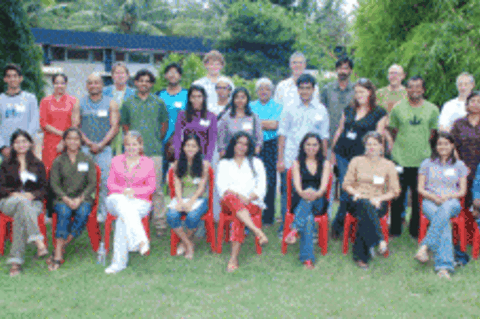
This initiative drew on live performance - theatre - to spread awareness about scientific advances and scientific research in India on issues such as genetic modification, birth control, organ donation, pesticide pollution, HIV, and inherited diseases.
In the initial phases of the project, the company was invited to access all laboratories, lectures, and presentations, guided by their NCBS project partner, who indicated the research areas which he thought had the most potential to form the scientific bases for theatre pieces. Alongside their own visits to lectures and laboratories, the company invited scientists, researchers, and students to join initial discussions and early rehearsals to discuss how scientific ideas might be dramatically developed. The directors led theatre workshops, which focused on the creation of theatrical metaphors. Scientists also contributed, explaining to the group the neurological relationship between memory and affect, which was an effort to add to the group's understanding of how to make a story emotionally and dramatically effective.
What resulted from the wide-ranging discussions and 11 workshops with theatre writers, directors, performers, writers, and companies, and with science, technology, and arts students were plays titled Amol's Stories and The Clearing. Both shows were performed in the NCBS open-air amphitheatre on February 6 2009; an audience of 150 attended. On February 8 2009, both shows were again presented (after an evaluation session) in the Khincha Auditorium of the Bharatiya Vidya Bhavan cultural centre. Another audience of over 100 attended, this time made up of Bhavan members, students (some from Vidya Niketan School), and the general public. A long discussion was held after the performances concentrating on the process by which the plays had come about, the representation of Indian (as opposed to American/Western) attitudes to post-traumatic stress disorder (PTSD) in Amol's Stories, and the range of invasive species covered in The Clearing.
Health.
According to Theatrescience, the ethical, economic, and political debate about biomedical science is keenly felt on a day-to-day basis. Shifting from a Eurocentric perspective, Theatrescience felt a need to explore Indian ideas and to investigate the connections between culture and science on the subcontinent.
Theatrescience was formed in 2002 as a way to explore biomedical science issues through the medium of theatre. It engages audiences and participants in discussions of social, ethical, and political issues relating to biomedical science and develops drama inspired by these issues. It has been supported by the Wellcome Trust since its inception.
NCBS is an affiliate of the Tata Institute of Fundamental Research (TIFR), Mumbai, involved in research in biological spectroscopy, nucleic acid biochemistry, cellular neurobiology, human and population genetics, cellular networks, and cell biology.
Funded by Wellcome Trust.
Theatrescience website, November 4 2010.

- Log in to post comments