










































Integrated Model of Communication for Social Change
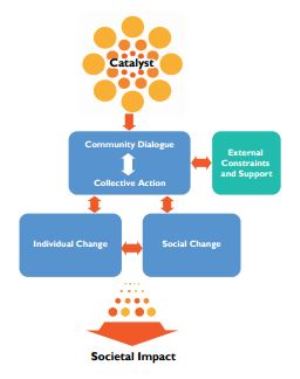
"The Integrated Model of Communication for Social Change (IMCFSC) describes an iterative process where a community engages in dialogue and collective action to produce social change and support improvements in the health and welfare of its members."
Used in social and behaviour change communication (SBCC) programming, this model can "guide the implementation and evaluation of community dialogue and collective action processes." It is used in the health sector to stimulate dialogue and action that can result in individual and social changes that "accumulate and result in a societal impact on health." It can be used when community and social factors are heavily influential and works, as stated here, most effectively "when used as a truly participatory exercise that allow community members to define the problem of interest, identify potential solutions to that problem and evaluate the outcomes of those solutions", as described in A Health Communication Capacity Collaborative (HC3) Research Primer.
"The different components of this model are:
- Catalyst: The model starts with a catalyst that can be internal or external to the community. This stimulus can prompt one or more community members identifying an issue of concern.
- Community dialogue: Once the issue is identified, an organized effort must be made to collectively agree upon and assess the problem, then determine a plan of action.
- Collective action: This aspect of the model provides steps to effectively execute the action plan and evaluate its outcomes."
Catalysts for dialogue and action include community members recruited and trained as change agents; community events of community-based organisations (CBOs); and mass media programmes on community concerns. Effectiveness can depend on community cohesion. "Evaluation of the community dialogue and collective action processes should be participatory" and may include building evaluation skills capacity in the community; "...this approach allows for continual improvement within the community and allows community members to move forward with effective solutions for future health problems." Evaluation might come from within the community, from external evaluators, and through social science researchers analysing the process across multiple communities.
- Log in to post comments