










































Kuwa Mfano wa Kuigwa: A Gender-Transformative Campaign to Reduce Social Acceptance of Intimate Partner Violence
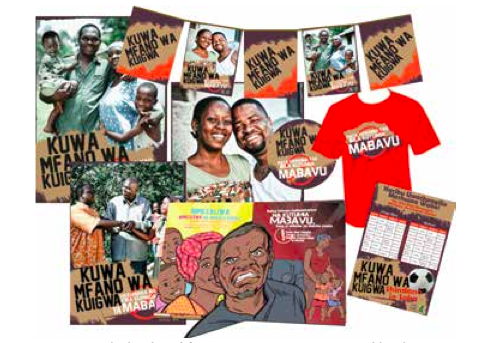
"Exposure to campaign messages led to more men believing that forced sex is violence and that a man is never justified in beating his wife. The campaign also increased men’s willingness to help a woman being beaten by her partner."
These were key results of the Kuwa Mfano wa Kuigwa (Be a Role Model) campaign in Tanzania. The campaign was launched in 2011 as part of the CHAMPION project, a six-year initiative (2008-2014) to increase men's positive involvement in preventing the spread of HIV in Tanzania. The Kuwa Mfano wa Kuigwa 6-month national social and behaviour change communication (SBCC) campaign was designed to reduce societal acceptance of intimate partner violence (IPV) by using a variety of mass media strategies coupled with community engagement and interpersonal interventions. This 4-page brief forms part of a series of briefs to highlight some of the CHAMPION project's achievements.
The Kuwa Mfano wa Kuigwa campaign was aligned to the CHAMPION project's overall objective to improve health by fostering an enabling environment for gender transformation. The campaign sought to prompt national dialogue about men's role in health and the importance of gender equity in reducing vulnerability to IPV, HIV, and other adverse reproductive health (RH) outcomes. The campaign combined mass media messages disseminated through television, radio, and newspapers, with SBCC materials such as brochures and posters, and community and interpersonal interventions. The campaign was intended to shift social norms regarding IPV, through five key communication objectives: "men's willingness to help survivors of IPV, talk with others about the negative consequences of IPV, recognize forced sex as IPV, reject the notion that IPV is justifiable under any condition, and believe that a home free of IPV is a happier home."
The campaign's primary intended audience was men aged 25 and older with intimate partners. Messages reached an estimated 4.5 million people through mass media and close to 40,000 men and boys through road shows, football matches, and bar activities. Evaluation results include the following:
- The evaluation found that the main behaviour change objective to increase dialogue about IPV and shift entrenched social norms was achieved, as demonstrated by exposure to campaign messages being closely associated with changes in the belief that forced sex is violence. "Men in campaign target districts were more than 3.5 times more likely than men nationwide to believe that forcing a partner to have sex is violence."
- As a result of the campaign, the percentage of ever-partnered male respondents willing to help a woman being beaten by her partner increased from 62% at baseline to 83% after the campaign. "At endline, men in campaign target districts were 4.5 times more willing to help in such a situation than were men nationwide."
- Nationally, the percentage of respondents who reported initiating a conversation about physical or sexual violence within intimate relationships in the past three months with anyone or specifically with a friend, family member, or community member increased between baseline and endline. "Men who recalled the campaign slogan were also 1.3 times more likely to report initiating a conversation than were women recalling the slogan."
Based on he campaign experience, it was found that "combining mass media and entertainment with community dialogue can be a transformative way to communicate the importance of gender equity and reduce vulnerability to IPV and its associated health consequences." Radio stations in Tanzania have great impact, but monitoring is necessary to ensure stations adhere to rotation plans. Public gatherings, holidays, and international events are also good opportunities to increase awareness about gender transformation. Combining these various approaches was found to be an "effective way to shift attitudes and behavior around IPV."
Engender Health website on March 18 2016.
- Log in to post comments