










































Mapping the Patchwork: Exploring the Subnational Heterogeneity of Child Marriage in India
Center on Gender Equity and Health, University of California San Diego (McDougal, Shakya, Dehingia, Bhan, Raj); United Nations Children’s Fund, or UNICEF (Lapsansky, Conrad); International Institute for Population Sciences (Singh); Kroc School of Peace Studies, University of San Diego (McDougal)
"The existence of spatial dependence and/or spatial heterogeneity can be important markers for patterns of social norms dispersion and variation across geographic communities, providing information that can inform social norms change intervention strategies."
Research from around the world has revealed a complex nexus of factors that contribute to child marriage, including normative values regarding the status, value, and rights of women and girls. To that end, development and public health interventions to address child marriage have increasingly focused on the role of social norms, emphasising community engagement as well as social and behaviour change (SBC) strategies to shift these norms at the community level. In India, child marriage is encouraged through cultural traditions that dictate gender-discriminatory norms rooted in patriarchal values and ideologies. However, the prevalence and the social and normative factors associated with child marriage are not uniform across India. This article explores the localised norms that may contribute to the continuation of the practice of child marriage in certain states and communities in India, with the hope that highlighting place-based variations may improve targeting of SBC prevention efforts.
As a backdrop for the study, the researchers introduce some concepts related to their conviction that it is through spatial clustering of socially connected individuals that clustering of social norms typically occurs. Namely, spatial dependence is the phenomenon whereby people living and interacting in close proximity to one another are more likely to mutually influence each other's behaviours than they are the behaviours of those who live at a greater distance. Spatial heterogeneity occurs when relationships between different characteristics or behaviours change according to geographic context. In other words, spatial heterogeneity takes a relationship between certain characteristics or behaviours that might normally be quantified at only a single, more aggregate level (e.g., a national-level estimate), and identifies how that relationship may vary according to place (e.g., the same relationship may manifest differently in different villages, communities, or districts).
Data were derived from the 2015-16 National Family Health Survey and the 2011 India Census, representing 636 districts in total. Analyses included global Moran's I, local indicators of spatial autocorrelation (LISAs), spatial Durbin regression and geographically weighted regression.
The data show that the prevalence of marriage before age 18 among women age 20-24 across assessed Indian districts in 2015-16 was 25%, with wide inter- and intra-state heterogeneity in levels of child marriage across the country. On average across districts, female residents are mainly rural-residing (72%), identify as legally recognised groups of marginalised individuals (members of scheduled castes, scheduled tribes, or other backwards classes - SC/ST or OBC) (75%), have 9 years of education, and report television as the most common form of regular media connectivity (69% weekly use). The levels of assessed variables were not randomly distributed across districts.
Spatial clustering was clear for levels of female education, with higher levels of female education in a given district significantly associated with lower levels of child marriage. The results also identify a significant indirect association between female education and child marriage: High levels of female education in neighbouring districts predict lower levels of child marriage in a given district five times more powerfully than those within its own boundaries. Cross-border marriages, including the practice of bride buying, may in part explain this finding. An additional explanation is that of social diffusion, where districts with higher levels of girl education and lower levels of child marriage may be more likely to both passively and actively share those values and norms, as well as backlash and stigma associated with norm divergence, with nearby communities. According to the researchers, "girls' education is important within local contexts (districts, in this case), but even more so within larger spatially-dependent cultural and socioeconomic contexts in which normative behaviours and exchange systems associated with child marriage thrive."
Furthermore, media connectivity, as measured via weekly newspaper use and mobile phone access for women, was strongly associated with lower district levels of child marriage, even after accounting for other covariates; this association was present, but marginal, for television use. For example, every 10 percentage point increase in weekly newspaper use was associated with a 1.2 percentage point decrease in the district prevalence of child marriage, and every 10 percentage point increase in female mobile phone access was associated with a 0.4 percentage point decrease in child marriage prevalence. Access to these forms of media may be broadly representative of higher socioeconomic status, which tends to be associated with lower levels of child marriage. The associations between media connectivity and child marriage, however, had heterogeneous coefficient values across India, suggesting that there are geographically specific factors differentially affecting these relationships.
Hot and cold spots (clusters of districts with high and low levels of child marriage, respectively) appeared concentrated around state borders. The results indicate that characteristics of neighbouring districts, as well as characteristics of a district itself, are important in explaining levels of child marriage, and that those relationships are not constant across India. Many state boundaries can be considered porous in terms of culture, with people from the same caste or sub-caste communities residing in adjacent states. In the context of child marriage, this is notable because marriages in India traditionally occur between individuals from the same sub-caste or community. Child marriage reduction programmes that are targeted within specific administrative boundaries may thus be undermined by geographic delineations that do not necessarily reflect the independent and interdependent characteristics of the communities who live there. Further research could help clarify differential risks for child marriage among border-proximate districts that may require joint action by states.
The researchers reflect on the fact that many child marriage prevention programmes, as with many initiatives focused on behaviour and norms change, commonly use multi-channel social change communication strategies. Additional research into the influence of locally rooted, place-based forms of media (i.e., community media) could offer additional insights into influential platforms for community engagement, particularly in districts near border-proximate districts. In addition, looking to the future, as mobile phones become more and more common across India, particularly among younger women, they "offer important opportunities for regular access to populations both at risk of, and with influence over, child marriage. These avenues for communication may offer low-cost means for engaging more young people in conversations around child marriage messaging and creating additional opportunities for youth-centered interventions and change....[However], caution is needed, as the most vulnerable girls and women may be least likely to have access to this technology, emphasizing the importance of closing the digital divide."
In conclusion, given the heterogeneous array of child marriage prevention programmes that have been implemented in India, in terms of intended population and programme content and design, these findings underscore the need for a deeper understanding of local challenges to roll-out, delivery, and uptake.
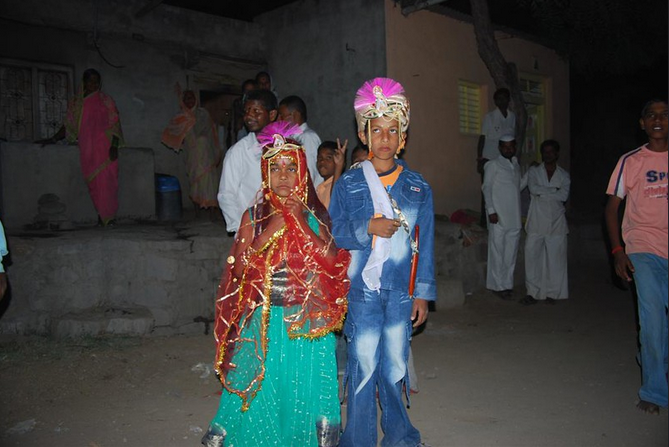
SSM - Population Health, Volume 12, December 2020. https://doi.org/10.1016/j.ssmph.2020.100688. Image credit: Naga Rick via Flickr
- Log in to post comments