










































Measuring Impact of Storyline Engagement on Health Knowledge, Attitudes, and Norms: A Digital Evaluation of an Online Health-focused Serial Drama in West Africa
University of Arkansas (Massey); University of Pennsylvania (Kearney); African Health and Education Network - RAES (Rideau); University of Michigan (Peterson); UCLA Fielding School of Public Health (Gipson, Nianogo, Prelip, Glik); The Ohio State University (Bornstein)
"...online health EE, particularly pro-health content that engages audiences with captivating stories, can lead to positive changes in KAN among netizens in francophone West Africa."
In low- and middle-income countries (LMICs), the use of storytelling in entertainment-education (EE) has been leveraged for decades to promote pro-health attitudes and behaviours. The growing availability of and desire to use digital technologies in LMICs provides an opportunity for traditional media and EE strategies to integrate online components. "Cest la Vie!" (CLV) is a serial drama created in French for West African audiences, whose episodes were made available on YouTube and Facebook to expand the reach of the television/radio broadcast. The purpose of this study was to evaluate if watching the CLV Season 2 series online had an impact on people's health knowledge, attitudes, and norms (KAN), focusing on populations in francophone West Africa.
CLV was developed in 2017 for broadcast media with the intent to entertain, educate, and promote positive health behaviours and social change. Storylines tackle complex and often taboo health topics, as well as the daily realities that West African individuals, families, and communities experience. The drama focuses on healthcare professionals and patients within a healthcare setting.
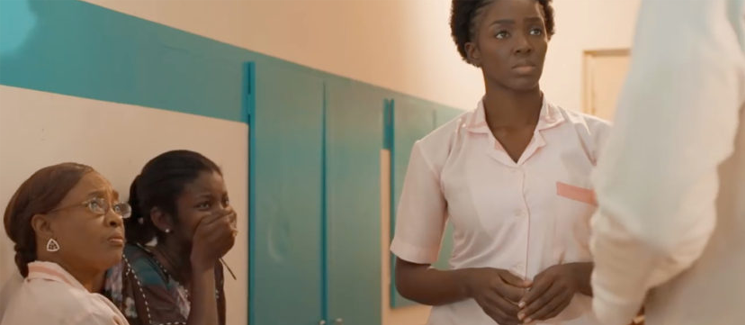
Between July 2019 and October 2019, 1,674 adult viewers of CLV and non-viewers who lived in Senegal, Niger, Burkina Faso, or Côte d'Ivoire were recruited from Facebook and YouTube. The researchers conducted an online longitudinal cohort study that assessed changes in health KAN between these groups (e.g., by asking, "In your opinion, taking emergency contraception is a socially accepted way to prevent pregnancy"). Participants completed a baseline survey prior to the online airing and then follow-up questionnaires at the conclusion of three select storylines related to: (i) sexual assault (episodes 10-14, two months after baseline in October 2019); (ii) emergency contraception (episodes 20-22, three months after baseline in November 2019 - episode 21 may be viewed by clicking on the video below; click here to view all the episodes); and (iii) female circumcision, also called female genital mutiliation - FGM (episodes 27-28, four months after baseline in December 2019. The image above is from a scene in which a character learns that her young daughter Caro has died after Caro's grandmother took her to a faith healer to be circumcised.).
One in four participants (23%, n = 388) had seen one of the three storylines from CLV Season 2 (i.e., they were CLV viewers). If participants had seen a storyline, the researchers assessed their level of engagement. Narrative engagement questions were modified for each storyline and developed based on existing literature. Engagement levels of low, medium, and high were determined by summing eight items.
At follow-up, viewers were more likely than non-viewers to agree that victims of sexual assault should report it to the police (P = 0.005), to have heard about emergency contraception (P = 0.003), and to know when to correctly use emergency contraception (P < 0.001). Viewers were also significantly more likely to believe that the practice of female circumcision should end (P = 0.001) and that it can lead to death (P < 0.001). Compared to people who did not see CLV, viewers of the series had 26% greater odds of answering pro-health responses at follow-up about sexual assault, emergency contraception, and female circumcision. The level of engagement with specific storylines was associated with a differential impact on overall outcome questions. Overall, amongst those individuals who watched a given storyline, those reporting more engagement were more likely to answer a typical KAN question correctly.
There was a strong association between respondents who reported medium or high engagement and their self-reported sharing of the CLV series with others. Individuals responding with medium engagement had 10.2 (95% posterior credible interval (CrI) = 2.9-42.0) greater odds to say they talked about the CLV series than an individual with low engagement, while an individual reporting high engagement had 23.2 (95% CrI = 6.5-93.4) greater odds of talking to someone about the CLV series than an individual with low engagement.
Reflecting on the findings, the researchers note that providing content online not only expands potential audience reach but also provides opportunities for audiences to engage with content in ways that would only be possible online (e.g., through commenting or sharing of content). Traditionally, social media and other online content have been developed in shorter format to be consumed very quickly; however, the findings of this study show that longer-format content, such as compelling mini-series that tap into storylines and emotions, can have an impact on the audience's health-related behaviours. When audiences identify or empathise with content (i.e., report high levels of engagement), there are greater changes in pro-health KAN.
In conclusion, as internet access continues to grow across the globe and health education materials are created and adapted for new media environments, this study provides an approach to examining the power of online EE content to change cultural perceptions, social norms, social behaviours, and public policies that impact health.
Journal of Global Health. 2022 May 14;12:04039. doi: 10.7189/jogh.12.04039; and CLV on YouTube, May 20 2022. Image credit: Drexel University Research Magazine
- Log in to post comments