










































Passages Project Theory of Change: Transforming Social Norms for Family Planning and Reproductive Health
Institute for Reproductive Health (IRH), Georgetown University
"Understanding how theories of norms change underlie the pathway to behavior change in the real world is key for norms-shifting projects."
Evidence suggests that addressing the social norms enforced by peers, families, and communities is a key leverage point for enhancing young people's ability to forge healthy sexual relationships and behaviours. The Passages Project (hereafter "Passages" - detailed at Related Summaries and in the video, below) aims to address a broad range of social norms, at scale, to achieve sustained improvements in reproductive health (RH), family violence, particularly intimate partner violence (IPV), and gender equality. This report lays out the pathways of norms change that guide the norms-shifting interventions encompassed by Passages. It offers a programming tool that charts how and why Passages interventions produce intended outcomes and discusses key considerations for planning norms-shifting interventions.
The ToC is grounded in social and behaviour change (SBC) theories, predominately the following:
- The theory of normative social behaviour, which holds that descriptive norms, or community-level perceptions of how common a behaviour is, directly influence behaviour. Injunctive norms, or community perceptions of negative and positive social consequences of engaging in a behaviour, moderate the influence of descriptive norms - for example, if a behaviour is seen as having negative consequences, people may be less likely to engage in it, even if it is perceived as common. Individuals' agency (perceived ability and resources to choose and engage in a behaviour) is also a driver of behaviour on this theory.
- The integrated behaviour model, which looks at intention to engage in a behaviour as having multiple components, including the normative environment and personal attitudes and agency related to the behaviour of interest. This model also considers the role of resources as a factor in behaviour change.
- The diffusion of innovation model, which proposes that innovations from an intervention are a type of communication that diffuses through various channels from the initial intervention group into the socio-ecological environment.

As shown in the figure above, the Passages theory of change (ToC) uses a social ecological perspective, beginning with seven broad, interconnected programme strategies aimed at fostering change at the individual, interpersonal, and community levels; individual-centred approaches are necessary but not sufficient for sustainable change:
- Individual strategies:
- Training and raising awareness of positive role models or individuals within a community who demonstrate attitudes and behaviours consistent with intervention goals. Examples include opinion leaders, reference group members, or those occupying positions of social influence.
- Increasing individual and community capacities to create and sustain a supportive normative environment for maintaining healthy behaviours. At the individual level, activities are designed to enhance individuals' knowledge, skills, self-efficacy, and resources to achieve their goals. At the community level, capacity-building focuses on strengthening community resources, such as social cohesion, so that communities can overcome obstacles and achieve their health and development goals.
- Interpersonal strategies:
- Dialogue and reflection offer a space for both of the engaged individuals to reflect on their beliefs, values, and behaviours, particularly in relation to prevailing social norms. Critical reflection occurs through dialogue with others facing similar experiences and challenges, and by learning and reinforcing new attitudes and behaviours.
- Peer support, whether social or emotional, entails people offering knowledge, sharing experiences, or providing practical assistance. These activities can shift perceptions of social norms by bringing young people together to discuss and offer support for new, healthy behaviours. Peer support can also minimise barriers to behaviour change.
- Community strategies:
- Social mobilisation is the process by which a range of civil society organisations, traditional and community leaders, and other actors raise awareness of and create viable solutions for a particular issue. It differs from community engagement, which furthers collective participation, but does not direct it toward a specific aim or behaviour.
- Collective celebration, pledges, and testimonials are designed to publicly demonstrate the commitment to and acceptance of positive attitudes and behaviours. Such activities increase the visibility of attitudes and behaviours previously hidden due to perceived disapproval, exposing more young people to alternative norms and behaviours.
- Structural strategies include fostering and linking people with high-quality, youth-friendly family planning (FP)/RH care; the intention to seek health services alone is not sufficient.
The Passages strategies were designed to work in concert with one another, diffusing throughout intervention communities and creating supportive normative environments for new behaviours. Three programme strategies are explicitly designed for diffusion: collective celebration, pledges, and testimonials; social mobilisation; and interpersonal dialogue and reflection. This approach reflects the ToC's theoretical roots in Everett Rogers' Diffusion of Innovations Model, which posits that intervention messages are communicated through various channels into the wider social ecological environment, including geographic, congregational, or other forms of community. In this model, diffusion is a type of communication through which messages about new concepts and social transformation are disseminated.
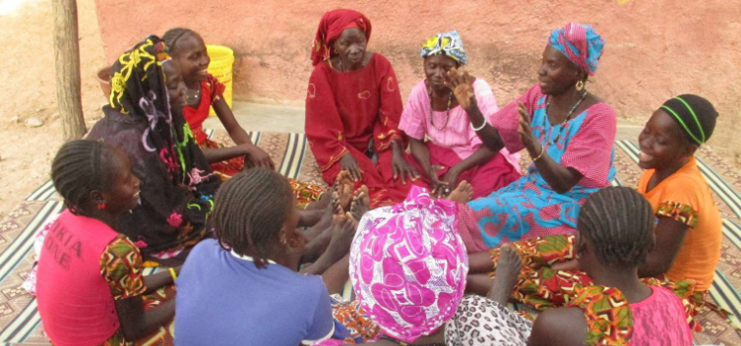
Based in social norms theories, the seven strategies represent approaches used across each individual Passages interventions. This report focuses on, and includes examples from, four of them: Transforming Masculinities/Masculinité, Famille et Foi (TM/MFF) in the Democratic Republic of the Congo (DRC); Growing Up Great!/Bien Grandir! (GUG!/BG!) in the DRC; Husbands' Schools/École des Maris (HS/EM) in Niger; and Girls' Holistic Development/Développement Holistique des Filles (GHD/DHF) in Senegal. (See pages 7-8 in the report for a brief overview of these four interventions.)
The primary priority groups for these interventions are at the centre of the ToC - e.g., very young adolescents for GUG!/BG! and GHD/DHF, and newly married couples and first-time parents for TM/MFF and HS/EM. However, as a norms-shifting project, Passages considers the reference groups - the people whose opinions, beliefs, and behaviours matter to the primary priority population - as key to change. Reference groups often have the power to enforce compliance with social norms by rewarding or sanctioning behaviour. In Passages interventions, reference groups include peers, faith and community leaders, teachers, parents, and grandmothers.
In explaining the hypothesised causal mechanisms leading from programme strategies to improved FP/RH and well-being among young people, the ToC next details the immediate or shorter-term outcomes at the individual, interpersonal, community, and structural levels, including:
- Improved attitudes related to FP/RH and gender equity: The thinking is that a higher prevalence of positive attitudes toward certain behaviours can lead to a greater group-wide disposition to perform those behaviours - and, ultimately, shift group norms.
- Increased agency related to FP and gender equity: Passages' intervention strategies work to improve youth agency while simultaneously bolstering supportive environments, strengthening their ability to take healthy actions.
- Strengthened supportive normative environment around FP/RH and gender: The multidimensional interventions tested under Passages consist of strategies to create a supportive normative environment, which the ToC's foundational behaviour change theories suggest facilitates the adoption and continuation of healthy behaviour.
- More FP/RH youth-friendly services: Passages interventions provided formal and informal linkages - and sometimes service improvement efforts - to youth-friendly reproductive health care, recognising the need for both an enabling structural environment and an enabling normative environment.
In the Passages ToC, these shorter-term outcomes lead to longer-term behavioural outcomes of gender-equitable behaviours and increased voluntary FP use, and they make these healthy behaviours more visible and acceptable within communities. The ToC hypothesises that young people with changed attitudes about what it means to be men and women and increased agency to enact behaviours in line with these attitudes, and who are living in supportive normative environments, will be more likely to engage in gender-equitable relationships and behaviours. These include, for example, shared couple decision-making about healthy timing and spacing of pregnancy, as well as reduced perpetration of IPV - and for these behaviours to be bolstered by shifted norms within their communities.
Finally, the ToC postulates that this sequence of changes leads to impact: improved RH and wellbeing in intervention communities. IRH writes: "Ultimately, we expect that working with target populations and their reference groups - at critical life transitions and across multiple socio-ecological levels - new ideation will diffuse through the community to achieve a tipping point of norms shifts, leading to sustained community-wide behavior changes."
In conclusion: "Social norms are complex and often 'hide in plain sight;' [the Passages] Theory of Change operates through multiple strategies and at multiple levels to define a pathway through which norms and behaviors may shift. By shining some light on this sometimes-unarticulated process," IRH hopes to make social norms programming more accessible to a range of behaviour change practitioners.
This report and the Passages Project are funded by the United States Agency for International Development (USAID).
Click here in order to download a brief [8 pages, PDF] summarising the main points of this report.
IRH website and Passages page on the IRH website - both accessed on March 23 2022; and email from Jamie Greenberg to The Communication Initiative on March 25 2022. Image credit: IRH
- Log in to post comments