










































Reaching Refugee Survivors of Gender-Based Violence: Evaluation of a Mobile Approach to Service Delivery in Lebanon
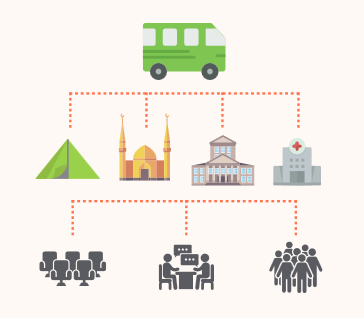
In October 2014, the International Rescue Committee (IRC)'s Women's Protection and Empowerment (WPE) Lebanon programme began implementing a mobile approach to gender-based violence (GBV) response and mitigation service delivery in Akkar district. The IRC's approach aims to reach non-camp based Syrian refugee women living within Lebanese communities with GBV case management and psychosocial support services. With support from the United States (US) State Department's Bureau of Population, Refugees, and Migration (PRM), the NoVo Foundation, and the Swedish International Development Cooperation Agency (SIDA), the approach aims to reach non-camp based Syrian refugee women living within Lebanese communities with GBV case management and psychosocial support (PSS) services. In 2015, the International Center for Research on Women (ICRW) collaborated with IRC to assess this approach. The purpose of the evaluation was to assess the extent to which the mobile approach is able to: (i) meet the safety and support needs of refugee women and girls and (ii) meet international standards to guarantee safety of GBV survivors and quality of services (including community engagement, safe spaces, a survivor-centred approach, safe referrals, confidentiality of services, and accessibility of services).
As noted here, as of 2014, 59.5 million people had been forcibly displaced as a result of conflict, violence, and human rights violations. This increase has been driven largely by the war in the Syrian Arab Republic (Syria) which has resulted in 4.8 million refugees, over half of whom are female. In Lebanon, 18% of the displaced Syrian population lives in informal tented settlements, where the risks to refugee women and girls are high. The stress and vulnerability created by displacement and these circumstances can lead to physical, sexual, and emotional abuse, including physical assault, verbal threats and intimidation, rape, and early and forced marriage. Beyond physical injury, these experiences can cause depression, stress and anxiety, and reduced self-efficacy in survivors.
In order to reach "hidden" and isolated Syrian refugee women and girls in Lebanon with potentially life-saving PSS and case management services, the IRC uses a mobile service delivery approach consisting of: (i) the mobile team model, which is designed to provide holistic services in each identified community on a weekly basis for a period of approximately 6-12 months; and (ii) the rapid response team (RRT) model, which is designed to quickly respond to referrals and acute emergency situations. The mobile teams and RRTs consist of 3 women: one community mobiliser, one caseworker, and one adolescent girls assistant. A male community mobiliser rotates amongst the three teams. Together, these staff members provide a variety of services, including PSS activities, community mobilisation activities (e.g., focus group discussions (FGDs) and community mapping), and case management in-person and by phone. Services take place in "safe spaces", which are central locations in the community, identified by community members, that are comfortable, safe, and familiar for women and girls such as mosques, clinics, and community halls. The mobile teams and RRT also identify focal points in each community who are tasked with engaging community members, disseminating information about the mobile services, and providing support (e.g., referrals) to GBV survivors when needed.
The evaluation consisted of 2 components: (i) one-time qualitative field research in and around Wadi Khaled, Lebanon in October 2015. Interviewers conducted semi-structured, in-depth interviews with 38 Syrian refugee women (aged 18 and over), 26 Syrian refugee adolescent girls (aged 14-17), and 11 IRC staff members. They also conducted observations of safe spaces and PSS activities. (ii) ongoing collection and analysis of programmatic monitoring data using 4 different tools: a site tracker, a bi-weekly monitoring sheet, the Gender-Based Violence Information Management System (GBVIMS), and a case management satisfaction survey.
Findings indicate that the safety and support needs of refugee women and girls in Wadi Khaled were acute: At the interpersonal level, they experienced social and financial marginalisation, loss of social networks, inequitable gender power dynamics, GBV, and limited access to essential services. At the individual level, they experienced emotional distress and a reduced sense of self. The mobile services improved their wellbeing by:
- Broadening Syrian women's and girls' social networks and building social cohesion;
- Increasing their access to support in the form of social relationships and the emotional support they provided, as well as advice, information, and some resources;
- Improving their communication skills and coping mechanisms, thereby ameliorating family relations;
- Breaking down barriers between Syrians and Lebanese and combatting stigma against refugees;
- Providing an opportunity to have fun and engage in stress relief;
- Increasing their knowledge of safety-promoting strategies, healthy coping techniques, effective communication skills, and ability to manage their own health and that of their families; and
- Helping them regain a sense of self and purpose and bolstering self-worth. In particular, the services were found to have empowered women and girls to critically consider and challenge inequitable gender norms and expectations. For example, in My Safety, My Wellbeing, adolescents practiced strategies for responding to street harassment or a proposition of early marriage. As a result of participating in these sessions, some participants described changing both the way they thought about and responded to gendered power dynamics.
With regard to international standards to guarantee safety and quality of GBV service delivery, among the recommended strategies to engage and mobilise communities are: to build on existing community-based initiatives, to use awareness-raising campaigns designed to reach the whole community, to involve men in community-based initiatives to help them understand the impacts of GBV, to strengthen social support networks within the community, and to support women's roles as community leaders and equal decision makers within their households. IRC's mobile services met international standards for GBV service delivery to various degrees:
- Engaging community members, especially through face-to-face communication through focal points and the male community mobiliser, was a key ingredient in the programme's success or failure to thrive within any given community; the loss of or failure to gain community buy-in and trust could be devastating for the GBV mobile services. In some communities, staff were unable to initiate mobile services activities because community leaders, fathers and husbands, or Syrian refugee women themselves did not support programme implementation.
- Identifying a safe space in which to conduct activities was one of the mobile services teams' first priorities upon entering a site and was also one of the biggest challenges, particularly when activities took place in tents.
- The services highlighted the needs, desires, and consent of GBV survivors as the most important feature of counseling, referrals, and safety planning; Syrian refugee women and girls appreciated Lebanese staff who treated them as equals.
- The mobile service delivery model posed unique challenges to maintaining client confidentiality, and staff took precautions and creative steps to help ensure clients' confidentiality.
- By design, the model overcame many of the barriers refugees faced to obtaining services. Phone-based case management and the 24-hour hotline greatly increased the accessibility of case management services. However, poor health, disability, caretaking responsibilities, and gendered expectations around mobility remained barriers to attendance.
A number of key features facilitated the programme's ability to effectively and ethically provide services to women and girl refugees embedded in host communities. These included the flexibility and adaptability of the model, identification of appropriate safe spaces for service delivery, employment of highly qualified staff, staggered delivery of services, and a flexible approach to case management.
Despite the potential limitations of this evaluation, findings suggest that the IRC's GBV mobile service delivery in Lebanon is a promising approach for accessing hard-to-reach populations of women and girls, and in particular refugees, with GBV response and mitigation services. Recommendations are outlined in the report that may enhance dissemination and future implementation of the GBV mobile service delivery approach in Lebanon and globally:
- Practitioners should: engage community leaders, service providers, and affected populations early and often; set the foundation for a replicable programme model; identify core programme elements and phase them in as trust is built with the community members; remain flexible and adaptable to changing circumstances; expand the model to integrate additional service providers and activities over time; build the capacity of local community members to foster sustainable outcomes; and conduct rigorous evaluation and testing of mobile approaches to GBV service delivery.
- Donors and policymakers should: support more innovative and flexible mobile approaches to provide services to those who are hard to reach; scale up proven programmes with longer-term investments to encourage sustainability; leverage influence with other donors and policymakers to support mobile service delivery in tandem with static services; and ensure funding utilized in mobile service delivery prioritises the safety and confidentiality of women and girls seeking services.
- Advocates and humanitarian actors should: raise awareness of the availability of mobile services in the communities in which they operate; mobilise local community leaders and members to advocate for social norms change; and advocate for changes in policies and laws that inhibit women and girls' access to services.
ICRW website, October 14 2016.
- Log in to post comments