










































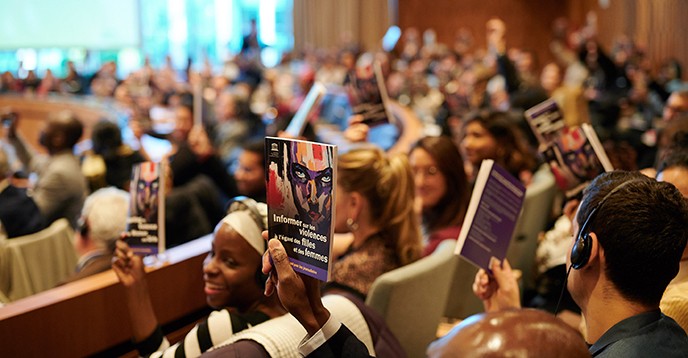
Reporting on Violence against Women and Girls: A Handbook for Journalists
"By placing the fight against violence against women at the heart of its work, the media can foster a change in public opinion and behaviour." - Anne-Marie Impe
Conceived in the framework of United Nations Educational, Scientific and Cultural Organization (UNESCO)'s mandate to promote media development, journalism education, and gender equality in media, this handbook is designed to be a practical resource for media professionals from across the world with the intention to stimulate reflections on reporting practices, provide information, and promote and improve ethical coverage of gender-based violence.
Gender-based violence involves difficult and often context-specific and norm-driven questions of power, rights, and obligations. According to UNESCO, media can impact on the achievement of gender equality, since they have the power and capacity to inspire change in norms, attitudes, and behaviours by determining whose voices are heard, why, when, and in what way. In fact, UNESCO contends that journalism serving the public interest is an essential lever in the fight against violence against women and girls (VAWG). For example, the #MeToo movement, which was for the most part launched by United States (US) newspaper investigations, entailed testimonies from women worldwide that made the issue go viral in a social movement of freedom of expression for women.
However, UNESCO is concerned that VAWG, if at all reported, is often relegated to the sidelines or circumscribed as a "family affair" or as a "personal problem", or it is framed in a sensationalist way that does not seize the gravity of, or accurately depict, the situation as a high-risk issue of public interest with both individual and collective implications.
This handbook does not seek to provide an exhaustive and complete analysis of the subject of gender-based violence, but it does intend to help radio, television, printed press, and social media professionals determine which channels of investigation and information would be relevant and ethical. It therefore provides working media professionals and those already involved in ethical journalism - which UNESCO views as inseparable from fact-based and gender-transformative reporting - with recommendations and examples of good practice to help them cover the issue in a way instills a human-rights-based awareness on the part of the public.
Divided into 2 main chapters, the handbook is structured to facilitate its use in fully busy news desks with tight deadlines. The first chapter features 10 fact sheets presenting 10 specific topics, arranged in alphabetical order, which can be consulted separately according to the needs of newsrooms:
- Cyberbullying and online harassment of women journalists
- Early marriages or child marriages
- Female genital mutilation/cutting
- Forced marriages
- Gender-specific foeticide and infanticide
- Sexual harassment, sexual assault and rape
- So-called 'honour' crimes
- Trafficking in persons and smuggling of migrants
- Violence against women in conflicts
- Violence by an intimate partner or ex-partner and domestic murders
Adopting a global scope, the handbook demonstrates how each of these types of violence occurs as much in developing as in developed countries, and therefore concerns us all. Each of the fact sheets presents a topic (definition, facts and figures, explanations, and context), followed by various tips and good practices for journalistic coverage of the topic. It also includes a glossary to allow for the informed use of language, a list of organisations to contact, and a selection of relevant documents for those wishing to learn more.
The second chapter provides general recommendations on how to address, frame, and cover stories on VAWG. It provides practical advice on key steps in the reporting and editing process, such as informed consent, responsive listening, choice of location, cultural sensitivity, choice of interpreter, interviewing children, choice of images, and assuring interviewees' sense of dignity, safety, and trust.
The necessity of eliminating violence and discrimination against women and girls to achieve gender equality has been highlighted in regional and international development agendas, including Agenda 2030 and Sustainable Development Goal (SDG) 5, Goal 17 of the African Union Agenda 2063, and the Beijing Declaration and Platform for Action (1995). In that light, the handbook's final section contains a list of International Declarations, Resolutions, and Conventions.
The Liaison Officer of the Permanent Observer Mission of the Islamic Educational, Scientific and Cultural Organization (ISESCO) to UNESCO has announced that ISESCO will fund the handbook's translation into Arabic (expected in 2020), as well as activities to apply the handbook in the Arab region. A Spanish translation is also anticipated.
English; French
152 (English); 160 (French)
UNESCO website, November 25 2019; UNESCO launch event details; UNESCO website, November 14 2019; and UNESCO website, January 27 2020 - all accessed on January 27 2020; and email from Mirta Lourenço to The Communication Initiative on February 18 2021. Image credit: UNESCO
- Log in to post comments