










































Solution Exchange

Solution Exchange is based on the observation that while "expert" knowledge is often well documented, valuable tacit knowledge gained through practitioner experience can often be lost or ignored. Its purpose is to facilitate access to knowledge such as whether a particular idea has been tried before or where to turn when facing a bottleneck, thus offering development practitioners a forum to benefit from each other's knowledge and experience. It is hoped that through these communities, members will have timely access to advice shared by their peers and have an opportunity to analyse, adapt, and apply solutions that are built on the lessons learned by others.
Communities are organised around selected development targets of both India's Tenth Five-Year Plan as well as the Millennium Development Goals (MDGs), with the goal of contributing to their successful achievement. Members come from government, non-governmental organisations (NGOs), development partners, private sector, and academia. As of this writing (October 2009), there are 11 active Communities, including the following:
- AIDS - Addressing challenges to achieving National AIDS Control Programme objectives for treatment and care of persons living with HIV and AIDS and preventing the spread of new infections.
- Climate Change - Addressing impacts of climate change on the environment and human development, including mitigation, adaptation, environmental finance, and regulatory/ policy frameworks.
- Decentralisation - Addressing challenges arising from political, functional, administrative, and financial decentralisation, including sectoral decentralisation and privatisation of services.
- Disaster Management - Addressing preparedness, mitigation, response, recovery, and rehabilitation issues with respect to disasters (natural and human-induced).
- Education - Addressing challenges associated with meeting national and globally mandated goals related to improving the quality of basic education and promoting access and enrolment through primary levels.
- Food and Nutrition Security - Addressing challenges to meeting the country's food and nutrition security goals - household agricultural production, food-related social safety nets, food safety, and dietary diversification.
- Gender - Addressing challenges to women's involvement in development - increased access, capacity, and equality in women's social, economic, and political endeavours.
- ICT for Development - Promoting information and communication technologies (ICTs) as an enabler for sustainable development and as an alternative means of livelihood for grassroots communities of India.
- Karnataka (bilingual) - Addressing topics which affect development issues in the
state of Karnataka, involving local language development practitioners in the discussions, and working toward finding local solutions. - Maternal and Child Health - Addressing challenges facing public health and nutrition practitioners engaged in reducing infant and maternal mortality.
- Microfinance - Addressing challenges to providing the economically poor with financial services for meeting basic needs, enhancing investment in income-generating and asset-building activities, and addressing risks.
- Water - Addressing water and environmental sanitation challenges in rural and urban areas in India - including access, quality, management, and service delivery.
- Work and Employment - Addressing challenges faced by practitioners engaged in reducing poverty in India through promoting gainful, high-quality work and employment opportunities.
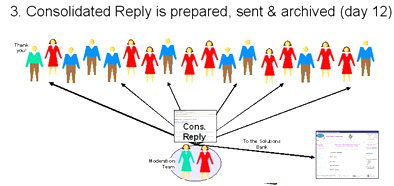
Solution Exchange provides these Communities with 4 basic services: "Help" offers Community members solutions to questions they raise; "Comment" provides decision-makers with feedback on draft policies, programmes and projects; "Discuss" seeks insights on issues of major concern to the Community; and "Collaborate" promotes small-group work to take forward members' ideas or products. The first 3 services are primarily email based, with a 2-person team moderating each group and researching additional material. The "Collaborate" service relies on face-to-face interaction, and is facilitated through collaboration software tools made available on the Community websites. Discussion threads from email-based services are synthesised into "Consolidated Replies" featuring the specific experiences and resources recommended by contributors or researched from published material, compiled into a composite of all available documented and tacit knowledge on the topic. Solution Exchange members also can post questions to more than one Community. If a query or an e-discussion is relevant to other Communities, it is "cross-posted", and the Consolidated Reply reflects the views of all contributors. The result is a combined perspective from professionals who may not normally interact.
Everyone in a Solution Exchange community is a member of a moderated mailgroup. A member will ask the Community for advice, experiences, examples, or referrals on a topic of concern. Other members respond based on their experience and knowledge. The moderation team provides additional research. Within a fixed time period - normally 10-15 days from the Query posting - the Consolidated Reply is issued.
To illustrate how it works: In January 2006, a government official asked the then 600 members of the Maternal and Child Health Community how those working in rural communities got women to a hospital in obstetric emergencies. In 3 weeks, 34 members came back with 16 examples ranging from community-pooled funds for taxi services to state-subsidised transport, along with 19 supplementary references - documented case studies, research work, websites, and contacts - that was then synthesised and issued as a Consolidated Reply. The expectation is that front-line health workers in villages without organised services will now have a ready reference of initiatives to adapt, sources to refer to, and people to contact.
HIV/AIDS, Education, Environment, Food Security, Gender, Health, Economic Development, Technology.
"Solution Exchange is one of a new generation of organizational concepts that works on the basis of collaborative, trust-based relationships, rather than traditional hierarchy-based relationships. It taps into the power of Communities of Practice" that explore and synergise development experience. These communities of practice leverage knowledge and strengthen partnerships between public, private, and community stakeholders - hopefully thereby accelerating India's development.
Since starting up in April 2005, Solution Exchange membership has grown between 80 to 90 a week – and (as of October 2009) stands at over 21,000 subscriptions (12,000 members subscribed to one or more Community) from across the country. To join one of the Communities, visit the Solution Exchange website.
Emails from Dr. E. Mohamed Rafique and Dr. Nabeel M. K to The Communication Initiative on June 30 2005 and October 14 2009, respectively; and Solution Exchange website, October 15 2009.
- Log in to post comments