










































Ujjiban
Launched in 2017, Ujjiban ("infusion of new life" in Bangla) was a 5-year social and behaviour change communication (SBCC) initiative to raise awareness of health issues and to create a conducive environment for sustainable health behaviour change in Bangladesh. Funded by the United States Agency for International Development (USAID), it was implemented by the Bangladesh Center for Communication Programs (CCP) and Save the Children in collaboration with the Government of Bangladesh Ministry of Health and Family Welfare (MoHFW), with a focus on two divisions: Chittagong and Sylhet. It also worked with community-based organisations to engage various audiences. The aim was to improve the health of Bangladeshis and their communities by increasing knowledge and generating awareness of positive health behaviours related to maternal, neonatal, child, and adolescent health, family planning, nutrition, tuberculosis (TB), and child marriage.
Ujjiban employed three main approaches - transmedia, community mobilisation, and capacity strengthening - to reach priority audiences at the national level and in Sylhet and Chattogram. These approaches were integrated in Ujjiban's interventions across all domains - individual, community, services, and systems. Informed by formative research, Ujjiban focused on informational and motivational gaps between knowledge and behaviours, while working to eliminate cross-cutting barriers, such as inequitable gender and social norms.
Namely, first, Ujjiban's national multimedia/transmedia campaign promoted health-related messages on radio programmes, drama series, a travel show, and public service announcements. The campaign also used digital tools such as social media and online games, and mobile apps and interactive voice response (IVR) technology to create engaging platforms where families, youth, and health professionals could ask questions and receive information. In line with the campaign's entertainment-education approach, the campaign's launch event used skits, songs and dances, and puppet shows to inform attendees about Ujjiban and its various activities. Small clips and trailers of the transmedia products were unveiled at the event, giving an insight on Ujjiban's approach to disseminate health information to trigger social and behavioural change, including influencing gender norms at the community and family levels.
To generate awareness of health issues and initiate community-level discussions for social and behaviour change, Ujjiban implemented a branded vehicle road campaign in different districts of the country during November and December 2018. The branded van traveled for 22 days, displaying and sharing health-related messages to the public. People could also interact in related live social media activity.
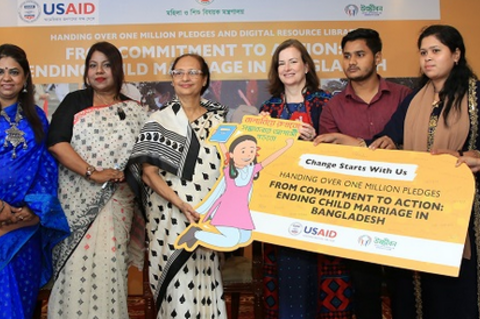
Second, in July 2021, the Bangladesh Secretary for the MOWCA launched a community mobilisation campaign called "Actions to Prevent Child Marriage in Bangladesh" to highlight the health risks of early pregnancy and the high returns of investing in girls' education. The campaign also worked to generate awareness about the law in Bangladesh that prohibits child marriage, to instruct people how to use existing mechanisms to report incidents in their community, and to help victims seek support. The campaign collected 1 million pledges from adolescents, parents, community leaders, policymakers, business leaders, and civil society representatives calling for an end to child marriage and reminding people that everyone has a responsibility to protect girls from the harmful practice.
The August 2022 event at which the State Minister for Women and Children Affairs (MOCWA) received the pledges featured a performance by Shaistaganj Theater Group of Sylhet, which performed an interactive popular theatre show. The event also highlighted a new digital library developed by Ujjiban and MOWCA. Housed on the MOWCA website, the digital library provides one-stop access to information on existing laws and other resources to prevent child marriage. The library provides a collection of ready-made SBCC materials designed to enable government and other stakeholders to reach broader audiences with messages developed specifically to end child marriage.
Third, as part of Ujjiban's commitment to empowerment for sustainable change, activities included strengthening capacity at national and local levels. Specifically, Ujjiban provided central- and regional-level ministry staff and relevant non-government organisations (NGOs) and institutions at the national and local levels with training, job aids, and transmedia products to help them plan SBCC campaigns, lead community activities, and offer high-quality interpersonal communication and counseling. Ujjiban also worked to integrate and ensure sustainability of digital tools and a supportive supervision app within government systems.
Health, Family Planning, Child Marriage
In a survey conducted in 2022 in Sylhet and Chattogram, 44% of women, 45% of men, and 37% of adolescents were exposed to Ujjiban-facilitated content through at least one channel in the last 12 months. Among other findings:
- There were significant increases from the start of the project in the percentage of women practicing key health behaviours across maternal and child health, family planning, nutrition, TB, adolescent health, and child marriage. For instance, a significantly higher percentage of women at endline had received four or more prenatal care check-ups, were using a modern contraceptive method, and had a child aged 6-23 months with adequate diets when compared to baseline data.
- People's support of more equitable household roles and responsibilities increased from baseline to endline. Such gender equity norms related to maternal, newborn, and child health increased from 34% at the start to 53% at the end, while in family planning, they rose from 59% to 76%.
- Participants exposed to Ujjiban-facilitated content reported higher knowledge, self-efficacy, couple communication, and social norms in their communities for health behaviours compared to those who were not exposed to Ujjiban-facilitated content.
- Statistical models demonstrated significant associations between exposure to Ujjiban-facilitated content and key project outcomes, including use of a modern contraceptive method, receipt of four or more prenatal check-ups, dietary diversity, and menstrual hygiene management, among others.
Lessons learned from Ujjiban that may be applicable to future SBCC projects include:
- Programmes should harness multiple ways to connect with various audiences: Ujjiban's coordination with partners across health areas and sectors facilitated high levels of exposure not only among women, but also among men and adolescents. Integrated projects require coordinated messaging across channels to reach all audiences.
- Health workers are essential to reaching women and girls: Exposure to Ujjiban-related content through health workers - whether government health workers or partner NGO workers - was significantly associated with both women's modern contraceptive method use and menstrual hygiene management among adolescent girls. Continued efforts to coordinate across different cadre of health workers will help ensure exposure to health messaging and women's engagement.
- Continued attention to household and community-level factors is needed: Across health behaviours, the influence of household- and community-level factors remains evident. Future programmes should continue to focus efforts on couple communication, household approaches to birth preparedness, gender equity, and social norms related to specific health behaviours.
Click on the video below for a short overview of the project.
USAID Bangladesh press release, July 29 2021; "USAID's Ujjiban Project hands over 1m pledges to end child marriage", The Daily Observer, August 21 2022; USAID's MaMoni Maternal and Newborn Care Strengthening Project Newsletter [PDF], Volume 1, Issue 1, January 2019; USAID's Ujjiban Project Launches National Multimedia/Transmedia Campaign to Improve Health Issues [PDF], April 2018; CCP website; "Celebrating the Successes of CCP Health Program in Bangladesh", by Stephanie Desmon, CCP, August 30 2022; and Ujjiban on Facebook - all accessed on September 13 2022. Image credit: The Daily Observer
- Log in to post comments