










































Tanggap Flu Burung! Avian Flu Public Awareness Campaign
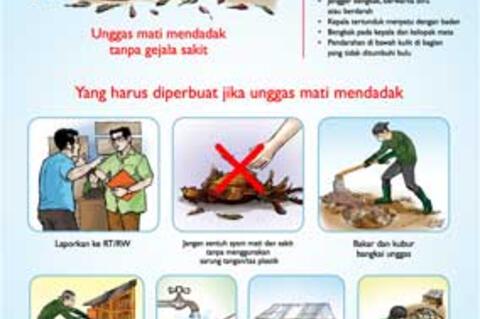
On September 1 2006, Indonesia launched a 4-month-long national campaign to raise public awareness about avian influenza. The "Tanggap Flu Burung!" campaign used television and radio spots, billboard ads, leaflets and other media to inform Indonesians about effective steps they can take to reduce the risk of contracting the H5N1 virus. The campaign was implemented by the Indonesia National Committee for Avian Influenza Control and Pandemic Influenza Preparedness (Komnas FBPI), which is a ministry-level committee that coordinates Indonesian actions aimed at controlling bird flu. The campaign was part of a broader awareness drive being undertaken by the United Nations Children's Fund (UNICEF), and sought to reach all Indonesians, including the millions of small-scale, backyard-poultry owners across the country.
Communication Strategies
This awareness campaign was driven by the belief that the involvement of all Indonesians - especially backyard farmers - is crucial in bringing avian flu under control. It drew on a variety of communication media in an effort to reach as many people as possible with messages designed to sharpen awareness, shape attitudes, and shift behaviour.
Specifically, four 30-second television and radio public service announcements (PSAs) were developed to illustrate each of the 4 key messages: wash (do not touch sick or dying birds; if you do, immediately wash your hands. Also, wash your hands and utensils with soap and water before you eat or cook), cook all poultry and eggs well, separate birds from people, and separate all new flocks for 2 weeks, and report (tell local authorities if you have had contact with sick or dying birds; go immediately to a health clinic if you have a fever with flu-like symptoms and have had contact with birds).
The spots - which feature English-language sub-titles and may be viewed by clicking here - feature late-night talk-show host Muhammad Farhan. This young man introduces each PSA (broadcast on all 9 national TV stations, and created for radio in local languages and dialects). The PSAs portray Indonesians learning about everyday actions that can be taken to prevent infection. As Farhan explains, "We are not focusing on scientific stuff, but simple, every day life. Through comedy and simple storylines, we get people to take more care, like proper cooking, keeping chickens outdoors and to getting to a doctor if you have flu." Lighthearted music is part of the effort not to inspire fear or panic, but to inform and to prepare. Farhan has also begun to include bird flu issues in his regular talk shows to spread the message. In addition, an emergency PSA was developed for broadcast in outbreak areas, featuring Dr. Lula Kamal.
Drawing on these same strategies, printed materials including billboards, magazine articles, and other print advertising - including informational leaflets and signage - were produced and distributed around the country. The common theme throughout all the materials, which can be viewed by clicking here, is that "our hands can prevent bird flu".
Specifically, four 30-second television and radio public service announcements (PSAs) were developed to illustrate each of the 4 key messages: wash (do not touch sick or dying birds; if you do, immediately wash your hands. Also, wash your hands and utensils with soap and water before you eat or cook), cook all poultry and eggs well, separate birds from people, and separate all new flocks for 2 weeks, and report (tell local authorities if you have had contact with sick or dying birds; go immediately to a health clinic if you have a fever with flu-like symptoms and have had contact with birds).
The spots - which feature English-language sub-titles and may be viewed by clicking here - feature late-night talk-show host Muhammad Farhan. This young man introduces each PSA (broadcast on all 9 national TV stations, and created for radio in local languages and dialects). The PSAs portray Indonesians learning about everyday actions that can be taken to prevent infection. As Farhan explains, "We are not focusing on scientific stuff, but simple, every day life. Through comedy and simple storylines, we get people to take more care, like proper cooking, keeping chickens outdoors and to getting to a doctor if you have flu." Lighthearted music is part of the effort not to inspire fear or panic, but to inform and to prepare. Farhan has also begun to include bird flu issues in his regular talk shows to spread the message. In addition, an emergency PSA was developed for broadcast in outbreak areas, featuring Dr. Lula Kamal.
Drawing on these same strategies, printed materials including billboards, magazine articles, and other print advertising - including informational leaflets and signage - were produced and distributed around the country. The common theme throughout all the materials, which can be viewed by clicking here, is that "our hands can prevent bird flu".
Development Issues
Health.
Key Points
The H5N1 virus is now endemic in poultry in 29 Indonesian provinces. According to Inter Press Service (IPS), as of September 2006 there were 50 human deaths from bird flu in Indonesia out of 65 reported cases. So far, IPS reports, 145 people have died due to bird flu out of the 247 cases reported globally, states the World Health Organisation (WHO). Vietnam follows Indonesia in human fatalities, with 42 bird flu-related deaths, after which comes Thailand, where 16 people have died. In China 14 deaths have occurred and in Cambodia, six.
Click here to access the Komnas FBPI Media and Information Centre, which provides up-to-date information on avian influenza, details on the National Strategic Plan for Avian Influenza Control and Pandemic Influenza Preparedness (2006-2008), and other bird-flu-related information.
Click here to access the Komnas FBPI Media and Information Centre, which provides up-to-date information on avian influenza, details on the National Strategic Plan for Avian Influenza Control and Pandemic Influenza Preparedness (2006-2008), and other bird-flu-related information.
Partners
Supported by UNICEF, with funding from the Government of Japan.
Comments

- Log in to post comments