










































COVID-19 Communication Inspiration Challenge: Insights and Learnings
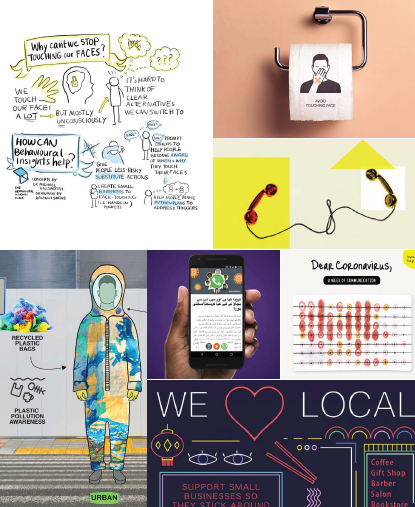
"Effective and inspiring messaging must be at the center of a more resilient, empathetic, and effective response to this global pandemic."
During the global COVID-19 pandemic, health experts, organisations, and governments asked people to change their behaviour by following guidelines around handwashing, staying home, and physically distancing themselves from other people. In an effort to understand which messages around COVID-19 are resonating around the world - and what is still missing from the effort - IDEO and OpenIDEO launched one of their open Challenges as part of a quest to put the power of human-centred design in the hands of many. Created by an interdisciplinary team of health experts, researchers, data scientists, and designers, this insights report synthesises the 922 submissions to the Challenge. (Also available, below, is the recording of a webinar held to delve further into behaviour change communication around COVID-19.)
Presenting participants with this question - "How might we rapidly inform and empower communities around the world to stay safe and healthy during the COVID-19 outbreak?" - the COVID-19 Communication Inspiration Challenge broke submissions into 3 areas:
- Sustainable and equitable access to information
- Inspiring and uplifting each other
- Thoughtful preparation for a new reality
In addition, IDEO and OpenIDEO decided to explore parallels that could be drawn between health behaviour changes like quitting smoking to behaviours like handwashing and physical distancing. As the report outlines, they drew on 3 behaviour change theories: the Health Belief Model (HBM), the Transtheoretical Model, and Diffusion of Innovations.
Three main insights - with examples, illustrations, and quotations provided in the report - include:
- People are seeking many types of information from many different sources. In addition to healthcare professionals, they are: turning to faith-based organisations; trusting in locals; turning toward family for support; and expressing the need for mental health support.
- Behaviour change is largely being sparked by creative and local messaging that sticks. People are: localising information and making it interactive; prioritising accessibility; crossing boundaries; making the invisible visible (e.g., through simple, visual, interactive tools); designing for a specific audience; using humour as a tool; learning from each other; and connecting traditional and modern communication methods.
- People are coping by finding ways to help, and these actions come in all shapes and sizes. They are: reallocating resources and encouraging local action; practicing social distancing; seeking inspiration and information; re-sharing resources; and sharing and building ideas.
Supporting data, based on assessments made during the Challenge, are included throughout the report. For example, in response to the question of whose needs are not being addressed by today's COVID-19 behaviour change campaigns, 70% of participants shared concerns that groups are being left out. Needs for children, the elderly, and those without access to the internet came up most consistently across the Challenge. Participants from Africa cite rural communities and people with disabilities as groups who aren't often heard, as well as the need for localised information, substantially more than other regions.
In addition, on April 7 2020, IDEO hosted a webinar with a panel of global leaders to examine insights generated by the Challenge, best practices for sharing trusted information, the importance of community co-creation, and the future of post-COVID-19 communication. More than 1,800 participants joined from all over the world. Panelists included:
- Paul Bennett, Chief Creative Officer at IDEO
- Khalid Hashi, Founder and CEO of Somalia-based organisation OGOW EMR
- Tracy Johnson, Senior Program Officer at the Bill & Melinda Gates Foundation
- Andréa Mallard, Chief Marketing Officer at Pinterest
Some of the key takeaways from the conversation:
- To cut through the proverbial noise:
- Say less: It can be more dangerous to have too much information, as misleading or even dangerous information can pop up (e.g., on social media); ensure that what is shared comes from sources of authority that can be trusted.
- Encourage people to look outward: Nudge people to ask how they might take action or help others.
- Take care with tone: For example, establish eye-contact and acknowledge shared humanity, on both a personal and organisational level.
- To rebuild community through inclusive co-creation:
- Contextualise information: Communicate information in a way that makes sense to the audience; it is important to design for all.
- Reach those who are most vulnerable: Ask who is being missed, how they can be brought into the conversation, and how to elevate their voices.
- Co-create with those whom you're designing for: Reframe how we think about our connection to each other through design.
- To engage people during stressful times:
- Enable meaningful action: A meaningful act of contribution, no matter how small, can feel better than the passive things we are being asked to do.
- Remember that people are looking for ways to help: Focus on creating things that are joyful, playful, and celebratory, rather than fear-inducing.
Access the webinar:
Emails from OpenIDEO to The Communication Initiative on April 11 2020 and April 14 2020; and OpenIDEO website, April 24 2020. Image caption: Images submitted as part of the Challenge
- Log in to post comments