










































Fact-Checking as Risk Communication: The Multi-Layered Risk of Misinformation in Times of COVID-19
University of Wisconsin-Madison (Krause, Freiling, Beets, Brossard); University of Münster (Freiling); Morgridge Institute for Research (Brossard)
"[M]ulti-layered risks involving misinformation pose unique communication challenges that fact-checking (the current mitigation strategy of choice) will fail to sufficiently address."
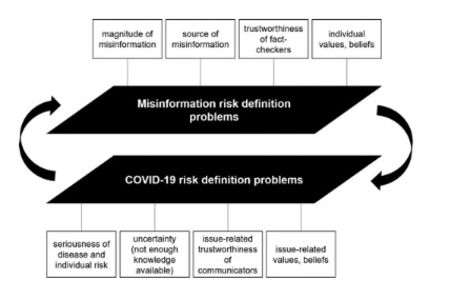
In a pandemic such as COVID-19, health-related misinformation can be a matter of life and death. In this context, and due to the uncertainties tied to a "novel" coronavirus, the World Health Organization (WHO) has characterised the COVID-19 information landscape as an "infodemic". This paper argues for the utility of viewing the problem as a multi-layered risk communication problem, discussing the implications of risk research for efforts to fact-check COVID-19 misinformation and offering practical recommendations.
The paper opens with some examples of COVID-19-related misinformation in the United States (US) by highlighting, for example, the concerns that many communication researchers and professionals have expressed regarding the coverage available on the conservative (Republican-leaning) US television network Fox News. While many experts seem to agree that Fox News poses a COVID-19 misinformation risk, the authors point out that Fox News viewers do not seem to agree with experts' assessments, exhibiting little concern with the network's reporting on the pandemic.
Due to varying perspectives on misinformation risks, the authors offer some clarifying definitions, including: (i) "misinformation", which they take to mean "any messages that conflict with the best-available evidence about COVID-19, and that would likely not be corrected if they were challenged"; and (ii) "fact-checking", which encapsulates a myriad of efforts by organisations to investigate claims that are shared in the news media and/or on social media (e.g., the WHO's website dedicated to COVID-19 "myth busting").
Yet, according to the authors, divergent understandings of the misinformation risk seem to be interacting with COVID-19 risk perceptions, in part because subgroups of the population may define misinformation risks differently. For instance, a nationally representative survey conducted in the US in mid-March 2020 indicated that most Americans agree about the risks posed by the pandemic itself; however, partisan/political divides emerge when the public is asked about who seems to be exaggerating/misreporting the risks of COVID-19. Pew research found that 77% of Republicans and Republican-leaning independents say the media have exaggerated the risks of the coronavirus outbreak at least slightly, whereas only 49% of Democrats and Democratic-leaning independents say so.
According to the authors, this analysis, which highlights the multi-layered nature of the misinfodemic risk, can help us understand "why ongoing efforts to fact-check misinformation about COVID-19 are unlikely to succeed in their current form". That is, Republicans who see journalists as the origin of misinformation will be more likely that Democrats to expect that fact-checking organisations will scrutinise COVID-19 claims made by traditional news media and that risk communicators will tell them how traditional media can be held accountable for COVID-19 misinformation.
Furthermore, Pew research has found that almost half of Americans view fact-checkers as somehow biased, meaning that ramping up existing fact-checking efforts may be ineffective. More research is needed here to both understand how various publics perceive "'corrective communications" and, as explored below, to build trust and be transparent about what is uncertain.
Finally, the authors explore issues with the "knowledge deficit model", such that, "even if the corrective message succeeds in correcting misperceptions, there is no guarantee that updated beliefs will lead to a change in behavior". Related to the limits of knowledge is the fact that, as has been demonstrated in research on vaccine communication, "risk and benefit perceptions are heavily influenced by message content that has little to do with facts. Instead, emotions tend to matter more..."
Based on the challenges they have outlined, the authors offer recommendations for fact-checkers in the COVID-19 context, arguing that they should:
- Do the work of building trust instead of just saying or implying they are trustworthy - e.g., by working with organisations that are trusted among most of the public, such as the WHO.
- Be clear when fact-checking likely-false information that a definite answer may not be known; research has found that highlighting uncertainties does not impact trust levels.
- Use emotions carefully - e.g., by trying to connect corrective information to audiences' values and concerns.
Journal of Risk Research, DOI: 10.1080/13669877.2020.1756385.
- Log in to post comments