










































Hesitancy towards a COVID-19 Vaccine and Prospects for Herd Immunity
University of Wyoming (UW)
"Measuring the share of the population that is reluctant to be vaccinated for COVID-19 can help policy makers, health care workers and other authorities to plan ahead towards minimizing the impact on public health from vaccine hesitancy."
Scientists from all over the world have come together to develop a vaccine for COVID-19. Yet a barrier to reaching herd immunity in the United States (US) and elsewhere is the prevalence of people who refuse or are hesitant to take vaccines. One factor that could influence uptake level of the vaccine in the general population is the effectiveness of risk communication, which is acknowledged to be a pillar of a coordinated response to infectious disease outbreaks. This randomised controlled trial (RCT) was designed to analyse whether inconsistent risk messages around COVID-19 in the US may affect health behaviour - in this case, vaccine decisions. Specifically, the study examined how vaccine avoidance is affected by the White House being more optimistic (communicating lower risks from COVID-19) than public health experts at the Centers for Disease Control and Prevention (CDC).
The researchers present some background data to explain that vaccine hesitancy is not equivalent to refusal. Previous research has found that around 10% percent of the US population refuse all vaccines, i.e., both vaccines part of the recommended vaccine schedule for children and influenza vaccines, while around 5% refuse only one vaccine. Forty percent of the latter group still expressed concerns about vaccines. "The fact that many who are vaccine hesitant are likely to take some vaccines, while perhaps delayed, means it is possible that a portion of those currently unwilling to vaccinate can be swayed. Here, risk communication may play an important role, given the correlation between perceived risks and vaccine acceptance."
The RCT, based on data collected primarily March 24-31 2020, involved a nationally representative sample of 3,133 participants who were asked to state their intention to vaccinate themselves and their children when a COVID-19 vaccine becomes widely available. Operating with an assumption that a COVID-19 vaccine would be 60% effective, the RCT entailed 8 treatment groups, across which the researchers varied: (i) the probability of infection (high/low), (ii) conditional mortality rate from COVID-19 (high/low), and (iii) whether the probability of infection is communicated by the CDC alone or jointly with the White House, where the White House states a lower probability.
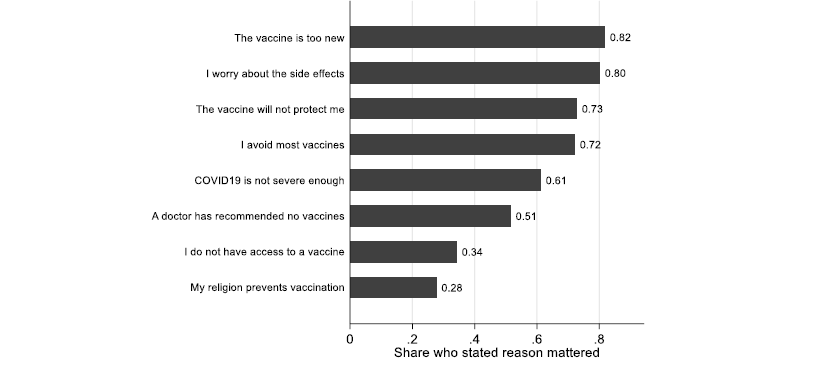
The results show that 13%-30% - or an average of 20% - of people would decline a vaccine for COVID-19. People avoid the vaccine mainly because of general vaccine hesitancy, distrust of vaccine safety, and vaccine novelty (see Figure 3 in the paper, above). For example, 82% of those who would decline the vaccine agreed with the statement "I worry the vaccine is so new we do not understand the side effects". Other reasons for declining the vaccine are doubts that the vaccine will protect one from catching the virus and the belief that COVID-19 is not severe enough to warrant vaccination. Also influencing people's willingness to be vaccinated is discrepancy in risk articulated by public officials. Those who were given the White House projection with a more optimistic view of COVID-19 risks - lower probability of becoming infected, compared to the risk communicated by public health officials from the CDC - were less likely to be vaccinated than those given the projections by public health officials only. In other words, "the probability of infection matters - the higher the probability, the more likely people are to choose to vaccinate."
The researchers use the survey results in an epidemiological model (Susceptible Infectious Recovered, or SIR) to examine how the observed vaccine avoidance would affect the ability of a COVID-19 vaccine programme to ensure herd immunity or otherwise save lives in an upcoming COVID-19 season. Estimates of basic reproduction numbers for the novel coronavirus imply that herd immunity could be achieved when somewhere between 60% and 80% of the population is immune, either from a vaccine or previous infection. Taking all factors into account - vaccine avoidance, vaccine effectiveness, current estimates of COVID-19 infectiousness, and an assumed low level of immune individuals - the SIR model shows that a vaccine programme in an upcoming COVID-19 season is likely to fail to ensure herd immunity, even if the vaccine is made available to the entire population. "All else equal, vaccine avoidance poses a greater challenge to the vaccine program if the infectiousness of COVID-19 is high, the effectiveness of the vaccine in preventing infections is low, or the acquired immunity level in the population when entering the next COVID-19 season is low."
If, however, it turns out that people who have recovered from COVID-19 become immune, which is unknown as of this writing, the vaccine has better chances of succeeding in achieving herd immunity. Even though the vaccine may fail to ensure herd immunity, it would still help mitigate the COVID-19 pandemic in the US.
Some insights from the RCT that could guide action going forward:
- A uniform risk message from government authorities is important, as inconsistent information from government authorities about COVID-19 risks may affect not only risk perceptions but also health-related behaviours.
- Distrust in the government is higher amongst those who decline the vaccine. To address COVID-19 vaccine hesitancy, tailored communication efforts might be in order and could include reaching out to healthcare providers (who have found in other studies to be a trusted source of vaccine safety information) and local authorities, including religious leaders. Government agencies may also benefit from the knowledge gathered from efforts to address vaccine hesitancy during recent measles outbreaks.
- Policymakers might consider regulations that require people to have COVID-19 vaccinations in order to attend schools or enter workplaces.
In conclusion, the researchers suggest that "Knowing about COVID-19 vaccine avoidance before a vaccine is available can help government agencies, health care workers and other authorities mitigate the impact of vaccine avoidance. Such efforts may involve developing policies and a preparedness for the vaccine avoidance, i.e., increase efforts to ensure those willing to take the vaccine have the opportunity to do so. It might also involve public information campaigns designed to reduce vaccine avoidance by increasing confidence in the effectiveness and safety of the vaccine."
https://dx.doi.org/10.2139/ssrn.3593098 - sourced from "UW Researchers Find Vaccine Hesitancy Would Hamper COVID-19 Efforts", UW, May 12 2020 - accessed on May 15 2020.
- Log in to post comments