










































Community Activism as a Strategy to Reduce Intimate Partner Violence (IPV) in Rural Rwanda: Results of a Community Randomised Trial
Johns Hopkins University (Chatterji, Heise); South African Medical Research Council (Stern, Dunkle); London School of Hygiene and Tropical Medicine (Stern, Heise)
"[C]ommunity mobilisation strategies as a means to reduce levels of IPV deserve further investigation in rural Rwanda and in other rural settings..."
Despite promising examples of the strategic use of community activism to shift the patriarchal norms, attitudes, and beliefs that undergird IPV, there is limited understanding of how activism actually translates into reduced violence, including how cultural context and programme implementation may affect impact. Conducted by external researchers as part of What Works to Prevent Violence Against Women and Girls, this evaluation focuses exclusively on the community activism/mobilisation portion of Indashyikirwa ("Agents of Change" in Kinyarwanda), a multi-component IPV prevention programme implemented by CARE Rwanda, the Rwanda Women's Network (RWN), and the Rwanda Men's Resource Centre (RWAMREC) between 2015 and 2018, with funding from the Rwandan office of the Department for International Development (DFID-R).
Indashyikirwa was implemented in predominantly rural, widely-dispersed communities in seven districts in the Eastern, Northern, and Western provinces of Rwanda, a country where IPV persists despite the passage of the Prevention and Punishment of Gender-Based Violence Law in 2008. The programme was built in part on insights on SASA!, a community mobilisation intervention to prevent violence against women and reduce HIV risk in Kampala, Uganda. (More information about SASA! is available at Related Summaries, below, and in Table 1 of the paper, which compares Indashyikirwa to SASA!. See also Figures 1 and 2 in the paper, which depict the programme's ultimate implementation and research timeline as well as its theory of change.)
The paper reports on the community-wide elements of Indashyikirwa. Key elements included:
- After completing a 21-session couples' curriculum focused on gender, power, relationship skills, triggers of violence, harmful alcohol use, sexuality, etc., individuals who expressed interest and met additional criteria were invited to attend 15 supplemental sessions on community activism. These sessions emphasised how to use participatory techniques to challenge prevailing beliefs and engage community members around transforming gender norms, balancing power in relationships, and interrupting violence.
- To cultivate a supportive environment for community change, RWN trained approximately 40 opinion leaders (e.g., local government, service providers, religious leaders) per intervention sector (midlevel administrative units with an average population of 25,000 people) at the beginning of the programme and again after local elections.
- RWN established 14 "safe space" drop-in centres (one per intervention sector), which were staffed by trained community volunteers who had been recruited from the villages where community activists (CAs) were active. These volunteers facilitated sessions on IPV and women's legal rights, and they accompanied women who wanted to seek assistance from health, justice and/or social services.
The impact evaluation took the form of a community randomised controlled trial (cRCT), with randomisation at sector level, as well as: (i) a longitudinal cohort of couples who attended the couples intervention and couples in comparison communities, interviewed at baseline, 12, and 24 months; and (ii) a pair of cross-sectional community surveys implemented near the beginning of the intervention and 24 months later. The surveys consisted of a household-based random sample of currently partnered women and men residing in villages from the intervention and control sectors (50 men and 50 women surveyed in each of the 28 study sectors, for a total of 1,400 women and 1,400 men at both waves). Results from the community surveys are presented in this paper.
In brief, there was no evidence of an intervention effect at a community level on any of the trial's primary or secondary outcomes - most notably, women's experience of physical and/or sexual IPV from a current male partner in the past 12 months (adjusted odds ratio (aOR) = 1.25; 95% confidence interval (CI) = 0.92-1.70, P = 0.16) or men's perpetration of male-to-female physical and/or sexual IPV (aOR = 1.02; 95% CI = 0.72-1.45, P = 0.89).
Despite the lack of a measurable community-level effect of the activism activities on IPV, both survey and qualitative data suggest that the women's safe spaces were generally well utilised and regarded by communities; for example, 92.8% of women and 96.2% of men were aware of the service and were willing to recommend it to others. Moreover, the majority of those who reported attending activities or seeking services at the women's spaces did so more than once.
The process evaluation data suggests several potential reasons why the activism component of Indashyikirwa failed to reduce IPV at a community level:
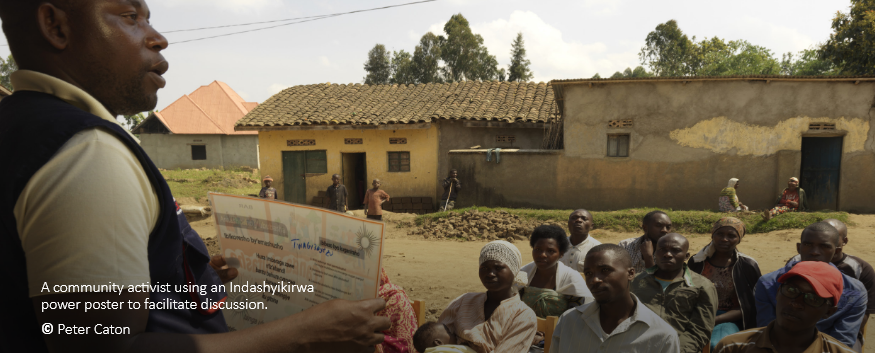
- A core concept of the SASA! approach to community mobilisation is engaging community members in conversation where they congregate: at moto stands, local repair shops, or local markets. Data suggest that this type of "informal activism" did not translate easily to the Rwandan setting, where more formal settings are the norm. Indeed, many CAs and programme staff reflected on the fact that community members did not feel comfortable discussing intimate matters in public. Because of this tendency, activists used existing forums, such as village savings and loan associations (VSLAs), to deliver their messages. Such forums, with their potentially large amount of attendees, often demand a more didactic style of communication than the interactive engagement anticipated by the SASA! model.
- Because of the time required to finalise the Indashyikirwa design, to pilot and implement the couples' curricula, and to adapt SASA! activist materials to the Rwandan setting, Indashyikirwa only had 1.5 years available for activism (November 2016 - June 2018). A SASA! fidelity brief suggests that a minimum of 3 to 5 years of community mobilisation is necessary to shift norms and reduce IPV. Accordingly, Indashyikirwa programme partners reported that community members did not have adequate time to internalise more advanced concepts of encouraging norm change and taking action against violence.
- There was a lack of clarity around the notion of phasing, a core concept of SASA!'s theory of change. Each phase of SASA! focuses on a different outcome: start (knowledge), awareness (attitude), support (skills), action (behaviour). Phased programming was a new and unfamiliar concept for Indashyikirwa partners, and it was difficult to anticipate when to move onto the next phase and to make the effort to do so.
Based on their experiences with evaluating Indashyikirwa, the researchers "strongly recommend that when assessing tradeoffs in data collection strategies, future studies find ways to both quantitatively and qualitatively explore individual-level exposure to programme-specific activities and content of messages received. Such data will be valuable for both process evaluation and interpretation of impact evaluations, especially in the case of null findings at the community-level."
In conclusion: "Consideration should be given up front into how best to encourage interpersonal reflection and collective action to transform norms and practices on gender, power and violence. Implementing agencies and donors should use the Indashyikirwa community component as an object lesson for the importance of cultural adaptation, adequate training and length of implementation."
Journal of Global Health. 2020 Jun; 10(1): 010406. doi: 10.7189/jogh.10.010406. Image credit: Peter Caton
- Log in to post comments