










































Count Me In
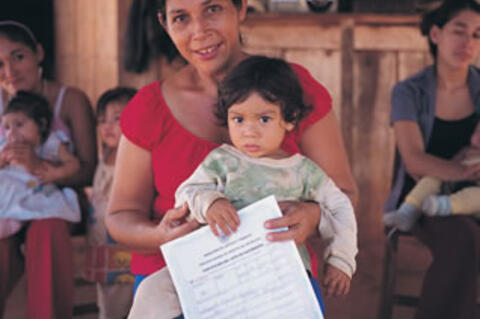
- the international community to give urgent priority to universal birth registration;
- governments to give greater political support to the issue; and
- grassroots organisations to raise awareness and demand action on birth registration in their own countries.
In order to raise public awareness of birth registration, Plan engaged in a wide range of activities. These vary from country to country depending on the national and local context, but, in general, Plan worked with children and their communities and aimed to ensure that the methods adopted are relevant and culturally appropriate.
At the local level, Plan conducted community-based awareness-raising sessions. For example, Plan in Zimbabwe found that communities were suspicious about birth registration and did not see how providing proof of identity would benefit them. Plan staff shared their knowledge about the importance of registering births for effective national planning and provided through face-to-face sessions practical illustrations of situations where proof of age is needed.
Another key Plan approach at the local level involved promoting birth registration through existing structures/collaborators such as:
- Community-based organisations (CBOs) and village leaders - for example, Plan in Nepal worked to spur awareness about the importance of birth registration by drawing on Village Development Committees to help initiate discussion about birth registration in women's savings and credit groups as well as in mother's groups. In Indonesia, Plan and civil registry staff joined community leaders to discuss birth registration, which has led to the formation of teams of youth volunteers in sub-districts and hamlets. Accompanied by Plan staff, each team went door-to-door to inform villagers about the rights of the child, the advantages of proving identity, and the procedures of registering a birth. The volunteers were said to be instrumental in assisting families, especially those who are illiterate, with completing birth registration forms and obtaining documents from the administration confirming their identity.
- Teachers - for example, Plan in Senegal organised orientation sessions for teachers on the importance of birth registration. Teachers now assist with registering their students, taking simple forms to the local council so that they can be officially recorded.
- Health professionals - for example, Plan in Kenya raised awareness of birth registration with traditional birth attendants (TBAs), who have been found to play an instrumental role in encouraging parents to register their children.
- Religious leaders - for example, in Bangladesh, with the help of the Islamic Foundation, Plan supported a District Resource Team in organising orientations on birth registration at Upazila levels for the Imam Society. This led Imams to speak about, and promote, birth registration through the mosque microphone before and after prayers as well as through personal contact.
- The media - for example, realising the reach of radio and print journalism to raise awareness about UBR, Plan in Guinea Bissau organised a workshop for local journalists; this event spurred the establishment of a local press correspondent network on birth registration. Similarly, Plan in Benin facilitated a national network of journalists on the rights of the child by gathering journalists and communicators from across the country for a 3-day workshop on birth registration; the journalists went on to develop their own national plan of action.
Other awareness-raising activities adopted by Plan included rallies, puppet shows, street plays, messages displayed on community notice-boards, and focus group discussions (FGDs) on birth registration. All these methods were used by Plan in India, for instance, during a "birth registration week' attended by civil registration officials, who issued birth certificates there and then. A similar activity was carried out by Plan Burkina Faso; local authorities were actively involved in the week's activities, and a total of 5,250 birth certificates were issued as a result.
Plan used a variety of information and communication technologies (ICTs) as part of this awareness-raising work. For instance, in an effort to foster birth registration among orphans and vulnerable children, Plan in Uganda developed simple radio spots in English and 3 local languages that were broadcast intensively on a local FM radio with a wide coverage area. Working in collaboration with the Philippine Information Agency, Plan in the Philippines developed short "infomercials" about the advantages of having a birth certificate, which were broadcast on radio and shown on television networks and cinema screens across the country. Public service announcements (PSAs) were screened at the 2007 Pan-African Film Festival (FESPACO) to help emphasise the importance of UBR. Called "Broken Dreams," the PSAs focus on 2 children - one aspires to be a doctor, the other a football player, but both are both are devastated when they discover that their chosen paths are blocked because they do not have a birth certificate.
The strategy of engaging high-profile celebrities in delivering messages about the importance of birth registration was integrated into this campaign. Plan in the Philippines invited Camerlita Ericta to act as a panellist at a press conference on birth registration; she was joined by representatives from the government and non-governmental organisations (NGOs). Along these lines, the first West and Central Africa conference on birth registration organised a separate workshop for African musicians, including many popular artists. At the end of the week, a free concert was held in Dakar's Iba Mar Diop stadium to raise awareness of birth registration activities.
Plan has advocated (and will continue to advocate) to governments at the local and national levels to increase political will for birth registration. For instance, Plan in Indonesia has promoted UBR through hearings with government and legislative bodies at national, provincial, and municipal levels, and - as part of its advocacy efforts in Sudan - Plan organised a national workshop on birth registration which resulted in a set of recommendations for change in legislation. These were then raised to the Sudanese national assembly by the National Council for Child Welfare. Plan is also pushing for the establishment of international guidelines to make sure that every child has a birth certificate.
In this campaign, partnership at every level - international, national and grassroots - was a core strategy. For instance, in Cambodia, Plan's partnership with the Ministry of the Interior and the Asia Development Bank facilitated the formation of mobile registration teams, which have issued birth certificates to over 9.5 million Cambodian children and adults since 2004. This strategy draws on Plan's belief that birth registration systems must be flexible. They need to reach rural, remote communities, offer retrospective registration, and identify hard-to-reach groups (indigenous/nomadic populations). To provide a bit more detail on the latter, Plan promoted the use of mobile registration units to reach populations living in inaccessible areas. The organisation has found that this approach helps to increase awareness of birth registration, provides a mechanism through which to collect public feedback on civil registration processes, and creates an opportunity though which to clear birth registration backlogs. For instance, in Sri Lanka, one Plan initiative involved asking plantation supervisors to give workers leave so that they could visit a mobile registration unit which was based at a local school.
Throughout all of these activities, Plan sought to involve communities and children from the very outset; this is based on the belief that their involvement builds trust and ensures compatibility with local realities. For instance, in Togo, Plan brought together separate groups of boys, girls, women, and men to discuss the causes, examples and consequences of a lack of a birth certificate - toward the development of local action plans. In the Philippines, children formed 2 theatre groups which perform in front of various audiences to raise awareness and encourage community members to register their children. Furthermore, with the support of Plan Nepal, child journalists are writing about the issue of birth registration in their newspaper. And children in the Dominican Republic helped produce a comic book developed as part of a birth registration campaign in collaboration with World Vision; as part of this effort, young people were also asked to participate in the filming of a television spot. At the international level, Plan developed a children's participation initiative in the run-up to the May 2002 United Nations General Assembly Special Session on Children (UNGASS), facilitating the participation of 17 child delegates in the Special Session. The young delegates promoted birth registration in a number of forums, including meetings, press conferences, radio and television interviews, and panel discussions.
Plan also focused on capacity building and experience sharing. Training for birth registration staff focused on improving motivation, efficiency, and the cultivation of correct data. For example, in Sri Lanka, Plan developed a toolkit to help officials carry out mobile registration in areas of non-registered children. Plan worked with various partners to organise regional conferences that bring civil registrars together to share experience and learning. Plan Bangladesh and Plan Vietnam organised government visits to "best practice" areas.
ICTs played a role in Plan's effort to promote UBR monitoring registration systems (to ensure that they keep pace with change and so stay sustainable). In Pakistan, for instance, Plan supported the development of an online birth registration system that allows all levels of government to view and track data. In Guatemala, Plan helped computerise the civil registry system.
Children, Rights.
According to the United Nations (UN), the births of an estimated 48 million children go unregistered every year; at present, no records exist of the birth of 6 of every 10 babies born in South Asia, and in sub-Saharan Africa the births of 55% of all children go unrecorded every year. This is problematic, Plan argues, because birth registration is a fundamental issue of child rights. A birth certificate means proof of identity and makes children safer from abuse and exploitation. The organisation indicates that registration is also a vital component of collecting accurate demographic data - which, in turn, allows countries to plan their national health and social services.
Despite this, many obstacles to UBR remain; details are available on the Plan website, but, in short include:
- At the local level:
- lack of awareness and motivation;
- fear of discrimination and persecution;
- incompatibility of birth registration with local realities; and
- lack of resources.
- At the national level:
- lack of political will;
- lack of resources; and
- legislative barriers.
- At the international level:
- lack of recognition, support and priority; and
- lack of implementation and action.
The campaign was launched at the UN headquarters in New York by Archbishop Desmond Tutu and Plan chief executive Tom Miller.
By the end of the campaign, which involved over 90% of Plan countries, the direct efforts by Plan and partners had reportedly led to over 40 million people - the majority of them children - in 32 countries being registered. Thirty percent of countries Plan focused on changed their legal systems as a result of Plan's advocacy work, resulting in free birth certificates and registration for more than 153 million children born between 2005 and 2009.
Email from Colin McCallum to The Communication Initiative on November 15 2006 (including a Press Release, Interim Campaign Report 2005-06, and Report Summary); Count Me In website; and email from Farrah Easton to The Communication Initiative, May 14 2008; and Count Every Child: The Right to Birth Registration [PDF].
Comments


- Log in to post comments