










































Harnessing the Power of Videos: A Video Storytelling Training Toolkit for Organizations Working with Adolescent Girls
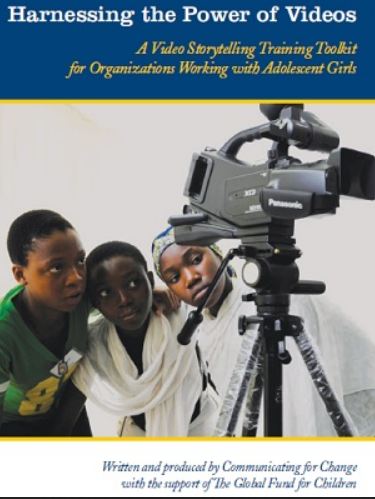
"Harnessing the Power of Videos is a training toolkit for community-based organizations on how they and the adolescent girls they serve can use visual media and technology to tell their stories and those of their communities; to be heard; and, in the process, to be empowered through increased skills and self-confidence."
This toolkit was built through a project in Nigeria that brought together 6 adolescent girls from Kduna State and 6 from Lagos to take part in a project aimed at training and empowering the group in the art of video storytelling. The project, initiated by The Global Fund for Children (GFC) and coordinated by Communicating for Change (CFC), involved 9 days of modules on creative scriptwriting, production, camera operation, and the editing process. Follow-up sessions were held 3 to 4 months after the workshop to enable the girls "to assess their progress since the initial training, review some of the skills and techniques of video storytelling that they had been taught, and learn how to share the stories they produce by holding community film screenings and participating in social media."
This manual was designed for organisations focused on promoting gender equality and improving the lives of adolescent girls and young women. As indicated in the toolkit, by developing the abilities of young girls to film their stories, their skills and confidence increase while they create advocacy tools for organisations working on their behalf, as well as evidence for donors who might support girl-focused programming. Public screenings can put forward a gendered perspective to foster debate and discussion amongst communities.
The manual suggests beginning with an organisational assessment of the capacity, skills, level of interest, and available financing for engaging in a girls' video project. Some strategies and approaches are included in the manual. It describes the necessary steps for planning, identifying, and training adolescent girls and implementing training sessions and activities. It also contains a series of icebreakers and energisers to make the training more interesting, engaging, and fun. "The training sessions can be completed in diverse environments; however, they are most effective with smaller groups of about 12 participants.
“Section One: Getting Started” includes in the planning stage includes a needs assessment discussion with possible data sources and key questions for:
• Focus-group discussions
• Semi-structured interviews
• In-depth interviews
• Observations
• Survey questionnaire
It encourages participatory processes and obtaining parent buy-in, as well as a discussion of how to engage donors.
There is a section on curriculum development and training tips for girl-friendly sessions including: ownership of the project by a girl's advisory board; a focus on their needs, issues, and time constraints; considerations of physical and emotional safety; teaching human rights; and keeping sessions interactive. Female trainers should share the vision of empowering girls and be good teachers and role models and should be included in curriculum design.
The manual offers a sample curriculum, how to use the videos for outreach, and how to assess the project. It includes assessment tools, handouts, and equipment lists. The outreach section suggests sharing the videos with digital networks such as: CNN iReport, TakingITGlobal, Voice of Africa (if appropriate), or other networks. It outlines how to plan a community screening, including objectives, questions for planning, how to know the audience, support through print materials, and how to evaluate a screening. A section on facilitating the screening includes tips for making the experience:
• "Meaningful enough for people to personally identify with
• Comfortable enough for people to feel free to speak
• Challenging enough for people to question personal and social patterns of thinking and behavior
• Informative enough to give people new skills and models for living their lives
• Entertaining enough for people to have a positive and fun experience"
Online sharing tips through video sites such as YouTube, Yahoo! Video, and Dailymotion are provided, along with a discussion of social networks, such as Facebook, and blogs.
Measuring project effectiveness includes evaluating goals such as capacity building, community involvement, quantity of videos, comprehension of video audiences, and impact of videos.
Editor's note, January 29 2024: This publication is no longer available online.
English
90
- Log in to post comments