










































Building Assets Toolkit: Developing Positive Benchmarks for Adolescent Girls
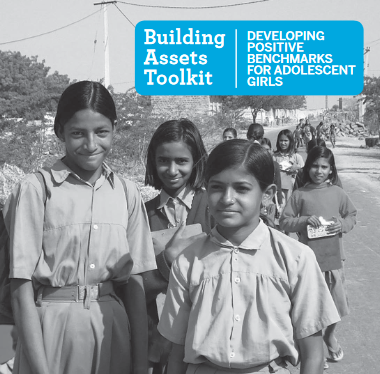
"The asset-building exercise offers a 'refreshed take' on girls programming, which can engage stakeholders at different levels and with different viewpoints. Together, these views generate an evidence-based dialogue."
According to the Population Council, the content of programmes for adolescent girls often is overly generalised and not adapted to specific populations. Furthermore, girls' well-being is measured by metrics that are too focused on what girls "are not": not pregnant, not HIV-affected, and not exposed to sexual coercion. Thus, the Population Council and partners have pioneered a process to assist in the development of relevant, tailored, and positive programme content. The asset-building approach helps craft stepwise, achievable benchmarks for girls by age, social category, and context. The Building Assets Toolkit introduces practitioners to this approach, guides them through the exercise, and models the critical thinking needed for effective programme design.
The toolkit includes:
- a 9-page instruction guide [PDF]
- a 39-page resource manual [PDF]
- a 67-page document [PDF] including: 100 asset cards and 10 cards for customisation; 8 age-range cards; and a programme-planning worksheet.
An asset-building exercise is designed to involve multiple stakeholders in determining what assets girls need in order to survive and thrive. "We rely on the life experience of girls and those who want to or aspire to work with them and to live in their communities, in combination with data, to craft a profile of essential 'assets' or widely achievable benchmarks for girls. These assets or benchmarks are then turned into program content. In essence, building a girl's asset profile is a process of envisioning what success looks like at different ages and in different places. Framed by local conditions and data, it is a strength-based approach that builds upon girls' existing capabilities." This approach is particularly important for programmes intended to reach the economically poorest girls in the economically poorest communities based on sound evidence on the reality of their lives.
As the reader will learn in perusing these materials, an asset is "a store of value that is related to what a person can do or be (their 'human stock')." The assets in this kit fall into the 4 broad categories listed below. Rather than looking at girls through one particular lens or within the context of one sector, the asset-building approach considers the assets in all of the categories: how they affect girls' lives and how they interact with each other.
- Human/health assets, such as knowledge about sexual and reproductive health (including sexually transmitted infections, or STIs), finding a health clinic, signs of danger during pregnancy and labor, and how to treat a young child with diarrhoea (for girls who care for younger children).
- Social assets, such as girl-only safe spaces, social support, having at least 3 non-family friends, access to mentoring, and developing life skills (decisionmaking, negotiating, building rapport with others).
- Economic assets, such as age-graded financial education, knowing how to create a simple budget (and establish a small savings account), and knowledge of vocational-training opportunities.
- Cognitive assets, such as numeracy, literacy, confidence and clear self-expression, critical analysis, communication, and problem-solving.
Suggestions for getting the most out of the exercise are offered, such as this one: "To see things from the girls' point of view, you can carry out the exercise with the girls in your community (or with girls in a similar community). You may want to provide a private space to do so. Ask girls what happens in their communities. What are the times of risk and challenge? What do they have the right to know?....Be sure to observe where girls in different categories and ages place the cards. Does their timeline look different than what the program managers had prepared?....In a day (or less) you can develop a list of assets by segment (age, geography, marital status, or some mixture)....[W]hen finished, you will have a sorted list of assets that can serve as the basis in developing your program's content."
Email from the Population Council to The Communication Initiative on July 14 2016; and Population Council website, July 14 2016.
- Log in to post comments