










































Interactive Radio for Justice (IRfJ)
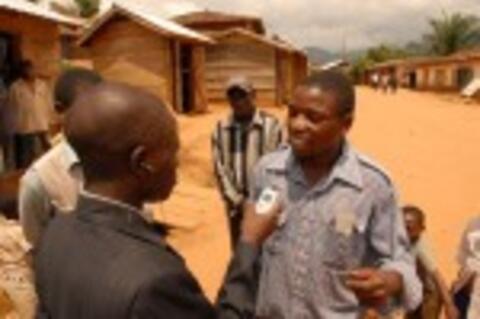
The project includes a number of radio programmes designed for different audiences and around various themes. Programming is produced in French, Swahili, and Lingala and is broadcast over community radio stations throughout the region. The base series involves discussions with studio or remote guests, such as prosecutors and defence lawyers from the ICC, judges, local police, and representatives from non-governmental organisations (NGOs). Other programmes include:
- Debating for Justice;
- A Child: Yesterday in the Bush, Today Part of the Community;
- Our Reconciliation;
- Our Dialogue for Peace and Justice; and
- On the Track of Justice.
Each episode of another IRfJ programme series, Justice Magazine, focuses on a different justice or human rights topic. The first programme in that series explored the rights of those who have family members and loved ones held at the Bunia prison. The series, which includes 10 programmes as of September 2010, is designed to address human rights and justice concerns voiced by listeners through a multi-genre production, using drama, commentary by listeners, and responses by a justice official who is invited to the studio.
For most of the programmes, the producers record questions from ordinary people and then put them to DRC authorities or representatives from the ICC, which is carrying out investigations into serious human rights abuses in the area. To facilitate this process, the radio station has set up 6 listening groups, which get together to listen to the programmes and discuss their questions on justice. The station tries to send journalists to these meetings on a regular basis to record questions for the programme. However, as the area is so vast, it is not always possible to send a journalist to every meeting. In this case, people can send short messaging service (SMS, or text messages) with their questions; a journalist is sent at a later stage to record their questions. The station's staff sorts out all the questions and decides who the most senior official would be to answer each question. Interactive Radio for Justice works on the principle that every question recorded gets an answer on air. According to the producers, the power of the programme is that everyone gets to hear the authorities' answer, and this gives it legitimacy.
The project also involves the production of original music around the following themes: respect for the rule of law; sexual violence, a crime; the future for youth after war; and reconciliation and peace. The songs are written in French, Swahili, or Lingala and are distributed free of charge on CD, as well as broadcast during all IRfJ programming. In September 2010, IRfJ produced its first Music for Justice CD in CAR. Click here to listen to and download songs from the first two CDs.
Peace, Reconciliation, Human Rights, Justice
IRfJ website and Radio Netherlands Worldwide website on December 11 2009; and email from Wanda Hall to The Communication Initiative on September 17 2010.
Comments

I am very much intersted in the project and want to be involved
Dear friend, i am a journalist and a human rights defender working with jurical clinic project in the province of Bas-Congo but working very hard to promote justice to voiseless specialy farm women who are violated everyday and those without defence so i would like to get involved in your work.
Each episode to another IRfJ
Each episode to another IRfJ program series, the magazine of Justice, focused on different judicial or human rights issues. In the first of a series program, discusses the rights of those who have family members and loved ones to be held in Bunia prison. This series of products, including 10 programs as of September 2010, aimed at addressing human rights and the audience of the administration of justice, drama, reviews, the audience and the response by more than one type of production, use, and judicial officials, were invited to studio. obd2 code reader
- Log in to post comments