










































Southern Sudan Interactive Radio Instruction (SSIRI)

The SSIRI programme for primary schools teaches English literacy, indigenous language literacy, mathematics, and life skills such as health topics, peace education, and mine awareness. It aims to complement the teacher's work in the classroom. The project staff says that the programme functions like another, skilled teacher in the room. It has the dual goal of promoting new teaching strategies for the teacher, while also leading the children in exercises that support active learning, reinforce key concepts, and make learning fun.
The lessons use a combination of games, songs, and stories to introduce educational content. In the programmes, a radio teacher named "Madame Rhoda" instructs the classroom teacher to invite participation by having students answer questions aloud and write on the chalkboard or, in lieu of a chalkboard, in the dirt. A cast of five additional radio characters leads other exercises where students sing songs and respond aloud to questions or statements. The broadcasts also instruct teachers to include girls and boys in the activities equally, which, according to the organisers, is a significant departure from traditional classroom practice.
For the participating schools and adult learning centres, the project provides radio broadcasts, solar-powered and wind-up radios, teachers' guides, and initial training for teachers. In addition, the project has a cadre of outreach coordinators who train teachers on how best to use and care for the radios and to integrate the programmes into the school day. The project has also developed basic monitoring and evaluation tools to track the impact of the programmes, such as attendance sheets, classroom observation forms, and pre- and post-tests for pupils.
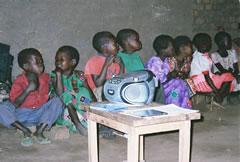
The programmes are broadcast on FM stations throughout Southern Sudan. In addition, for those located in areas that cannot receive the radio broadcasts, EDC and the Ministry are delivering the programmes using digital devices ranging from MP3 players to boom boxes using solar panels or hand-cranking devices to recharge batteries. Over 90,000 children (June 2010) receive the programmes in six states in southern Sudan as well as Blue Nile and Southern Kordofan. In addition, over 300,000 youth and adults receive the English and primary school programmes in their homes.
Education.
The programme aims to reach schools, often with no classrooms or desks, and to support the great majority of teachers who are not trained. According to the organisers, "In some parts of southern Sudan, school consists of one teacher, 80 students, and the shade provided by some trees. In others, children gather for school in a small hut or 'tukul' made from mud bricks and thatch, with no electricity or running water. Teachers might have chalk and a chalkboard, but books, paper, and pencils are rare."
Ministry of Education, Science and Technology, United States Agency for International Development (USAID).
IID of the EDC website on February 16 2007; email from Athanas Mwamba to Soul Beat Africa on September 22 2008; EDC SSIRI website, accessed on August 6 2009; and email from Richard Trewby to The Communication Initiative on February 27 and September 1 2010.

- Log in to post comments