










































Practicing Democracy
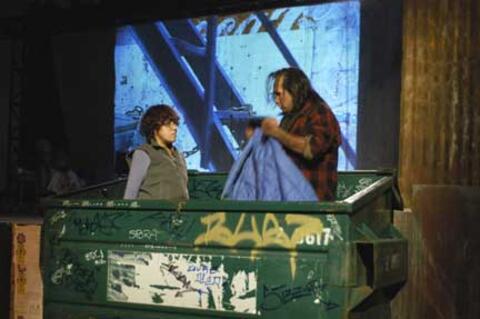
Practicing Democracy used theatre as a strategy to address this question: how can the city of Vancouver respond to the results of cuts to welfare? The idea was to create opportunities for participatory democracy through creative, community-based dialogue involving those most affected by this particular issue. Community participation was central to the project. In April 2003, organisers presented a list of 4 possible broad topics to the public for their input. These topics were purposefully vague so that people living the issues of the welfare cuts could come together, and - within the general subject matter - define what the cuts really meant from their own perspectives (rather than from the "executive artist's" perspective).
In February 2004, a group of 30 citizens gathered for a weeklong "Theatre for Living" workshop. Prior to the start of the workshop, organisers interviewed all the participants and, from those interviews, decided on a cast that is diverse and representative of the city. All workshop participants were paid to participate. Theatre games and exercises were used to explore how the issues affect the lives of the participants, and to form the subject matter of the play. Using this material, the cast and Artistic and Managing Director created a short play (10-20 minutes in duration) over a 3-week period. Touring in community halls throughout Vancouver, the play told a story in which characters are struggling with the fallout of the welfare cuts. Community organisations involved in the issues under discussion worked with Headlines' staff to promote the theatre events in their community spaces.
Audience participation was central to the production itself. The play was performed once, all the way through, so that the audience could see the situation and the problems presented. The story built to a crisis and stopped there, offering no solutions. The play was then run again, with audience members able to "freeze" the action at any point where they saw an incident of oppression, or a character engaged in a struggle. An audience member yelled "stop!", came into the playing area, replaced the character he or she saw struggling against the problem, and tried out his or her idea. Organisers call this an 'intervention'. Part the role of the Joker (facilitator) was to focus the audience on areas that are within the jurisdiction and power of the City of Vancouver. Organisers worked with community media to create an interactive web/telecast. In order to extend the reach of the performances, and therefore the public input, people in Vancouver who were unable to attend the play could participate in interventions using telephones or the internet. People could call in from home or enter the Headlines Theatre website to talk or cyber-chat with an actor, who would then run into the theatre and do the intervention on their behalf.
A legal expert documented the interventions, collated them, studied them, and translated the desires at the core of the actions into legal language. The resulting paper, which calls for the creation or revision of civic legislation around the issues under investigation, was presented to City Council and participating agencies in April 2004. The Council agreed to consider this input as part of their deliberations.
Participatory Democracy, Poverty.
"Theatre for Living" is based on the work of Augusto Boal, the Brazilian creator of the "Theatre of the Oppressed". In 1997, Boal became a Vereador (city councilman, assemblyman, alderman) in the District of Rio de Janeiro. As part of his agreement to run for office, he took his entire theatre company into office with him, and together they developed Legislative Theatre. Groups around Rio (from street cleaners to blind people) created plays on issues of importance to them. Through this interactive process, they suggested laws that might be passed to improve their lives. Boal then took these laws to the Chamber and proposed them; in this way, 22 laws were passed over 2 years. As Boal writes in his book, Legislative Theatre envisions citizens not as mere spectators to the actions of elected officials; rather, the idea is that electors should give their opinions, discuss the issues, advance counter-arguments, and share the responsibility for what their elected officials do.
Headlines Theatre, City of Vancouver.
Email from David Diamond to The Communication Initiative on September 19 2003; and Practicing Democracy page on the Headlines Theatre website, November 6 2009.

- Log in to post comments