










































Small Children, Big Cities
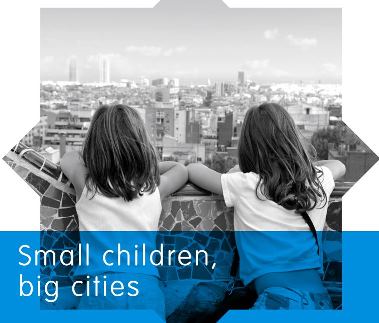
"This edition of Early Childhood Matters brings together articles from India to the Netherlands and the United States, exploring issues ranging from playground design to the effects of noise and crowding, 'public parenting' as the middle classes reclaim urban spaces, and ways to get children's voices heard in urban design decisions."
In this issue of Bernard van Leer Foundation's Early Childhood Matters, editor John Cary considers: "How to connect abstract policies to the daily experiences of children, caregivers and parents? How to move the needs of children further into the mainstream of discussions about urbanisation? And how to involve children themselves, tapping the fresh thinking and creative energy of urban youth? Where their governments, schools and parents fail them, children themselves often innovate surprisingly effective and powerful responses." Its publication coincided with a conference held by the Bernard van Leer Foundation in New Delhi, India in November 2014, in partnership with India’s National Institute of Urban Affairs (NIUA). Below are the articles and authors with Cary's comments on the content:
- Small children, big cities - John Cary
- 'People who grow up in a city that cared for them are more likely to care for their city' - An interview with Jagan Shah, Director of NIUA, discussing the philosophical implications of making cities child-friendly "'as a way to inculcate in young people the responsibility and reciprocity on which all democratic societies ultimately depend'. As he says, explaining why child-friendliness is an objective that interests his organisation so much, it 'cuts to the heart of many overlapping problems and doesn’t just benefit children'." Urban spaces like public libraries and parks can expose children to nature, diversity, and literature.
- The enduring legacy of playground designer Aldo van Eyck - Katie Crepeau discusses the legacy of Aldo van Eyck who designed and built over 800 playgrounds in Amsterdam, Netherlands. She "spotlights two present-day initiatives in the same vein, focused on reintroducing play as critical to child development..."
- 'Families are beginning to reclaim city centres' - An interview with Lia Karsten, who "observes that 'children used to be seen as resilient, whereas today they are primarily seen as vulnerable'. She discusses public places as places for "public parenting."
- The Bureau of Re-Funification - An interview with Andrew Slack, who "extends ...themes of play and children’s involvement in reclaiming urban spaces, describing an experimental ‘Bureau for ReFunification’ that he and a group of young people piloted in Washington, DC, [United States] as part of a Smithsonian Institute initiative." Slack "practises what media scholar Henry Jenkins has coined 'civic imagination', empowering children and adults alike with the capacity to imagine beyond the status quo", for example, he encourages civic action through his global Harry Potter Alliance.
- 'Cumulative risks need comprehensive responses' - An interview with Gary Evans, whose topic is 'learned helplessness' - a phenomenon in which, "in the words of Gary Evans, ‘once you conclude there’s nothing you can do about an adverse stimulus'..."
- Human-centred design and the need for new ideas - Marika Shioiri-Clark "details her work in India, Nigeria and elsewhere to directly engage women and girls. As she puts it, 'you come up with ideas by meeting with real people and understanding a broad picture of their lives, what barriers they face, and where there are opportunities to make things better'."
- Blueprints for hope: engaging children as critical actors in urban place making - Deborah McKoy, Shirl Buss, and Jessie Stewart "point out that ‘while [young people] are willing and able to contribute meaningful insights about the places where they live, they are rarely involved in community redevelopment visioning and design processes.'"
- Designing spaces that users can define - Monica Chadha considers unexpected restrictions when "urban planners [fail] to avoid being overly prescriptive as they design public spaces for children.
- 'Interventions must be low-cost, low-tech, and paired with a public health message' - An interview with Peter Williams who "looks at the intersection between urban design and infectious disease. From tuberculosis in London to diarrhoea in Bangladesh, what needs to be done is well understood; the key to making it happen is to understand the interplay among local stakeholders and what resources can be leveraged."
37
Early Childhood Matters website, December 1 2014. Image credit: Photo: ©iStock.com/Maica
- Log in to post comments