










































Reflect ICTs Project (India)
- strengthen Collective Action for Drought Mitigation in Bolangir (CADMB) to enhance the impact of actions at the district level;
- complement existing information channels - newsletters, posters, cultural groups, radio, and video - with the aim of providing thorough and accessible documentation and dissemination of village plans and collecting traditional knowledge on drought early warning, coping mechanisms, and crops;
- strengthen micro-macro linkages for policy advocacy, challenging government policies with information from the ground;
- facilitate communication between Reflect circles to enhance identification of common issues and to stimulate collective action;
- diversify the types of information available within Reflect circles and network. A district-level resource centre, linked in to block-level structures, will provide information to be sourced and translated both from external sources into Reflect circles and from the village level outwards;
- build capacity to use and manage ICTs and information resources; and
- influence other projects and partners through issue-based networks and dissemination of learning through pilot processes.
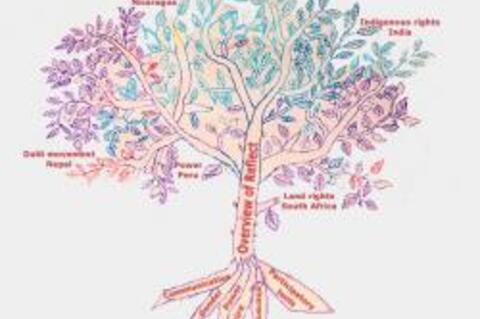
The central project strategy is building on the work of existing community-based discussion circles in an effort to enhance the capacity of people to make strategic choices about the media of communication most relevant to them and the technology they need and use. Reflect is an approach to adult learning and social change used by over 350 organisations in more than 60 countries.
As the first step, coordinators were selected to lead the effort to train Reflect group facilitators. The staff structure is designed to provide continuous capacity-building support to facilitators to the end of eventually increasing provision of ICT (based on community-identified needs) as tools to bring together both facilitators and circle participants. The idea is this: By accessing relevant information through appropriate communication technology, economically poor and marginalised people would enable themselves to take action on issues that affect their lives in order to overcome chronic hunger, reduce distress associated with migration, and effect drought mitigation in Bolangir. Strengthening the literacy and numeracy skills needed to articulate one's rights to usher in good governance are key goals; communication technologies are recognised as effective strategies to empower economically poor people with information and to enable them to communicate with external stakeholders. Preliminary research and needs assessments were conducted; print media, folk media, and electronic media were identified as key tools for this population.
After a period of familiarising themselves with the work of Reflect and the CADMB, these coordination teams undertook a participatory assessment of current communication practices among Reflect circles, designed a training module for the Training Of Trainers (TOT) sessions, and conducted networking and advocacy sessions with the State Government in order to ascertain proper legislation for combating distress in migration and ensuring food security and sustainable employment opportunities for the poorest sections in Bolangir. They also visited IT kiosks established by the United Nations Development Programme (UNDP) and the United Nations Information Technology Service (UNITeS) following the super cyclone in 1999.
In May 2003, ActionAid conducted a six-day TOT workshop for the master facilitators belonging to the CADMB network. This workshop was followed by four-day field-level trainings conducted by the master facilitators and the ActionAid team for the circle facilitators in June and July 2003. Participants discussed the most effective means of disseminating information, the acquisition of information to build potential, the self-knowledge and self-respect gained through acquiring functional literacy and numeracy skills, understanding rights and how to assert those rights, and acting upon acquired information in a planned/strategic and collective manner. Several games and role-plays were conducted in an effort to explore how power centres at different levels exploit information for the fulfillment of their vested interests. Follow-up sessions were conducted; one 3-day orientation programme on Legal Literacy focused on "Distress Migration".
This analysis is intended to lead to a planning process at community level. As part of this process, facilitators will experiment with some aspects of the TOT sessions with at least one Reflect circle for one week or longer in order to feed the needs and perspectives of Reflect participants back into the design of future training modules. Strategy meetings identified future plans for the area, which included provision of ICTs to enable Reflect groups to realise their full potential and so motivate them to confront their deprivation through increased communication skills, as well as organising participants through a strong people's network from village level to district level to assert basic rights to those who can influence policy. As part of this process, choices will be made about the use of a grant for technology and staff to be provided in the second and third years. In India, the focus is on local media and culture (like radio featuring local talent). The resulting 'communications centre', or whatever materialises from the planning processes, will be monitored according to indicators and objectives set by the communities themselves.
Drought, Chronic Hunger, Distress Migration, Technology, Rights.
Bolangir is one of the economically poorest districts of India, with over 70% of the population living below the official poverty line. ActionAid India started work there in response to severe drought in 1997. According to organisers, drought is a political issue in this area. They say it is related more to the distribution and management of resources like land, forest, water, and access to food and employment, as well as to local knowledge and community participation, than it is to the amount of rainfall (which is high - 1000 mm above the annual average). Traditional coping mechanisms, including land management and distribution, types and distribution of crops, maintenance of forest resources, and types of technology used. Drought-resistant crops have been replaced by high-yield modern varieties that thrive only on the richer, wetter land and traditional drought period foods from the forest are no longer available. Even the handouts, organisers say, fall into the "wrong hands" due to corrupt practices.
After the drought, initial analysis showed a lack of local participation in planning and decision-making. Reflect was used at village level to identify the most vulnerable groups and facilitate their analysis, planning and action. Reflect circles have drawn up micro-level plans, in accordance with legal state processes, and are now working to make them happen. Due to sustained efforts by the CADMB, the reflect process (through micro planning) has been recognised by the local government as a "good practice". The current programme works through 95 circles in 400 villages, managed by CADMB.
There are estimated to be 30 NGOs working with Reflect in India, including: The Central Drought Action Committee of Bolangir, CADMB (network of 21 organisations), Adhiti, Disha, Chetna Vikas, Naz Bharat Jagriti Kendra, Singbhum Legal Aid and Development Society, Nidan, Samajik Shaikshanik Vikas Kendra, Sarbik Gram Bikash Kendra, and Yakshi. The Reflect ICTs project is funded by the Department for International Development (DFID).
Emails from Hannah Beardon to The Communication Initiative on May 19 2003 and February 6 2006; India project description on ActionAid website; and Reflect ICTs website.
Comments

- Log in to post comments