










































Soccer Aid
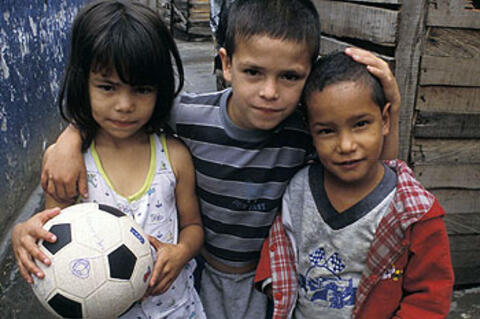
Soccer Aid drew on the widespread love of the sport of football (soccer) - particularly in the lead-up to the 2006 World Cup tournament - and the spirit of competition as a backdrop for stimulating attention to problems afflicting children worldwide. A week-long UK television broadcast was at the heart of this initiative. During a half-hour show each day, viewers watched World Cup football legends and major celebrities training, competing for a place in one of two teams ("England" and "The Rest of the World"), and finally battling it out on the pitch for the Soccer Aid title at Old Trafford (which was broadcast live).
Conceived by UNICEF UK Ambassador Robbie Williams, Soccer Aid drew on the close involvement of well-known athletes, musicians, actors, and fashion models. Soccer Aid stars John Barnes (from team "England") and Eddie Irvine (from team "The Rest of The World") joined Martin Peters (goal scorer in the 1966 World Cup England victory over Germany) and 50 volunteers from T-Mobile to launch a 250-mile charity dribble/football road-show. Furthermore, during the broadcast week on ITV, 6 PSAs were presented by singer Robbie Williams, soccer star David Beckham, actor Ewan McGregor, actor James Nesbitt, model Elle Macpherson, and actor Paul Bettany. These spots told the stories of children whose lives have been affected by HIV/AIDS, malaria, malnutrition, lack of education, lack of clean water and abandonment. For example, in a film recorded at Bernabeu stadium in Madrid, UNICEF Ambassador David Beckham spoke about the number of people who die each day from malaria: "80,000 people come to the stadium to watch Real Madrid play every week. 80,000 is around the same number of people, mainly young children, who die every single month from malaria..." All the films may be viewed online.
The use of information and communication technologies (ICTs) was also a means for involving the public in Soccer Aid, such as through a film clip of the teams' visit to Downing Street (for a reception that was hosted by Prime Minister Tony Blair) and behind-the-scenes photo galleries featuring UNICEF Ambassadors during the shooting of the Soccer Aid films. UNICEF's Soccer Aid website also featured ideas for getting involved and raising funds, such as by organising a local Soccer Aid event or football trivia quiz. Links are provided here to the Youth Voice website, which offered fundraising ideas specifically geared toward children and young people - such as a sponsored keepy-up or penalty shoot-out, or a five-a-side tournament. (UNICEF UK Youth Voice is a network of young people who support UNICEF's work through fundraising, campaigning and speaking out.) ITV also launched its own Soccer Aid website to provide details to viewers about the initiative and to facilitate donation.
Children.
Soccer Aid raised over £2 million, which was more than double the original target UNICEF had hoped to reach. Individual contributions from the British public accounted for £1.2 million (viewers participated in donation via competition phone lines and text messaging). Funds raised by Soccer Aid will support specific projects which are run by UNICEF and delivered with its partners, including:
- Protecting children against malaria on Sebang Island in Aceh province, Indonesia - UNICEF along with CARE International and Save the Children Fund have distributed 15,000 insecticide-treated mosquito nets to families at risk of malaria. Research found that the rate of infection had dropped by 72.7% just one month after distribution.
- Looking after children orphaned by AIDS in the Imsimbi, Illovo and Bhekawandle communities of Umbumbulu, South Africa - UNICEF and the National Association of Child Care Workers (NACCW) are working to protect orphaned children through "Isibindi; Circles of Care". As part of this project, 17 community members were trained to work daily with families in their homes by helping with food preparation, supervising homework, facilitating grief work, promoting healthy practices, teaching life skills, growing food gardens, fostering access to grants, and ensuring that children are enrolled in schools.
- Helping ensure girls go to school in Zambia - UNICEF and Oxfam support "Parent School Community School Committees", through which parents and local community groups come together in support of their local schools, by giving them hardware such as desks, learning materials and computers or by providing teacher training.
- Providing families in Mozambique with clean water and adequate sanitation - UNICEF and Water Aid support the government in improving the provision of clean water and good quality sanitation by increasing the number of water pumps and the amount of technical equipment available, as well as by running education campaigns to increase public understanding about the importance of clean water and to promote the teaching of hygiene to children in school.
- Making sure children receive enough of the right foods in Malawi - Together with Concern Worldwide, UNICEF in Malawi is supporting feeding centres in 19 districts and treating around 4,000 severely malnourished children a month. They also reach out at community level through the Community Therapeutic Feeding programme.
- Preventing children from being abandoned in Ukraine - Working with the UK-based organisation Hope and Homes for Children, UNICEF is supporting the Kherson Mother and Child Centre, set up to protect children from being abandoned early in their lives (0-3 years) through psychological, social and medical assistance as well as the promotion of close relations between mother and child. Since September 2003, the Centre has prevented 116 cases of child abandonment.
UNICEF and ITV, with support from T-Mobile.
Comments

- Log in to post comments