










































Kenya Equity in Education Project (KEEP)
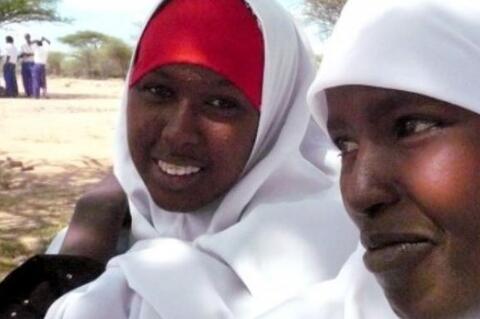
KEEP is working in 75 primary and 14 secondary schools in four communities in and around the Dadaab and Kakuma refugee camps to improve girls access to education by creating girl-friendly school environments (i.e. separate latrines for girls to ensure privacy and safety) and fostering parental and community support for girls' education. With its aim to increase female enrolment in schools, KEEP is supporting girls financially with scholarships as well as with school materials such as uniforms, solar lamps, and sanitary products. KEEP is also providing remedial tutoring for girls to help improve performance and confidence.
The project strategy also considers the continuous involvement of parents and the wider community as absolutely essential to their work, and so KEEP is also collaborating with experts in the field of social change and community mobilisation to generate support for girls' education through using participatory social media campaigns (including through SMS, radio, and films) to share information and generate discussion on girls' education. In collaboration with Farm Radio International, KEEP has partnered with Dadaab FM on a radio campaign to generate parent and community support for girls' education in these four communities.
Another project approach is to engage with men and boys to addressing gender issues. As well, KEEP intends to work with role model individuals who have attended university in Canada to feed back their experiences into the wider community and to be a leading example and motivation for female students in the area.
Girls, Education, Refugees
The KEEP project builds on previous work by WUSC to promote girls education. In 2008, with the support of 60 Million Girls Foundation, WUSC and WTK piloted a girls' education initiative which focused on remedial education courses. "Thanks to the after-school courses, girls were able to catch up on their homework and become more confident in their abilities. With the funding from 60 Million Girls and BPRM, WUSC and WTK were able to learn lessons and build the evidence base necessary to attract additional donor support."
Center for Educations Innovations website, WUSC website, and Farm Radio website on January 18 2016.
- Log in to post comments