










































Mapping Tool: Planning and Measuring Nutrition Interventions for Behavior Change
"While it is challenging to measure behavior change, this is a critical undertaking to track progress and understand why and how change happens to inform current and future projects."
Developed by the Independent Evaluation Group (IEG) of the World Bank Group, this mapping tool aims to helps users plan and track behaviour change efforts to improve nutritional outcomes. It offers examples of behavioural objectives and indicators to measure change across the following determinants: food and care; health services; water, sanitation, and hygiene (WASH); and social norms. It was designed for use by development practitioners managing nutrition and other social programmes seeking guidance to:
- Identify the main actors that require behaviour change support - e.g., mothers of children under 5, especially in first 1,000 days; husbands and mothers-in-law; opinion leaders, community organisations and volunteers, and the local population; and frontline extension and outreach workers.
- Plan interventions along the results chain that are expected to influence needed behaviour changes:
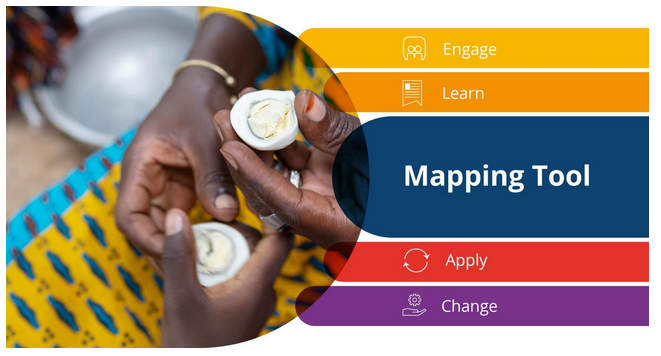
- Engage: Actor gains adequate awareness and motivation to develop new capabilities.
- Learn: Actor develops new knowledge and skills for changing behaviour.
- Apply: Actor draws on available resources and programmes to support behaviour change.
- Change: Actor consistently supports change in determinants of undernutrition.
- Track and measure behaviour changes in the main actors to improve nutrition determinants (e.g., social norms) and make needed course corrections to ensure programmes and projects are on track. For instance, a process map extracts evidence on behaviours of actors along the results chain, outlining the actions needed to improve nutrition determinants. Relevant actions can be supported by nutrition programmes and projects to facilitate behavior change in a country context.
According to IEG, the approach outlined in this mapping tool can also be applied to behaviour change programming beyond nutrition.
Editor's note: The behaviour change mapping tool is based on evidence from an IEG evaluation of the World Bank's support to reducing child undernutrition. The evaluation recommends that country programmes increase their focus on behaviour change and social norms through lending, analytical work, and measurement efforts. A December 2 2021 webinar, in English and French with simultaneous translation, features highlights from the evaluation and a discussion with current and former leaders of multi-sector nutrition programmes. Click on the video below to watch the webinar in English, or click here to watch it in French.
English; French
14
"How Does Nutritional Behavior Change Happen? A Tool to Help You Apply the Lessons", by Jenny Gold and Mercedes Vellez, IEG, February 14 2022. Image credit: IEG
- Log in to post comments