










































Grandmothers Project - Change through Culture: Program for Girls' Holistic Development Qualitative Research Report
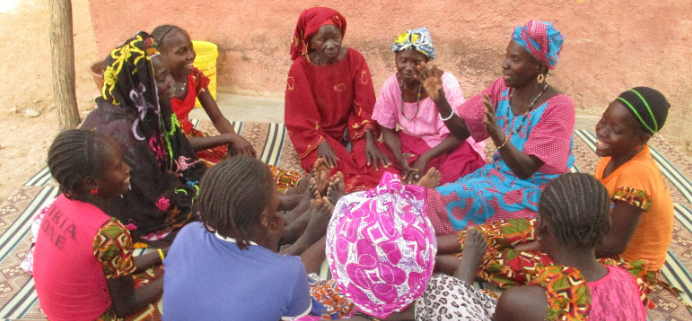
"...it [the programme] started by going to the roots of the problems in order to solve them." (Father, Koumera)
Senegalese societies, like societies around the world, are characterised by hierarchical structures that define social obligations and accord power and rights to some family and community members over others. This authority can include the right to make decisions about boys and girls schooling and marriage, for example. Among the Peuhl communities in Senegal, elders hold a special place in society as custodians of wisdom, knowledge, and tradition that they pass from one generation to another in order to protect and promote the well-being of children and communities. It is through their actions to preserve tradition, social relationships, and customs that these elders preserve and protect themselves and their identity.
The American and Senegalese non-government organisation (NGO) Grandmothers Project (GMP) started working in Vélingara, Senegal in 2008. In this region, girls have limited voice in decisions related to their own education and marriage. GMP seeks to improve adolescent health and well-being by promoting certain cultural values and practices. GMP promotes change in social norms that affect girls well being by building on existing cultural values, defined age and gender roles, and social dynamics. GMP's Girls Holistic Development (GHD) approach involves working with grandmothers as change agents to uplift their previous respected and influential role in society and to build relationships between adolescents and grandmothers. Implemented in rural and urban areas in Vélingara, GHD seeks to empower girls and create an enabling environment where family and community actors support change related to girls' education, child marriage, extra-marital teen pregnancy, and female genital mutilation/cutting (FGM/C).
GMP's Change Through Culture methodology uses an inclusive and participatory approach that engages adolescents, parents, elders, traditional community and religious leaders, local health workers, and teachers in various dialogue-based activities to strengthen relationships and communication - both between generations and between men and women. The aim is to increase social cohesion between community leaders and members, a prerequisite for collective action for girls.
The intervention begins with a quick assessment of the roles, cultural values, traditions, and communication within the community, followed by a series of participatory and bottom-up activities that aim: to strengthen social cohesion and cultural values (e.g., via inter-generational forums, Days of Praise of Grandmothers, and training of grandmother leaders); to foster the holistic development of girls (e.g., via discussion sessions between women, girls, and grandmothers and girl-grandmother "under the tree" non-formal education sessions); and to reinforce positive cultural and educational values and teachings (e.g., via teacher-grandmother workshops, grandmother presentations to classes, and books on positive cultural values).
This report shares the findings of a qualitative study carried out by the United States Agency for International Development (USAID)-funded Passages Project to understand the contextual characteristics and mechanisms of change that influence whether and how GHD achieves its objectives. The Passages-GMP collaboration began in 2017, when GHD was beginning an expansion into seven villages in Vélingara. This presented an opportunity to assess GHD impact using a mixed-method, quasi-experimental design to explore how norms change processes work. The qualitative study consisted of in-depth interviews (IDIs) and focus group discussions (FGDs) in each site, with very young adolescent girls (VYAs) aged 10-14 years (16 IDIs; 4 FGDs), grandmothers that represented leaders in the community (16 IDIs; 4 FGDs), mothers and fathers of VYA (16 IDIs; 4 FGDs), and community leaders and influential community members (4 FGDs).
Key results (quotations below are drawn from the text of the report):
- Community view and perception of the GHD approach: Interviewees expressed their enthusiasm for the GHD approach, as "created space for discussion and to have their opinions heard. They noted the value GHD placed on local cultural roles and traditions and described this as an entry point for establishing community trust in and engagement with the GHD team. They compared the GHD approach to other interventions that impose foreign values and do not consult communities on their project approach....Many participants described the approach as a platform for the community to discuss problems, including norms and practices that are harmful for VYA and to identify their own solutions through consensus building, for example, on how to prevent child marriage. According to interviewees, decision-making in both families and communities has become more inclusive, more participatory, and more gender-equitable."
- Changes in relationships in families and communities: "Adolescents, parents, and grandmothers frequently stated that the GHD dialogue approach has improved various facets of relationships and communication within families and communities. They particularly pointed out increased understanding in families between parents and adolescents, guided by mutual respect and the use of more open, non-violent communication even when there is disagreement. Fathers have changed their approach to decision-making and now listen to the opinions of other family members, including VYA" on subjects such as girls' schooling and marriage. "Girls stated that they now have more confidence to express themselves, and to advocate for their desires, and that their fathers consider their opinions before making decisions on their behalf..." The intervention reestablished the traditional role of grandmothers as counselors, advisors, and guardians of history and culture. Through the project, grandmothers "reported feeling more confident in their relationships...feeling more valued and able to contribute" to girls' and community well-being. As theorised by the project, as relationships between girls and grandmothers strengthened, grandmothers "...used this newfound role to advocate for girls...[R]elationships...have been strengthened through the intergenerational dialogue."
- Changes in social norms and behaviours:
- Child marriage: "As communication increased across age and gender groups due to GHD, mothers, fathers, grandmothers and girls described having conversations about when and to whom girls should marry....Grandmothers and girls formed closer bonds and were able to discuss girls preferences related to marriage, education and their lives. Grandmothers became advocates for girls, speaking with her parents and others on her behalf and girls became more vocal....Fathers maintained their role as final decision makers, but many now listen to grandmothers, mothers and girls...and in many cases to shift their decision accordingly. Through participation in GHD, grandmothers stated that the community perception and practice of child marriage is changing for the better (towards delayed marriage), with many people raising concern of reproductive health risks associated with girls' pregnancy at a young age..."
- Extra-marital teen pregnancy: "....Previously, many girls were married at younger ages and did not complete their schooling. One driver of this was parental concern for girls extra-marital teen pregnancy; early marriage helped prevent this situation. As parents started to send girls to school, concern for extra-marital pregnancy increased. At the same time, grandmothers, in their close relationship with girls, encouraged girls to spend more time at home, after school and in the evening, rather than socializing. Parents expressed relief in a perceived decline in early pregnancy with girls increasingly continuing their schooling and postponing marriage."
- Girls' education: "Due in part to GHD activities and a national government campaign to keep girls in school, many parents, grandmothers, and girls described support for the idea that girls should complete their schooling and wait to marry when they are older. Parents described their own transition from dismissing school as unimportant and not necessary for girls to seeing the value of girls' education as a road for them to have access to better jobs and income. As a result,..some mothers have decreased domestic tasks assigned to their daughters to allow them to have more time for studying."
- FGM/C: "When asked about FGM/C in the community, some participants noted that FGM/C had started to decline as people were concerned about the negative consequences of FGM/C. Though this project cannot confirm whether there was a decline in FGM/C, especially as it takes place at much younger ages in this region, the study did show a shift in attitudes related to FGM/C with participants noting the health risks associated with FGM/C. By working across generations with men and women, GHD engaged both those who influence decision-making on FGM/C - men, religious and community leaders - and those that participate in or conduct FGM/C ceremonies - grandmothers."
Based on the findings, the report offers recommendations for GHD (and other programmes), going forward. For example, the results highlight that change (in terms of girls' well-being and fostering greater collective accountability for their welfare and development) is more likely to occur when:
- A range of community stakeholders are engaged, with emphasis on dialogue among elders (grandmothers), girls, parents, and decision-makers (community leaders, school officials, etc.).
- The approach is grounded in local culture, so that community members can see themselves and their culture valued.
- Social cohesion is built, allowing for collective decision making that benefits girls' development and well-being.
- There is a focus on strengthening intergenerational and gender relations.
Click here for the 55-page report in English in PDF format.
Click here for the 67-page report in French in PDF format.
Institute for Reproductive Health, Georgetown University website, May 5 2021; and email from Anjalee Kohli to The Communication Initiative on May 14 2021. Image credit: GMP
- Log in to post comments