










































Adaptation Learning Programme for Africa (ALP)
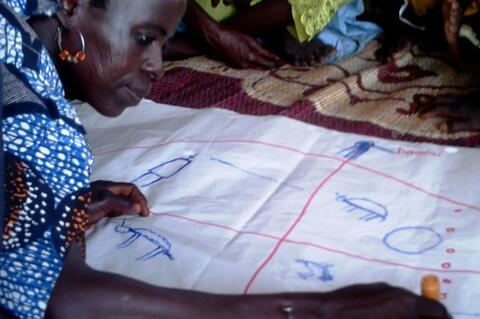
In order to achieve its objectives, the programme will: develop and apply innovative approaches to community-based adaptation (CBA) to generate best practice models; empower local communities and civil society organisations to have a voice in decision-making on adaptation; promote best practice models for CBA among adaptation practitioners; and influence national, regional, and international adaptation policies and plans. Learning from the programme will be shared with policymakers and adaptation practitioners across Africa and globally.
The ALP will build on CARE's people-centred approach to adaptation, which combines strategies from CARE and other organisations' development experience with scientific knowledge on climate change. The approach is focused on building adaptive capacity at the household and individual level by increasing resilience of livelihoods and reducing disaster risks, particularly for the most vulnerable groups. Advocacy and social mobilisation to tackle the underlying causes of vulnerability are key elements of the strategy. The approach also recognises the importance of an enabling political and institutional environment for local action, and prioritises capacity development for local actors, as well as engagement in local and national governance to facilitate adaptation.
In order to effectively empower communities and civil society organisations in decision-making on adaptation, CARE will partner with local stakeholders to facilitate a participatory and inclusive approach to local planning, in particular to ensure the views of economically poor women and other marginalised people are incorporated into key decisions related to adaptation.
To demonstrate models of best practice for CBA that can be scaled up and replicated across a range of climate and socio-economic contexts, ALP will use learning networks and other approaches to disseminate these models. Through ALP, CARE will promote the adoption of these best practices by civil society and government institutions across Africa and globally.
The hope is that the knowledge, capacity, and networks generated by the ALP will help to identify the most efficient and effective ways to enable adaptation by the most vulnerable. The programme will use these experiences to inform policy recommendations on adaptation funding mechanisms and community-based approaches at international and national levels. This will provide openings for other civil society organisations, local government institutions, and communities to access the resources required to take action on adaptation.
Climate Change
According to organisers, people in sub-Saharan Africa are very vulnerable to the impacts of climate change. The continent is already prone to erratic rainfall, droughts, floods, and cyclones, and climate change will only exacerbate these ongoing challenges. At the same time, Africa is grappling with the burden of poverty, environmental degradation, inequitable land rights, heavy reliance on the natural resource base for livelihoods, and the HIV and AIDS epidemic - all of which limit the ability of people and institutions to adapt to climate change at the community level. Research conducted by CARE in Africa indicates that climate change is already having significant impacts on food and income security, and that these impacts are particularly serious for women and other marginalised groups.
Care, United Kingdom Department for International Development (DfID), Ministry of Foreign Affairs of Denmark, and the Ministry of Foreign Affairs of Finland.
CARE's Adaptation Learning Programme for Africa [PDF] on July 27 2010; and ALP website, November 5 2012.
- Log in to post comments