










































ALIV[H]E: Action Linking Initiatives on Violence Against Women and HIV Everywhere Framework
"Despite the growing body of evidence on preventing VAW and HIV, there remains limited practical programmatic guidance on how to integrate and operationalize this evidence, either programmatically or within national policies."
The Action Linking Initiatives on Violence Against Women and HIV Everywhere (ALIV[H]E) framework provides a step-by-step approach to developing an effective programme, including a monitoring and evaluation (M&E) framework, for implementing and evaluating violence against women and adolescent girls (VAW) and HIV responses. It is the product of a partnership between the Salamander Trust, the Health Economics and HIV and AIDS Research Division (HEARD) of the University of KwaZulu Natal, the AIDS Legal Network, the ATHENA Network, and Project Empower. The framework was piloted by organisations in five countries in sub-Saharan Africa and one in India, and, through an iterative learning process, their experiences informed its development.
This framework is about the need to, and how to, strengthen and expand the evidence base to include the voices and priorities of those most affected by VAW and HIV at the community level. "Meaningful participation of those most affected by VAW and HIV in the development of effective responses lies at the heart of this document. It is both a human right and of strategic importance; only through personal experience can people gain insight into the challenges they face, including potential opportunities for improving them."
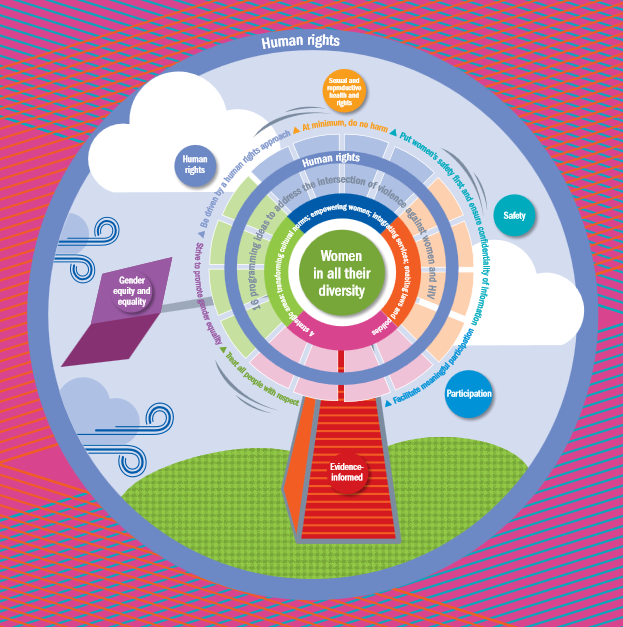
The Joint United Nations Programme on HIV/AIDS (UNAIDS) is supporting the development of this applied research implementation framework in an attempt to provide practical guidance on the "16 ideas wheel", which was created by the World Health Organization (WHO). At its centre is the recognition that: gender inequality is a determinant of VAW and HIV; VAW is an indirect factor for HIV risk; sexual violence is a direct factor for HIV; and violence as an outcome of HIV status and HIV disclosure. The wheel highlights 16 programming ideas (e.g., social norms marketing/edutainment or behaviour change communication campaigns) clustered under four strategic approaches to address the intersection of VAW and HIV (see Annex 2 for details).
The framework is structured in three parts, containing four sections, seven steps, nine actions, and eight annexes. It provides a step-by-step "staircase" approach to developing a clear programme for implementing more effective VAW and HIV responses, taking the reader through the planning and M&E stages. It is designed to be completed using a participatory, group-based approach, drawing together community members who are interested in and able to work towards strengthening programming around VAW and HIV. All the steps and actions can be completed through group discussion, practical exercises, and reflection with community members, under the guidance of local non-governmental organisations (NGOs) and community-based organisations (CBOs) leading creative and dynamic programmes to address VAW in the context of HIV. The actions in the framework could be covered over the course of a week, or participants could meet weekly for 9 or 10 weeks to cover the same content at a more measured pace.
Editor's note: Click here to access "ALIV[H]E in Action: Key Examples of the Action Linking Initiatives on Violence Against Women and HIV Everywhere (ALIV[H]E) Framework" [PDF], which Salamander Trust published in March 2019 to share key examples of how the ALIV[H]E framework has been used in different regions of the world.
95
Emails from Alice Welbourn to The Communication Initiative on November 24 2018 and March 25 2019.
- Log in to post comments