










































Capacity Building to Prevent and Respond to Gender-Based Violence: Project Description and Evaluation of RESPOND/Guinea
The RESPOND Project/EngenderHealth
This 33-page evaluation report discusses an assessment of the the RESPOND Project's work to supporting follow-up services to women who had survived violent attacks during political demonstrations in Conakry, Guinea on September 28 2009. According to the report, Guineans and international observers were shocked at the violence, including brutal rapes, that followed a political demonstration in a stadium in Conakry. The immediate response was limited and underscored the urgent need for more and better-quality services throughout the country for survivors of sexual violence (SV) and other forms of gender-based violence (GBV). The United States Agency for International Development (USAID) Guinea mission tasked the RESPOND Project with supporting follow-up services, strengthening local capacity for GBV prevention, and improving the health sector's response to SV. According to the evaluation report, despite the short time frame of the project, it was able to not only assist survivors of the September 28th violence, but also helped to improve local capacity for responding to GBV.
In April–May 2012, RESPOND collected endline data on the process, outputs, and short-term effects of the project through individual interviews and structured observations of community GBV prevention activities. Interviews were conducted with 149 stakeholders who contributed to or participated in the project, such as September 28 survivors, participants in GBV prevention activities, and health care providers. According to the report, the project vastly surpassed its benchmarks for the number of September 28 survivors whose needs were assessed and addressed, reflecting the enormous on onoing need for services following the violence. In total:
- The needs of 179 survivors were assessed (the goal was to reach 50).
- Eighty-seven received medical care related to the September 28 violence, such as sexually transmitted infection (STI) treatment, surgery for severe perineal tears, and treatment for uterine hemorrhage (the goal was to reach 20).
- Fifty survivors received psychosocial services from a psychiatrist (the goal was to reach 25).
- Social workers provided assistance to 153 survivors, to help them reconcile with family members who had rejected them after the incident (the goal was to reach 25).
- Sixty survivors received economic reintegration services, including trainings in business and vocational skills (the goal was to reach 25).
In endline interviews, September 28 survivors expressed great appreciation for the services received. The report states that a number of survivors now earn an income with the business and vocational skills they learned through the project. However, some survivors had continuing medical, psychological, social, and economic needs that the project could not fully address during its brief duration.
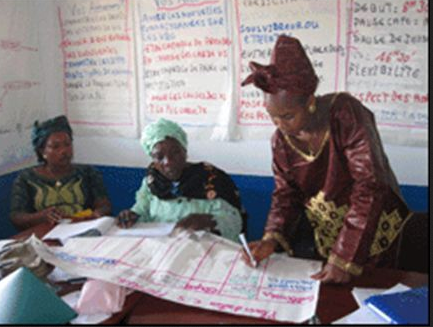
To build local capacity to prevent GBV, RESPOND trained 10 Coalition Nationale de Guinée pour les Droits et la Citoyenneté des Femmes (CONAG-DCF) trainers in the engagement of communities in challenging gender norms and GBV. The training materials built upon existing tools and approaches, including EngenderHealth’s Men As Partners® (MAP) resources. Trainers reported that the training they received helped strengthen their confidence and capacity to discuss topics that were previously taboo, make compelling arguments to prevent GBV, and lead the exercises that would be used in the committee trainings.
Local officials selected well-respected community members, men and women, to serve on GBV prevention committees, including religious leaders, youth leaders, and women’s group leaders. The 10 CONAG-DCF trainers then conducted two five-day trainings for 110 members of the 10 community-level GBV prevention committees. Following the training, each GBV prevention committee conducted at least four GBV awareness-raising sessions per month, including sermons, community discussions, and dramas. They reached a total of 8,892 men and women over a four-month period. Interviews with CONAG-DCF trainers, committee members, local leaders, and participants showed that the training and activities were highly valued and perceived as having increased discussion and openness about GBV and gender norms. Committee members came to be seen as resources in their communities for GBV survivors and for others seeking advice and referrals.
To improve the health sector response to SV, RESPOND and the Ministry of Health (MOH) conducted five-day trainings in SV response for a total of 53 health care providers, surpassing the project’s objective to train 42 providers. According to the report, both groups of trainees made gains in knowledge of SV response: Post-test scores after both trainings were at least 15 percentage points higher than pretest scores. Most providers (88%) led debriefings for the staff at their facilities to share key parts of their training. Comparisons of baseline and endline facility audit data showed that the proportion of facilities with guidelines for addressing SV increased from 43% to 95% and that the use of identification codes to protect the confidentiality of survivors increased from 0% to 90%.
The evaluation identifies the following overarching lessons learned, among others:
- Seek guidance from a multisectoral steering committee. The project’s steering committee was instrumental in ensuring that activities met locally felt needs and in earning the project credibility in country. By involving local NGOs, service providers, and ministries in the steering committee, RESPOND also reinforced referral linkages between these bodies and provided a forum for sharing ideas across sectors.
- Take a holistic approach to GBV. It is important to recognise that the interrelated needs of GBV survivors span multiple sectors. While RESPOND addressed the medical, psychosocial, social reintegration, and economic reintegration needs of September 28 survivors, they did not cover legal aid, protection services, and safe houses. A strength of the curriculum for health care providers was that it included a module on referrals to nonmedical services; however, it did not train providers to lead survivors through safety planning. The health sector response to SV would be strengthened if safety planning were added to the provider curriculum and protocols.
- Link prevention and response. The project could have been improved by linking GBV prevention and health sector activities more closely: Committee members could have contributed to providers’ action plans for improving services or could have referred survivors to specific, trained providers if they had met them through the project.
- Ensure adequate time for building the capacity of health sector and community partners. With more time and greater funding, the project could have done more to build capacity for GBV prevention and the health sector’s response to SV. Capacity building is rarely achieved through a single training event, and considerable follow-up support and mentoring may be needed to foster the knowledge and skills needed by both health care providers and community members to address GBV effectively in their respective spheres.
The evaluation also identified the following as programmatic lessons learned:
- Build leveraging of local resources into the GBV prevention committee model. All committee members said that they wished to continue conducting awareness-raising sessions, but most said that they would need continued support to do so. The support they had received was a transportation stipend, and it made a meaningful difference to them. If training had prepared committee members to secure funding or in-kind donations, their efforts would be more sustainable. Trainers should share strategies for leveraging local resources and ask committee members to include resource mobilisation activities in their action plans.
- Coordinate exchanges between committees. After the GBV prevention training, committees did not have an opportunity to learn from each other during the project. Were the project to be replicated in the future, it would be beneficial to invite committee members to attend awareness-raising sessions led by neighboring committees, learn from them, help them solve problems, and offer suggestions for improvement.
- Update and disseminate the MOH protocol on care of SV survivors. Facilities in the intervention areas adopted the RESPOND curriculum on SV care as a protocol because they lacked access to the official MOH protocol (Ministère de la Sante et de l’Hygiène Publique, 2009). The MOH and partners should update this protocol, produce copies, disseminate it to all facilities, and train facility staff in its use, to ensure that it is institutionalised.
- Expand the content of health care providers’ training. Due to time constraints, the curriculum for health care providers did not cover a number of important topics, such as: in-depth discussion of gender and GBV; how to comfort survivors and offer psychosocial support; action planning to address specific barriers to accessing high-quality care; and clinical training on how to offer medical treatments for SV survivors.
Click here to download the full report in PDF format in English.
The RESPOND Project EngenderHealth newsletter on January 17 2013
- Log in to post comments