










































Groots Kenya Mobile Phone Mentoring Strategy
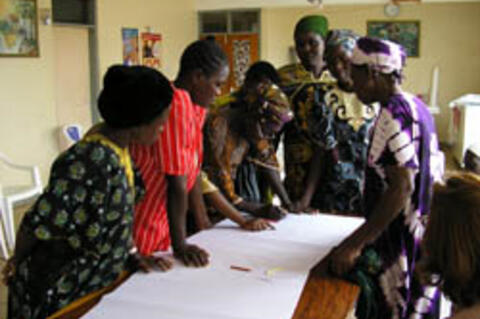
The project involves the formation of community watchdog groups, which are led by women who monitor and report any land rights violations involving women and orphans. These watchdog groups work with relevant non-governmental organisations (NGOs), government institutions, traditional leaders, and faith-based organisations (FBOs), as well as the provincial administrators through the office of the chief and assistant chiefs. According to Groots, the chiefs and assistant chiefs are the lowest government administration unit at community level and are very crucial in determining and safeguarding the rights of marginalised people in any community in Kenya. However, most of them have limited knowledge, information, and capacity to handle and/or support property disinheritance cases brought to their attention.
The mobile phone became a tool that facilitated mentoring among the chiefs from the four regions, who are being presented with unlawful land grabbing cases by the watchdog groups. Through short messaging service (SMS) and direct calls, they receive guidance and information on succession law and procedures from the chief who acts as mentor and advisor. This is complemented by the use of community radio which works to create awareness about the property rights of women and orphans in the broader community. Grassroots women and members of watchdog groups also use mobile phones to report cases of property grabbing to the chiefs, and to provide support to victims of disinheritance.
Rights, Women, Children.
According to the organisation, the increase in knowledge among the chiefs has led to a transformation of attitudes towards women's and orphans' property rights and has facilitated more efficient working methods at administrative and community levels. The use of the mobile phone mentoring strategy by Groots Kenya has led to the following achievements:
- enhanced knowledge and skills in addressing women's and orphan's property rights among the chiefs across the four regions through mentoring and networking;
- increase in resolved cases where women and orphans had lost property to relatives;
- strengthened relationships between the provincial administrators and grassroots women in the community through partnerships;
- enhanced follow-up and support of pending cases in the office of the chief and law courts; and
- a significant reduction in costs (related to travel, accommodation, and other logistics), since the regions were spread over long distances.
Although the above achievements were realised, the following challenges were experienced: high poverty levels, which hinder communities and chiefs from purchasing airtime; illiteracy, mainly among grassroots women, who are hence unable to read messages; a limited number of cell phones in communities, thus heavy reliance on those who have cell phones to access information; and a lack of formality in communication, which makes it difficult to hold any party accountable.
Most groups tried to have parallel meetings in their own different regions and tried to converse in a form of teleconferencing through mobiles. Unfortunately, the mobile phones used by many communities have no features such as speaker phones which would have enabled more than one person to listen to a call.
Affiliated Network for Social Accountability website on April 14 2008.
- Log in to post comments