










































I Care About Her Campaign
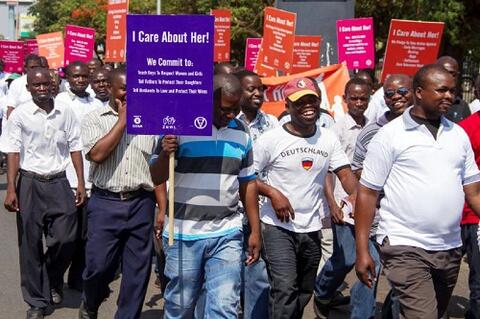
The I Care About Her project is designed to build a movement of men and women who reject violence. "It works primarily with men, as the primary perpetrators, to transform the attitudes and beliefs that perpetuate violence, while also advocating for better laws and policies to address gender inequality, better implementation of existing laws, and ending impunity for perpetrators." According to an Oxfam report (see Source below), "cultural, traditional and religious practices and beliefs all contribute towards maintaining unequal power relations which place men and boys in a position of power over women and girls. In recent years, progress has been made at national level in laws promoting gender equality. However, Zambia's dual legal system, which allows local courts to administer customary law, allows practices which discriminate against women to continue."
The project began with a media campaign which included media advertisements and billboards communicating the need for men to play a role in the fight against violence, and a series of broadcasts on national television and radio to create a platform for men to discuss and challenge their beliefs and behaviours around VAWG. In September 2013, the second season of the I Care About Her men's discussion series was launched on national TV and radio, featuring men discussing topics such as how they can support ending violence against women and girls and the impact this violence has on communities.
I Care About Her also mobilises men through public events, including marches to coincide with the 16 Days of Activism against Gender Violence and International Women's Day. Building on the interest developed through this mass mobilisation, a grassroots campaign to train men as "champions" to end VAWG was launched in late 2013. Champions are responsible for identifying a core group of men to start discussion groups. Discussions are based on 17 Community Education Cards, each of which deals with topics such as women's rights, the nature of VAWG, and common myths about domestic violence and rape. Women have formed parallel discussion groups in some communities, to raise consciousness around the attitudes that propagate violence, including their own.
Police officers are also being trained as champions, with the am of having one champion at every police station in Zambia. "These officers are responsible for attending to cases of VAWG and educating colleagues about women's rights."
The school project component of the project was officially launched in April 2014. "Discussion groups are being run in 20 schools, with plans to expand. These groups aim to educate girls and boys about VAWG and encourage them to take action to end it, and challenge unhealthy gender norms from a young age. Curriculum materials are being developed especially for schools, and school heads have requested training to support the programme."
Oxfam is also supporting local partners with capacity development, and is facilitating monitoring and evaluation. "Regular field visits and learning events allow Oxfam and partner staff to improve the programme collaboratively. Oxfam also acts as a convener, facilitating linkages between partners, larger networks and major players such as government organisations. "
Gender-based Violence
According to the I Care About Her Case Study, "51.9% of women in Zambia have experienced physical or sexual violence, and when economic and emotional abuse are included, the figure may be as high as 89%. In most cases, the perpetrators are never brought to justice." Following the start of the I Care About Her project, "interviews with men in four target districts revealed a significant reduction in reported incidences of violence against their wives and increased understanding about VAWG, as well as greater respect for women. The community groups have proven powerful accountability mechanisms, creating social incentive for men to change violent behaviours."
"The programme has also been highly successful in involving men in the fight against VAWG. 90 champions have been trained, and more and more men are asking to join the movement. Over 3,900 men have taken part in community discussion groups, thousands more have joined the marches, and the billboards and broadcast panel discussions have been effective in generating debate. The programme received an award at the Gender Links Summit in April 2014 in the category of "Alliance and Coalition Building" for its successes. "
Oxfam, Young Women’s Christian Association (YWCA), Zambia National Women’s Lobby (ZNWL), Panos Institute Southern Africa (PSAf), Women in Law in Southern Africa (WiLSA), and the Forum for African Women Educationalists (FAWEZA).
- Log in to post comments