










































Illustrated Manuals for Development Projects (IMDP)

Initial training manuals were produced as part of a research project conducted in collaboration with local farmers. That is, from 1994-1997 research was undertaken to develop a technique of producing sequences of illustrations to convey simple agroforestry practices to illiterate women farmers. Field work was based in The Gambia, West Africa; the research drew on local expertise and on wider information available on illustration for development. Agroforestry was chosen as a starting point for this work. However, organisers say, many other subjects can be developed as manuals using this technique.
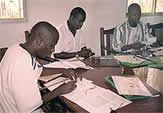
Following the research, a pilot study was undertaken to test the technique and train staff in 12 organisations in Ghana and the Gambia who then produced manuals for their own field training activities. Among the findings:
- The development of appropriate illustrations for training manuals (without text) should involve the intended user group and be locally and culturally appropriate. Guidance must be given on the method of sequencing the pictures. Only simple techniques are suitable for illustration and subjects must be avoided if they are likely to be misinterpreted, especially if this could cause harm to individuals or the environment.
- Although the skills of the artist are important, ability to understand illustrations depends on other factors, such as the client's previous experience of seeing and using pictures, practical skills, experience of the subject, ability to visualise an object or situation, and age of viewer.
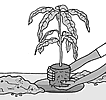
- Black-and-white illustrations provide less information than colour illustrations but are cheaper to reproduce and therefore more likely to be made available to rural women farmers. Line drawings provide information about shape but it is often difficult for a person looking at a picture to distinguish the object from the background. This task was made easier by adding shading, or blocks of colour.
- The most appropriate method of black-and-white illustration intended for photocopy reproduction is free-hand line drawing enhanced by computer graphic shading.
Organisers then began testing and adapting these techniques to suit many different organisations in developing countries. The work involved training, identifying the simplest and most effective methods of using the techniques, and promoting the results so that organisations in other counties have access to techniques and manuals. Subsequent manuals were produced by African organisations as a result of workshop training. The outputs of this research and pilot period included:
- An information Pack containing 8 simple manuals, an introduction and explanation of how to use them, and a CD-ROM of over 100 illustrations featured in the manuals (available for purchase by clicking here)
- A Training Handbook describing the technique (available for free download on the IMDP website).
- Very simple training manuals on a range of subjects (many produced by local groups) that can be viewed, downloaded from the website, and then photocopied (copyright-free). Click here for details.
The project now focusses on training and dissemination of information of the techniques and provides a growing online library of locally produced manuals. These manuals are produced i) by using information on the technique (Training Handbooks) available on the IMDP website or ii) training provided by project staff to small groups and individuals in the UK or home country.
Literacy, Agroforestry, Women.
To date, the focus of the project has been on the West African region, which contains a number of the world's poorest countries and has a high rate of illiteracy. Field work has largely addressed rural women, many of whom have low or no literacy skills but a strong drive to implement projects to benefit their community and environment. Many of these women are disadvantaged by factors that prevent or restrict their involvement, such as cultural constraints, demands on their time, and lack of access to information.
According to organisers, in many rural development programmes, field-level training is the most appropriate means of communicating new ideas and practice. Unfortunately, they say, staff responsible for conducting the training often have few resources to help them with this task and work in villages scattered over large areas. In addition, in many rural areas poverty and illiteracy are common and people have no access to appropriate reference material that could reinforce what they have learned. With insufficient follow-up to their training, details of techniques and new ideas may be confused, forgotten, or are not adapted to local requirements.
Organisers state that the IMDP techniques involve a blend of both basic and advanced technology. Groups interested in developing manuals using these techniques will need staff with a range of skills including community participation techniques and basic drawing and computer skills. They will also need access to a computer, a simple scanner, and a printer.
The Institute of Ecology and Resource Management at the University of Edinburgh. Funded by the European Commission, the Christian Initiative, and the Department for International Development.
Email from Rose Clarkson to The Communication Initiative on February 16 2004 and September 12 2004; and the IMDP website.
Comments

- Log in to post comments