










































Khabar Lahariya
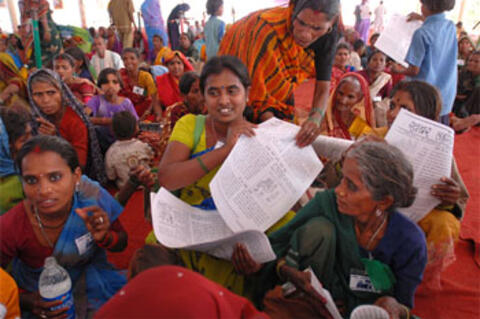
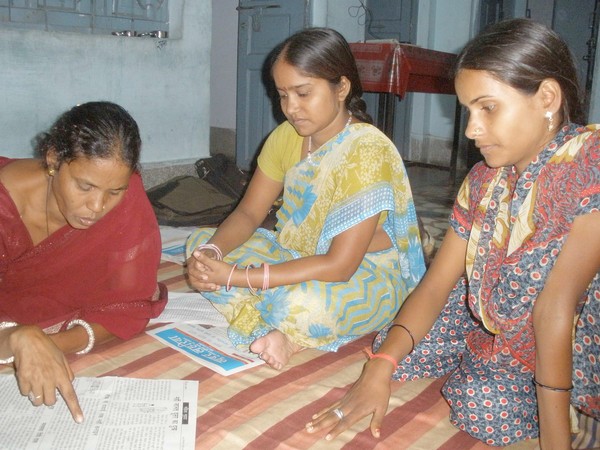
KL's collective process of production takes place over a 2-day writing, editing, and illustrating workshop. Many of the dozen or so women on staff were beaten or sexually abused as children, married off young, endured abusive marriages, and/or faced struggles in obtaining an education and/or a divorce. Considerable effort is made, therefore, to develop their literacy skills as well as to build other capacities - for instance, their ability to move around and interact with various people in the public sphere, their levels of information and understanding related to politics, and their writing and editing skills. According to KL, "Designing the journalism workshops for rural women with little exposure to mainstream media has been exciting and challenging. The workshop content has included discussions around what constitutes news, as well as the practical aspects of identifying sources of news, gathering information, validating news sources and conducting interviews. The workshops have adopted a hands-on approach, where participants gather news, do interviews and then file their stories. An exposure to different styles of writing is also provided."
Not only do the women write the stories, they edit, handle layout, proofread, and solicit ads for KL's 2 editions. Written in the local language, Bundeli, KL provides a mix of news, information, and entertainment specifically for its Bundelkhandi audience, which is rural and which has mostly low levels of literacy. The 8-page newspaper covers current political news and stories on the functioning of panchayats, the bureaucracy, schools, and hospitals in the region. Its reportage of violence against women and marginalised sections of society critiques the tendency of contemporary media to sensationalise such incidents. Specifically, there are pages on current news (Taaza Khabar), national and international news (Desh Videsh), women's issues (Mahila Mudda), panchayati raj, "news from here and there" (Mili Juli), regional news, governmental news (Sarkari), and an editorial page (Hamaar Sandesh). Recent stories included alleged bribery at health clinics, a bureaucrat reported to be siphoning off money meant for widows, and a piece on the brother of a powerful politician who built a house, blocking water that had gone to Dalit farmers nearby and destroying their livelihood. Through these types of stories, KL staff hope to help their fellow underprivileged readers know their rights, understand what government programmes, are available and teach them how to apply for assistance.
Because politics in the traditional sense is historically not a domain in which women belonging to marginalised communities have engaged, KL initially did not report on political news. When the women decided to "blank out" the Lok Sabha election because they felt under-confident and lacked information, organisers conducted a "crash course" on politics, then planned and produced 3 "election specials" with the team. The special issues contained interviews with local candidates from different political parties, as well as information and opinion pieces.
KL's objective of reaching out to villages in which other forms of information and entertainment are limited has led to its being sold not only by reporters and other newspaper agents but also at small shops and tea stalls in the block headquarters and in remote villages and hamlets. Staff members, paid between US$60 and US$140 per month, spend several days each week carrying copies to distant villages, some accessible only by hiking trails. (One 23-year-old staff member explains that "It's hard enough to reach many of these remote areas. Then you have to stay and sell the papers [for 4 cents].") In the remote communities, they pick up stories from readers or from residents petitioning for justice in courts and government offices. Thus armed, they return to their weekly editorial meeting with a minimum of 5 ideas and hash out among themselves what stories will make it into print. Other recent efforts to expand KL's reach have included increasing its periodicity (it is now a weekly publication) and registering the paper as an independent legal entity to enable the group to function as an independent production unit.
Women, Rights, Media Development.
KL's newsstand price covers less than 20% of the operation's US$67,000 annual operating budget. The difference is covered by Nirantar, a New Delhi-based civic group specialising in gender, literacy, and development issues. The group conceived of the project and believes it can serve as a model for other communities in India. In 2008 the KL group registered as an independent organisation, Pahal. Pahal is now, with Nirantar's support, finding its feet as "one of the only rural women's media collectives in the country."
Caste is a social institution that is probably here to stay, the KL women say. But they believe that, if you are educated and know your rights, people are more respectful. They claim that, as Indian society changes, affected by urbanisation and internal migration, a more liberalised economy and political shifts, the grip of this restrictive system is slowly weakening.
Disha Mullick, a Nirantar programme coordinator who helps train prospective reporters, said that the very act of doing a job at which they ask challenging questions of high officials, rich locals, and derisive politicians is empowering. Organisers claim that KL "has enabled rural, Dalit, newly-literate women to enter and transform the public arena of media and information creation, a space traditionally dominated by 'upper-caste' men....[I]t strengthens grassroots democracy and challenges gender and caste relations. Its investigative style of reportage not only makes it popular with its readers but is also important in putting in place a culture of accountability and transparency. Several reports published in Khabar Lahariya have enabled people to act and demand redress." One reporter commented on the benefits that learning how to use technology have brought: "This job has really helped me stand up and be independent," said Kavita, age 30. "A year ago, I never even imagined something like a computer or the Internet existed."
Nirantar won the United Nations Educational, Scientific and Cultural Organization (UNESCO) King Sejong Prize for Literacy 2009 for KL. Click here for details.
"India - Dalit Women Find Their Voice Through a Newspaper", Los Angeles Times, October 25 2009, by Mark Magnier - forwarded to the Women's United Nations Report Network (WUNRN) listserv on November 9 2009; and KL website, December 28 2009.

- Log in to post comments