










































Malaria NightWatch
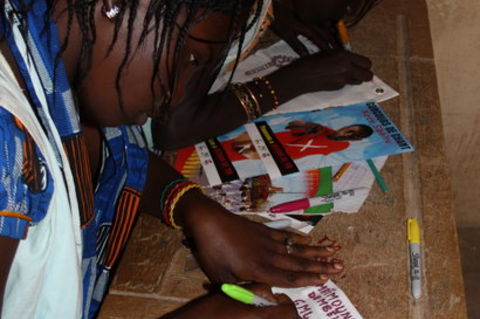
NightWatch, launched in September 2010 by Lalela Project and Malaria No More, centres on nightly reminders to sleep under a mosquito net, broadcast though 30-second radio and television spots featuring celebrities, as well as through SMSs (text messages). The reminders are broadcast at 9pm, the hour before malaria-carrying mosquitoes come out. The media campaign is complemented by grassroots initiatives, billboards, launch events, and media advocacy to re-inforce the messages. First launched in Senegal as a pilot project, the campaign rolled out to Cameroon in 2011, and plans to expand to Chad and Tanzania in 2012.
The programme was designed around the idea of "taking back the night" to create positive behavioural changes to increase mosquito net usage. In the evenings, just before the malaria-carrying mosquito comes out, organisers broadcast messages by leaders and celebrities via radio, television, and SMS to emphasise the need to consistently use bed nets. The 30-second messages provide information about malaria and ask families: "It's nine pm...are you and your family safe under your mosquito nets tonight?" The programme is similar to the American public service announcement (PSA) of the 1980s that asked parents to check on their children: "It's ten pm...do you know where your children are?"
Each country-based campaign is designed to complement on-going bed net distributions and the technical work of the government and other health partners. For example, the programme launched in Cameroon alongside the distribution of 8.7 million mosquito nets and according to Malaria No More, will do the same in Chad where 3.3 million nets are planned for distribution in 2012. By coupling NightWatch with national bed net campaigns, the campaign seeks to leverage massive investments in malaria control to make those resources more effective and national campaigns more efficient.
The strategy also includes producing creative content which is strategically designed to resonate with local populations. To ensure that NightWatch messages are relevant and effective, Malaria No More conducts research on knowledge, attitudes, and behaviours around malaria and the cultural landscape in each country. Every country is different and nationally representative surveys address everything from the appropriate message tone and knowledge gaps, to who the most trusted spokespeople are and what the most popular communications medium is. These findings, combined with the Ministry of Health’s official messaging, guide message content. Content is refreshed as net distributions enter a new phase and studies are conducted annually to measure NightWatch’s reach and behaviour change impact.
The reach and impact of the mass media campaign is further complemented by launch concerts, national malaria anthems, wall calendars or billboards featuring the messages, brand, and spokespeople of the campaign. The campaign is further reinforced by a three-step school-based curriculum designed for youth aged 12-14. First, there is a "rite of passage" where every student passes a nine-point test about malaria and net usage. Then students receive a certificate of accomplishment and pledge to use their nets. Finally, in the "dream keeper" activity, students identify their dreams and goals for the future, and draw these dreams on a dream banner. The students keep their dream banner under their mosquito nets as a reminder to keep themselves and their dreams alive.
Along with encouraging malaria behavior change, the campaign seeks to encourage public demand for malaria prevention tools and government accountability. By creating a highly visible mass media platform, NightWatch also aims to mobilise funding and engage new leadership in malaria and attract non-traditional players across the entertainment, public, and private sectors to the malaria fight.
Cultural icons who have committed to the programme include: Youssou NDour; Akon; Viviane (musicians, Senegal); BabyFace; R. Kelly; Ludacris; 50 Cent; Usher (musicians, U.S.); Yvonne Chaka Chaka (musician, South Africa); Les Nubians; Richard Bona; Lady Ponce (musicians, Cameroon); Fally Ipupa (musician, DRC); Alexandre Song (footballer, Cameroon); Papis Demba Cisse; Moussa Sow (footballers, Senegal); Luc Mbah a Moute (NBA Basketball, Cameroon), among others. According to Malaria No More, both celebrities and the private sector are attracted to a high-visibility platform that provides the opportunity to link their image with a positive, high-quality campaign while promoting the health of their communities.
Click here to listen to Youssou N'Dour's announcement on the Malaria No More website.
Malaria
According to Malaria No More, a nationally representative survey with 2,000 participants in Senegal in July 2011 showed that 58% of respondents had been exposed to a NightWatch message, and that of those exposed 74% were able to successfully recall that the message was “sleeping under a net is important" and 72% recalled that the message aired at 9 p.m., when malaria-carrying mosquitos comes out to bite. The survey also showed that exposure to NightWatch made a person 16% more likely to know that mosquitoes are the cause of malaria and 24% more likely to know that the malaria-carrying mosquito bites at night. Children whose parents heard the messages were 8% more likely to have slept under a bed net the night before.
In Senegal, 47 community radio stations were broadcasting 10 different NightWatch PSA radio spots to some of the most rural parts of Senegal. Malaria No More is also working with Peace Corps volunteers who have relations with local radio stations to franchise the NightWatch platform and spread it virally.
Lalela Project, Malaria No More, ExxonMobil, Cotco, MTN Cameroon, Tigo Senegal
Lalela website and Malaria No More website on July 2 2011 and March 6 2012, and email from Trish Delude on March 2 2012.
Comments

Malaria Observatory: MDGs-based Innovation (Congo-Brazzaville)
Malaria Response: Timely Public Health Intelligence... Today, malaria requires innovative approaches, comprehensive policies, evidence-based strategies, coordinated efforts and, not least, accountability for tracking progress (7) on key fronts - e.g. hygiene, sanitation, prevention, care and research. However, that does not mean that things can change overnight. Reorienting the response to malaria in high-burden countries is a long-time process (9), if only because of the time lag to restructure the workforce and because of the enormous inertia stemming from inadequate institutional landscapes.
At the same time, there are promising perspectives for transforming the workforce that context-sensitive policies and effective strategies require. For example, Malaria Observatories, once fully established, could, and should, become institutional reservoirs for generating that precious workforce. The challenge is, therefore, to ensure that emerging partnerships and networks of governance are:
I) Adequately inclusive of all actors and sectors (see below);
II) Responsive to local needs and demands (1,4,10);
III) Accountable, flexible and coherent;
IV) Focused on sustainable and equitable development - see Malaria Observatories: Opportunity for Development (Michel ODIKA, World Bank, Washington, 2010).
Getting started: historical and political opportunity for effective action… The project to establish a Malaria Observatory in Congo-Brazzaville (Central Africa) must be regarded as a wide-ranging opportunity in terms of sustainable and equitable development. Why? Possibly because opportunities are often the starting-point of long-lasting enterprises and, therefore, constitute a substantial part of our time on the solution...
As things now stand, Congo-Brazzaville is likely to become the world's first country to establish a Malaria Observatory (1,2,3). Thus, today the foundations exist for high-burden countries, most of them in sub-Saharan Africa, to formulate responses commensurate with the challenges of:
I) Stopping and reversing malaria (4,5);
II) Reaching and achieving most of the Millenium Development Goals (MDGs) (3,5);
III) Reducing health care costs (efficiency savings) by improving governance and leadership (6);
IV) Institutionalizing and optimizing multi-stakeholder partnerships and networks (2) operating under the supervision of a Malaria Coordinating Authority.
For the first time ever in the world, complementary partners - e.g. health professionals, environmentalists, NGOs, etc. - will be called on to work together on preparing, budgeting and implementing a country-specific Malaria Action Plan (MAP). However...
Building a critical mass of capacity for positive change (9). However, Congo-Brazzaville will initially face such challenges as:
I) Involving key stakeholders;
II) Providing basic data and strategic information (7);
III) Translating "Action Frameworks" into "Action Plans" with supporting budgets, assigning responsibilities and tasks, and, not least, allocating resources to all partners that are called on to act (4,10);
IV) Mainstreaming "Malaria Action Plans" into "National Development Plans" and "Expenditure Frameworks".
What else? In order for all those concerned to work towards common objectives according to common priorities, Congo-Brazzaville is likely to experience additional challenges, such as:
I) Strengthening governance (Capacity building) and leadership (Building capacity);
II) Establishing the legal and policy framework;
III) Creating space for multi-stakeholder collaboration and participation;
IV) Developing pertinent and relevant partnerships, notably with research centres, NGOs and multilateral institutions (2).
Spurred by the growing awareness of global threats and of the stratification of health outcomes along environmental and social fault lines (6), the Congolese highly strategic decision to establish a Malaria Observatory constitutes, not only a "credible alternative to development assistance" (4,10), but equally a "major shift in scope" (3,5). But...
From advocacy to action... But that is just the beginning. Because malaria and its toll cannot be reversed in the short-term, there is crucial need for sustaining full-scale responses for the next years. Consequently, each plan or programme established today must become the building blocks for longer-term and sustainable strategies to free Congo-Brazzaville of malaria. So to speak, African governments will have to make this conceptual leap in their planning and actions. In other words, they have no choice but to move from the reactive to the active and strategic (8).
Ultimately... The time has come for common ground on addressing malaria. Today, there is robust political commitment. Otherwise said, success in terms of real progress on key fronts is in sight. However, securing this success will demand unprecedented resources beyond... Congo-Brazzaville. It is my highest hope, therefore, that other African governments make clear their political will and historical commitment to establish... Malaria Observatories (3). Why?
EXPERIENCE-BASED ANSWER: It bears reminding, in the final analysis, that fighting malaria is, and must remain, a... "global agenda for action" (9,10). Otherwise...
Doctor Michel ODIKA (Project coordinator, Congo-Brazzaville)
1. Paludisme: enjeu géopolitique et géostratégique (Michel ODIKA, Tribune de Genève, 2011).
2. Observatoire du Paludisme: projet de souveraineté sanitaire (Michel ODIKA, Projet de société, République du Congo, 2011).
3. Malaria Observatories: MDGs-based Perspectives for Africa (Michel ODIKA, World Bank, Washington, 2011). Unlike strategies previously implemented in Congo-Brazzaville, the project to establish a Malaria Observatory can be viewed as an innovative bridge to most of the Millenium Development Goals (MDGs), especially those related to:
- Mitigating the damaging impact of poverty on individuals, societies and economies (MDG I);
- Reducing child mortality (MDG IV);
- Improving mother and child health (MDG V);
- Fighting... malaria (MDG VI);
- Promoting environmental safety and sustainability (MDG VII);
- Fostering partnerships for development on a global scale (MDG VIII).
4. Paludisme: forteresse de l'aide au sous-développement (Michel ODIKA, Tribune de Genève, 2011).
5. Malaria Observatories: Focus on the Millenium Development Goals (Michel ODIKA, World Bank, Washington, 2011).
6. Reducing health care costs by reducing the need and demand for medical services (James FRIES, New England Journal of Medicine, 1993).
7. Estimating trends in the burden of malaria (Richard CIBULSKIS, American Journal of Tropical Medicine and Hygiene, 2007).
8. WHO/World Malaria Report 2010.
9. From malaria control to eradication (Kamini MENDIS, Tropical Medicine and International Health, 2009).
10. Malaria Funding Requirements (Michel ODIKA, World Bank, Washington, 2010). To get high-burden countries to the crucial point where future generations are free from malaria will require that every aspect of the response be scaled up and sustained over the longer-term - i.e. environmental safety, high-quality care, effective governance, innovative leadership...
- Log in to post comments