










































Masculinité, Famille, et Foi (MFF)
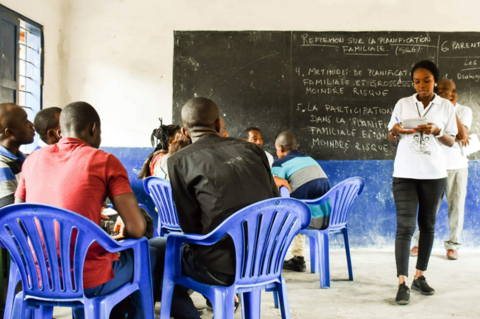
"Faith leaders and congregations can shape and sustain equal - as well as unequal - gender norms through references to Biblical scriptures and guidance on marriage and family life..."
Harmful gender and social norms, often influenced and justified by religious beliefs, are widely recognised as root causes of violence. Implemented in Kinshasa, Democratic Republic of the Congo (DRC) from 2015-2020, the Masculinité, Famille, et Foi (MFF) programme engaged the faith community to reduce intimate partner violence (IPV), increase shared couple decision-making, and improve voluntary family planning (FP) by transforming social environments. Developed by the Institute for Reproductive Health (IRH) at Georgetown University through its Passages Project, MFF sought to guide faith leaders, young couples, and congregations to identify, create, and embrace social norms associated with positive masculine identities and gender-equitable behaviours. MFF was subsequently scaled up at additional congregations in Kinshasa, as well as in Rwanda.
MFF is an adaptation of the Tearfund-developed Transforming Masculinities (TM) approach, an evidence-based intervention for religious leaders and faith communities to promote positive masculinities and gender equality and to reduce sexual and gender-based violence, or SGBV (see Related Summaries, below.). Long-term sustainable change to prevent the incidence of SGBV depends on a transformative shift in gender norms, deeply held beliefs, and the practices that follow those. Faith leaders, who are usually part of the communities they serve, are in a position to influence that kind of change through their own transformational journey and modelling.
Rooted in a pursuit of gender justice, TM's set of core principles include:
- Challenging harmful social and gender norms: addressing gender inequality and power hierarchy as root causes of SGBV, challenging the normative environment, and promoting positive alternatives and collective action;
- Community mobilisation: involving structured and layered intervention models that are community-owned and led;
- Experiential, practical learning: moving away from theoretical discussions;
- Inter-faith: bringing communities together, promoting social cohesion, and working in collaboration where needed and appropriate;
- Accountable practices: fostering a reflective process that is personal and relational;
- Learning and adaptation: ensuring rootedness in the lived experiences of survivors and local communities and adaptation in response to those; and
- Continuous learning and feedback loops: developing a programme that is not only reflective and challenging of gender norms for participants but for implementing and supporting organisation staff as well.
Based on the understanding that spiritual beliefs and faith leaders are part of the structure that shapes social and gender norms, MFF sought to dismantle the norms that God created men as superior to women and that it is acceptable for a man to use violence to correct his wife's behaviour. MFF adapted TM to include reflection on normative environments and the acceptability of FP, addressing the norm that, as household decision-makers, men can dictate women's ability to seek and use FP.
MFF was implemented in 17 Protestant churches in Kinshasa in partnership with the Eglise du Christ au Congo (ECC). In brief, specific actors and activities included:
- Protestant faith leaders at national, provincial, and congregational levels took part in facilitated, reflective workshops designed to effect attitude change and spark behaviour changes in their ownl lives and relationships. These workshops drew on Biblical scriptures to discuss gender equality, IPV, FP, and positive masculinity. This personal change in faith leaders enabled them to role-model and share scriptural messaging as part of a commitment to create an environment that supports FP use and rejects family violence.
- Gender Champions, most of them adolescents and youth, facilitated group discussions with young couples called "community dialogues" (a guidebook for which is available at Related Summaries, below). Gender Champions are congregation members selected by faith leaders and trained to act as change agents and peer mentors.
- Newly married couples and first-time parents (ages 18-35) participated in these facilitated community dialogues for eight weeks. The final two sessions included an FP health talk.
- Congregations received sermons on MFF themes and testimonies by community dialogue participants. They also participated in group discussions and mobilising events around gender equity, which encouraged them to reflect on the ways in which they interact and make decisions in their intimate relationships. These examples reflect the MFF strategy for diffusing messaging into the broader community: "organised diffusion".
- MFF partner Association de Santé Familiale (ASF)/Population Services International (PSI) sought to create an enabling service environment by, for example, training providers in youth-friendly services, leading FP health talks, offering referrals to FP and SGBV services at the end of the community dialogues, and maintaining a confidential health hotline.
In Kinshasa, ECC scaled up MFF from June 2020 to May 2021, reaching 24 new congregations. Several original MFF interventions were adapted and/or expanded. For example, members of the ECC youth department presented MFF-themed drama, poetry, song, and dance during the main Sunday service to all the congregation members. Another organised diffusion strategy centred around radio shows, which were broadcast in Kinshasa through two Christian stations and ECC's own radio station. Broadcasts consisted of 15 minutes of scripted information on IPV, FP, and gender equality written and read by members of the ECC MFF directorate and trained facilitators. Some longer broadcasts included debate and Q&A with listener call-ins and text messages.
In October 2019, Tearfund and IRH facilitated a workshop in Kigali, Rwanda, with 16 local nongovernmental organisations (NGOs) from the Great Lakes region of East Africa to explore possible partnerships for scale. Passages partnered with two of them from March 2020 - May 2021 to build their knowledge and capacity to implement MFF, adapt intervention materials, and align MFF with their organisational priorities.
Click here [PDF] to read more about the scaling up process and lessons learned from it.
Visit the IRH website to access all MFF project reports and resources.
Gender, Sexual and Reproductive Health, Gender-Based Violence, Family Planning
The rates of IPV perpetrated by men against their female partners in DRC are among the highest in the world, as physical violence is an accepted male behaviour and a way of asserting control as head of the household. Socially-understood gender roles endorse early marriage and high fertility, and the threat of IPV prevents women from seeking health services, including FP.
Religion (especially Christianity) is important in the DRC, with faith leaders having a strong influence over communities' beliefs and practices. According to MFF baseline data in Kinshasa, 75% of male and female respondents considered religion to be very important in their lives and attended a church service weekly. Data show that faith-based organisations are active in responding to material need, providing between 50% and 70% of healthcare in the region.
In Powerful Partnerships: Engaging Faith Leaders in Norms-Shifting Interventions [PDF], IRH shares implementation insights and recommendations on partnering with faith leaders and supporting them as MFF change agents. For example, there was initial resistance from some faith leaders from conservative denominations to discussing FP in churches and to the use of certain FP methods. In response, faith leaders who were supportive of FP, typically from more progressive denominations with more advanced educations, met with their peers to allay concerns, highlight FP-related challenges in their congregations, and encourage them to be involved in MFF. "This success of faith leaders working with fellow faith leaders to bring them along with the project and discuss their attitudes and concerns highlights the advantage of working with multiple leaders of different ages, genders, and theological positions."
IRH website, March 24 2022. Image credit: IRH
- Log in to post comments