










































Mobile Phone Data for Informing Public Health Actions across the COVID-19 Pandemic Lifecycle
ELLIS, the European Laboratory for Learning and Intelligent Systems; and Data-Pop Alliance - plus see below for full authors' affiliations
Decision-making and evaluation of non-pharmaceutical interventions (NPIs) during the COVID-19 pandemic require specific, reliable, and timely data, including about human behaviour (e.g., mobility and physical co-presence). Concerned by their observation that there is little coordination or information exchange between national or regional initiatives leveraging mobile phone data, this group of authors outlines the ways in which different types of mobile phone data can support efforts to contain and slow the spread of the COVID-19 pandemic. They identify key reasons why this is not happening on a broader scale and offer recommendations on how to make mobile phone data work against the virus.
As outlined here, there are at least 4 areas of inquiries for which the use of mobile phone data are relevant (see Table 1 in the paper for examples):
- Mobile phone data can provide access to previously unavailable population estimates and mobility information to enable stakeholders across sectors to better understand COVID-19 trends and geographic distribution.
- Such data can shed light on cause-and-effect questions, which seek to identify the key mechanisms and consequences of implementing different measures to contain the spread of COVID-19.
- Predictive analysis seeks to identify the likelihood of future outcomes and could, for example, leverage real-time population counts and mobility data to allow stakeholders to assess future risks, needs, and opportunities.
- Impact assessments aim to determine which, whether, and how various interventions affect the spread of COVID-19 and require data to identify the obstacles hampering the achievement of certain objectives or the success of particular interventions.
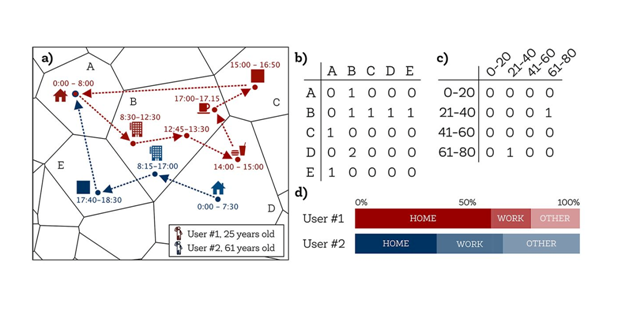
The authors stress that, while the relevance and specific questions raised as part of these areas of inquiry differ at various stages of the outbreak, mobile phone data provide value throughout the epidemiological cycle. They explore a variety of aggregated metrics using mobile phone data that can help fill gaps in information needed to respond to COVID-19 and address uncertainties regarding mobility and behaviours. For example, contact matrices (typically computed by age group) estimate the number and intensity of the face-to-face interactions people have in a day. Contact tracing apps can then be used to identify close contacts of those infected with the virus.
They argue that, while attention to the potential mobile phone data holds is growing, and though local alliances have been formed, internationally concerted action is lacking - both in terms of coordination and information exchange. Some of the reasons they cite include: lack of a "digital mindset" and capacity on the part of governments; challenges with access to data; concerns about privacy, data protection, and civil liberties; failure on the part of researchers and technologists to articulate their findings in clear, actionable terms; and weak political will and resources to support preparedness for immediate and rapid action.
To help surmount these challenges, the authors call on governments, mobile network operators (MNOs), and technology companies (e.g., Google, Facebook, Apple), and researchers to form mixed teams to focus on using mobile phone data analysis to fight COVID-19. They suggest 4 key principles that should guide the implementation of such mixed teams: (i) the early inclusion of governments, (ii) the liaising with data protection authorities early on, (iii) international exchange, and (iv) preparation for all stages of the pandemic.
Among the factors to be considered:
- "One key challenge is to make insights actionable - how can findings such as propagation maps finally be utilized (e.g., for setting quarantine zones, informing local governments, targeting communication)."
- "[A]ny efforts should meet clear tests on the proportionate, legal, accountable, necessary and ethical use of mobile phone data in the circumstances of the pandemic and seek to minimize the amount of information gathered to what is necessary to accomplish the objective concerned."
- The authors see "a clear need for more international exchange, with other domain experts, but also with other initiatives and groups; findings must be shared quickly..."
In conclusion: "promising approaches are emerging: the EU [European] Commission on 23 March 2020 called upon European mobile network operators to hand over anonymized and aggregated data to the Commission to track virus spread and determine priority areas for medical supplies..., while other coordination initiatives are emerging in Africa, Latin America and the MENA [Middle East and North Africa] Region. It will be important for such initiatives to link up, share knowledge and collaborate."
Full list of authors, with institutional affiliations: Nuria Oliver (ELLIS, the European Laboratory for Learning and Intelligent Systems; and Data-Pop Alliance); Bruno Lepri (Data-Pop Alliance; and Fondazione Bruno Kessler); Harald Sterly (University of Vienna); Renaud Lambiotte (University of Oxford; and Turing Institute); Sébastien Delataille (Rosa); Marco De Nadai (Fondazione Bruno Kessler); Emmanuel Letouzé (Data-Pop Alliance; and OPAL Project); Albert Ali Salah (Data-Pop Alliance; and Utrecht University); Richard Benjamins (Telefonica; and OdiseIA); Ciro Cattuto (University of Turin and ISI Foundation); Vittoria Colizza (INSERM, Sorbonne Université, Pierre Louis Institute of Epidemiology and Public Health); Nicolas de Cordes (Orange Group); Samuel P. Fraiberger (World Bank); Till Koebe (Data-Pop Alliance; and Freie University); Sune Lehmann (Technical University of Denmark); Juan Murillo (Banco Bilbao Vizcaya Argentaria); Alex Pentland (Massachusetts Institute of Technology); Phuong N Pham (Data-Pop Alliance; and Harvard University); Frédéric Pivetta (Dalberg Data Insights); Jari Saramäki (Aalto University); Samuel V. Scarpino (Northeastern University); Michele Tizzoni (University of Turin); Stefaan Verhulst (The GovLab, New York University); Patrick Vinck (Data-Pop Alliance; and Harvard University)
Science Advances 27 Apr 2020: eabc0764. DOI: 10.1126/sciadv.abc0764