










































New Masculinity and Family Planning: A Gender Transformative Approach to SBCC in Rural Guatemala
Pan American Social Marketing Organization/Population Services International
"SBCC contributes by creating enabling environments that help individuals, health providers, leaders and communities to start a conversation, analyze the information, challenge their own beliefs and traditions, and take well-informed and voluntary decisions about their FP needs."
This presentation examines the Support for International Family Planning Organisation (SIFPO) programme, which is an effort to support Guatemala's Ministry of Health (MOH) in its efforts to reduce maternal mortality and chronic malnutrition rates by increasing the voluntary use of modern family planning (FP) contraceptives and providing quality FP services. Funded by the United States Agency for International Development (USAID) and implemented by Population Service International (PSI)'s global network, which includes 65 national health organisations, SIFPO is being implemented in the Western Highlands of Guatemala with a focus on the indigenous population of rural areas. For reference, Guatemala ranks among the lowest in the hemisphere in terms of maternal and reproductive health indicators; the contraceptive prevalence rate (CPR) remains one of the lowest in Latin America, and ranks fourth in the world for chronic malnutrition. Some country indicators show that the intervention area has the poorest health indicators. This is the same situation for poverty indicators. 41% of the population is indigenous Maya, highly concentrated in rural areas. While a majority of Guatemalans speak Spanish, 40% speak one or more of the 22 indigenous Mayan languages. There are wide gaps in income, education, and key health indicators between indigenous and non-indigenous segments, and 75% of indigenous people live in poverty. Compared with the national average, the CPR is much lower among indigenous women, who tend to live in the rural Western highlands and are three times more likely to die from complications related to pregnancy or birth.
To understand behavioural determinants and the socio-cultural context, in 2013, organisers carried out a baseline study: the Tracking Results Continuously (TRaC) Study on Family Planning among indigenous men and women of rural areas in the Guatemala Western Highlands. They found that machismo prevails as a social norm, there is a lack of social support toward FP, and most women cannot decide to use contraceptives by themselves (she might face verbal, physical, or financial abuse unless the male partner gives his consent). These findings supported a 2008 USAID/Health Policy Initiative study, Barriers to Access Family Planning by Indigenous Population in Guatemala Study that identified biases on the impact of FP (e.g., women using FP can cheat and/or fail to comply with their expected role) and restrictive social/family environment for the use of FP (e.g., patriarchal culture). Then, prior to strategy design, implementation, monitoring, learning, and evolving (September 2014 to date, 2016), formative qualitative research was conducted in 2014. It consisted of 8 focus groups with men, women, youth, and traditional birth attendants.
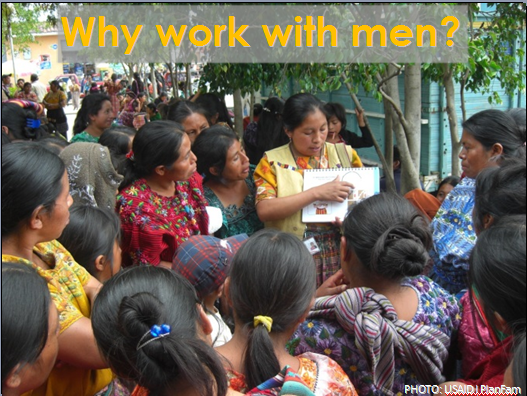
Interventions focused on working with men to transform gender relations (create new masculinity roles) in order to promote equality and respect as a means to reach health outcomes. Activities included:
- Training on gender and new masculinity for health providers - Programming steps can include something as simple as including gender sensitivity training in institutional capacity-building efforts. Social and behaviour change communication (SBCC) can be used to increase awareness of inequalities within the community and encourage critical assessments of existing harmful gender stereotypes.
- Interpersonal communication (IPC) - approaching and engaging men in FP at community level. SBCC has been used to increase awareness of inequalities within the community and encourage critical assessments of existing harmful gender stereotypes. The idea is to start a conversation about gender and present individuals and communities with an opportunity to reflect critically on how gender norms affect the well-being of individuals, families, and communities as a key first step to transform the status quo of gender inequality towards one of egalitarianism.
- Advocacy - This involves engaging civil society men's networks to approach local leaders and authorities and encouraging critical assessment of existing harmful gender stereotypes related to FP.
- Communication campaign in mass media and community channels to promote new masculinity roles and FP among indigenous men 15-54 years of age in rural areas - accomplished through partnership with Men's National Network, a civil society men's organisation that advocates at the national level for health, nutrition, and education rights of the underserved indigenous population. Materials included radio spots, posters, flyers, and testimonial videos disseminated through radio, newspapers, health services, and schools. Languages included Spanish (printed materials) and 6 Mayan (radio). Duration was 5 months of radio and 1.5 years through community channels (IPC, health fairs, kiosks, advocacy). Four roles of new masculinity were emphasised (the responsibility rests on both the man and the woman) with regard to: education of children, nutrition of the family, decisions about money use, and FP. The campaign lets community health workers (CHWs), health providers, and civil society leaders use these materials to promote conversation and analysis around gender inequity and new masculinity roles, linking it to FP.
An evaluation of the campaign was carried out. 59 gender and new masculinity training sessions were conducted for health providers and local organisations. 3,403 men were reached through IPC sessions, and there were 127 referrals for vasectomies. More men have shared with their wives the responsibility of FP and recognised FP as a benefit for their lives. 100% of those surveyed liked the 4 posters and 4 radio spot, whose key message by each piece was: "education of children is the responsibility of both the man and the woman", "nutrition of children is the responsibility of both the man and the woman", "decision for using the household money is the responsibility of both the man and the woman", and "family planning is the responsibility of both the man and the woman". Answers obtained during "spontaneous recall", indicate that 85% of men recall the secondary message of the campaign corresponding to "planning for the number of children is the responsibility of both the man and the woman". The health service was a popular way of seeing/hearing these messages. Focus group discussions with the National Men Network, Indigenous Women Alliance (ALIANMISAR), and the Observatory for Reproductive Health (OSAR) found that the campaign promotes male engagement. Messages were well received by communities The images help illiterate people understand message, and the posters and testimonial videos were identified as the most useful materials for advocacy - they "opened eyes, helped remove customs". It helps to address local leaders, and an alliance with civil society is helpful to advance gender norms transformation. In general, the campaign has helped to generate awareness, educate, and address machismo.
Organisers reflected that more men were reached through IPC sessions when using the campaign materials. There was a similar productivity between male and female CHWs to conduct IPC sessions and make referrals to health services. One photograph in the presentation shows a female CHW talking to a group of men about FP and showing them how to use a condom. "A female CHW well trained in gender, new masculinity, contraception methodology, and empowered to talk can be as effective as male CHW to address men." SBCC contributed to creating an enabling environment to talk, challenge beliefs, and make informed voluntary decisions about FP. Key alliances with civil society and local partners promoted campaign ownership and good results. The campaign empowered equally men and women.
The main challenge is intregrating FP with maternal and child health (MCH) services, where SBCC is crucial to engage fathers and not only mothers. Work will continue in promoting new masculinity roles, not only related to health but also to men engaged in education of children, nutrition of the family, sharing decisions about the money use, etc.
SBCC Summit website, March 4 2016; and email from Haydee Lemus to The Communication Initiative on April 25 2016. Image credit: USAID|PlanFam
- Log in to post comments