










































Nivedita
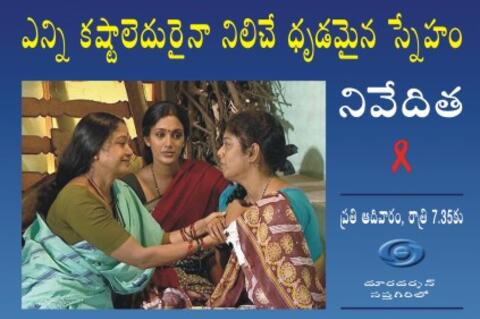
Nivedita was first broadcast on January 3 2010, and is televised on Doordarshan Kendra Hyderabad on Sunday evenings in the prime time slot at 7:35 p.m. in Telugu, the official language of Andhra Pradesh. Click here to watch episodes of Nivedita with English subtitles online (added only after the Telugu version of that episode has aired on TV). As part of the story, Nivedita, the young heroine, learns that her older, Sub-Inspector husband, Shyam, has been unfaithful to her while she was away giving birth to their second daughter. Nivedita is soon reunited with her childhood friend, Sushila. Faithful Sushila is now showing signs of ill health after her husband died a few months earlier, following a long battle with mysterious illnesses. Nivedita advocates the diagnosis and treatment of her friend and learns the hard truth about her own risk of HIV. Nivedita forms a self-help group (SHG) in which Sushila and her condition become accepted and understood. Nivedita is then able to negotiate first a female condom, then an HIV test, for Shyam.
The first 5 episodes set up the story, but from week 6 through 26 (ending July 18 2010), each episode concludes with an epilogue wherein a known celebrity directs viewers to various places they can find help. Depending on the viewers' situations and the topic of their questions, viewers responding to the series will be directed to:
- Local Asha Mitralus (SHG women trained in HIV topics by Andhra Pradesh State AIDS Control Society);
- The 104 helpline for answers to their questions about HIV and for referrals to Integrated Counseling and Testing Centers (ICTCs);
- District-level women's helplines;
- Anganawadi centres (for further referral to numerous women's welfare schemes and to the Legal Services Authority);
- Local SHG coordinators for increasing women’s social, economic and political capital and legal advocacy; and/or
- Local village health workers (Accredited Social Health Activist (ASHA) workers).
The interactive Nivedita website links the television show with organisers' broader vision of redressing women's vulnerability to HIV/AIDS: community-based action and formal government action. Namely, noting that SHGs play important roles in women's empowerment, both at the local level and through statewide networking, organisers welcome inquiries by post or mail from women needing help finding their particular community activist/organiser. In addition, those who register for access to the Nivedita referral network can access contact information for those within the formal government system (e.g., the Legal Services Authority and the Department of Women and Child Development) who can help them access counselling and shelter schemes. "With such safety nets in place a vulnerable woman is better placed to negotiate sex with her husband for the security of her family. She'll be a survivor, and so will her children, even if her husband and in-laws insist on making dangerous choices."
Organisers encourage people to download posters developed to support the series: "You can play a significant part in improving the lives of families around by simply hanging a poster in your office, meeting room or wherever people you serve congregate."
Women, Gender, HIV/AIDS.
According to organisers, because of systemic gender inequalities, women are less able to protect themselves and their children from HIV/AIDS. Lack of education, livelihood skills, access to information, mobility, defense against domestic violence, and access to legal and health services leaves women highly vulnerable to HIV/AIDS. Women are also biologically more susceptible to HIV/AIDS. However, organisers claim, data show that married women's single greatest HIV/AIDS risk factor is a husband with multiple partners. They note that, in India, women now make up 39% of people living with HIV/AIDS, a rising trend.
Email from James and Ava Kramer to The Communication Initiative on March 9 2010 and April 30 2010; and Nivedita website, March 9 2010.
Comments

really helpful thank you
very helpful and expansive in its explanation

- Log in to post comments