










































Radio Station Building Project

The programme content for the radio stations built through this programme is determined by the local communities running the stations, but lack of information access is the key rationale for the programme as a whole. As a consequence, radio content generally has a strong emphasis on information and education programming, augmented with some entertainment programmes.
Staff of the stations receive training from KBR68H and PPMN on programme production and, as their capacity grows, so too does the number and variety of programmes they are able to produce. Generally, though, the output includes a daily local news bulletin as well as talk shows on topics of local interest. These can range from talk shows on local government, education, health, and farming, to programmes on human rights. Experts on the topics under discussion, where available, are drawn from the local community, from local non-governmental organisations (NGOs), and from the local government, but presenters also draw on other materials (such as specialist magazines) to provide tips and advice to listeners.
Listener participation is always strongly encouraged and in most areas the prevalence of mobile phones and the popularity of text messaging means that on-air debates are lively. In some more remote areas where mobile phone access is unavailable or very limited, particularly in Papua, listener participation requires people coming to the station to give their views, which they do. In one station in Papua recently, after the station broadcast a report about a local primary school that had been closed because of teacher absence, some women from villages in the vicinity walked for three days to get to the station in order to inform them that schools in their areas were also closed for the same reason and asking for this information to be publicised in order to try to get a response from the local government.
The goal of such programmes is clearly to inform and educate, but they are also intended to encourage active public participation in debates about local issues to enable listeners to engage in the democratic process and to recognise their right to do so.
Entertainment programmes are also usually popular, as the stations are in areas where there are few, if any, other entertainment options. Local songs from the area are often a big draw, with Indonesian and western music also popular in some areas.
These locally produced programmes are complemented by the radio programmes that are produced by radio news agency KBR68H and made available to these stations via satellite. Each station can choose which of KBR68H's 8 hours of content produced each day it wants to broadcast, enabling selection of programmes that are of relevance and interest to particular listeners. KBR68H's programmes include national and international news bulletins, as well as news analysis and talk shows covering a range of issues, such as the environment, human rights and legal reform, and religious tolerance. These programmes are reportedly popular with listeners to these remote stations as it allows them to keep abreast of developments in other parts of the country. The programmes also enable them to engage directly in national-level discussions, as KBR68H provides a toll-free phone number and numbers to which they can send text messages, enabling them to debate directly - albeit at a distance - with the experts in the KBR68H studios in Jakarta.
Rights, Democracy and Governance.
There are two main determining factors in selecting the locations for stations. The first is to build or rebuild information access in disaster areas. The second is a part of the country which has limited or no local media and information access. In the case of one of the two stations built to date in the Central Highlands of Papua, for example, the motivation was the news that, following a crop failure in the area, 60 people had died from hunger, despite the fact that, close by, there were government food stocks available. If the community had been able to access a means of disseminating information about their dire situation, organisers claim, there need not have been loss of life.
Since the building of a radio station, Radio Pikonane, inhabitants of this very isolated part of Papua have, for what organisers describe as the first time, regular access to up-to-date news. The station's farming programme is helping improve crop yields and, as a result of the station providing information about harvests on the radio, buyers now come to the farmers. Formerly, the farmers had to take their crops a few hours walk to the nearest town. As a result, the farmers are able to command much higher prices for their crops. Radio Pikonane has also started a programme on women's rights aimed, amongst other things, at reducing the high incidence of domestic violence. (Click here to view a 5-minute video showing the station launch event; also see this related article in Inside Indonesia).
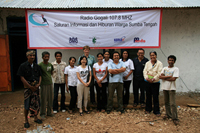
The establishment of Radio Gogali, on the island of Sumba, provides another illustration. Although just a one-hour flight from Bali, Sumba has poverty levels well above the national average and very few homes with electricity. Almost 60% of children drop out before finishing primary school, and access to fresh water is the exception rather than the norm. The absence of any local media in the west of the island means that information dissemination has until now been largely limited to word of mouth.
Within 5 months of the initial July 2008 visit by the Jakarta team, Radio Gogali was up and running. "For the first time, the population of Central Sumba could hear local and national news, as well as listen to talk shows and popular songs, on their own community radio station. In an economically deprived part of the country such as Sumba, a radio station has enormous potential to play a positive role in the area's development, and this is what drives this radio building programme. As PPMN Programme Manager, Eni Mulia, explains: 'We know that Central Sumba has very high rates of illiteracy, while radio is a very flexible medium for conveying messages. We see that Radio Gogali therefore offers a chance for the people of Central Sumba to fight their way out of poverty and underdevelopment.'"
The head of the health and social affairs department for Central Sumba is working with Radio Gogali on plans for a regular talk show to discuss basic health issues. At the top of her agenda is encouraging some changes in traditional childbirth practices that have resulted in an unusually high rate of deaths of women: "Until now we had to go house to house to talk about these things, but with the radio we can reach so many more people." The following vignette supports this rationale: "...[O]rganised gangs of animal thieves have for some time caused major hardship to poor farming communities that can ill afford to lose any of their precious livestock. So, when a listener sent a text message to the radio station in early February [2009] with news that thieves had stolen some horses from a nearby village, the presenter was quick to act. As well as announcing the details of where the animals had been taken from, the presenter urged listeners to converge on the area and block off the roads leading out of the village. Many people heeded the call and, soon afterwards, five thieves had been caught red-handed with the animals they had stolen."
October 2011 update, in the words of MDLF's Tessa Piper: "The valuable development role being played by Radio Pikon Ane, and the leadership of the station's manager, Kathe Vince Dimara, in enabling this was recognized in July [2011] when she was chosen as the winner of the S.K. Trimurti Award - an award for female journalists or activists who fight for gender equality, freedom of expression and freedom of information - by the Indonesian journalists' association, the Alliance of Independent Journalists (AJI) at their 17th anniversary event in Jakarta in July. MDLF, KBR68H and PPMN are currently working on the latest station to be built as part of this program, in conjunction with the local community, in the regency of Sarmi in Papua province."
MDLF, with KBR68H and PPMN working closely with the local communities in all aspects of the design and implementation of the radio station building programme. The Dutch government is providing financial support.
"Indonesia: Forgotten Region Finds Voice", by Tessa Piper, MDLF website, May 25 2009; and emails from Tessa Piper to The Communication Initiative on June 24 2009 and October 9 2011.
Comments

Establishment of radio stations
Far reaching as it includes response in part to new media use.
Really really interesting
Really really interesting and inspirational.
- Log in to post comments