










































Reporting on Violence against Women: A Case Study of Select News Media in Seven Countries in Latin America and the Caribbean
"As news media actors select, articulate, and disseminate information, they are implicated in the public discourse that informs social beliefs and behaviors. It is therefore essential that news media actors be sensitized to this issue in a way that supports the global movement to eliminate all forms of discrimination and violence against women."
This report from the Inter-American Development Bank (IADB) outlines the results of a preliminary case study of the portrayal by the news media of violence against women in Latin America and the Caribbean (LAC). It focuses on national print news agencies in 7 countries: Brazil, Colombia, El Salvador, Jamaica, Mexico, Paraguay, and Uruguay. The aim of this analysis is to identify general patterns on the way the news media conveys violence against women and highlight areas that require additional scrutiny by the news media as well as civil society, government, and the international development community.
The author, Luísa Abbott Galvão, begins by exploring violence against women as a significant human rights issue in Latin America - and the role that the media plays in shaping perceptions of it. She cites a series of surveys undertaken in 12 LAC countries that found that between one-fourth and one-half of women reported having experienced violence by an intimate partner at some point in their lifetime. This includes various forms of physical violence, coercion, and emotional abuse (Bott et al., 2012). "The press not only documents instances of violence against women, but it also molds and reifies our beliefs regarding gender norms and roles....On the one hand, the idea that the victim did something to deserve violence or did not adequately resist can lead to their being judged and ostracized, thus excusing the aggressor and the aggression. On the other hand, even when female victims are viewed as 'legitimate', we are faced with a problematic paradox: by emphasizing women's disproportionate share of the burden of violence, female identity becomes further associated with this very oppression."
The analysis was carried out in 2 parts. First, major national newspapers and magazines from each focus country were identified and directly monitored over the course of 6 weeks (October 19 to November 30 2014). The selection was based on the national reputation of each agency. This initial prioritisation was based on considerations related to the reach that such outlets have in shaping the public discourse and to practical constraints relating to the scope of the project. Second, for the sake of contextualisation and comparison, daily Google alerts were set up using key terms to gauge the kinds of news agencies covering the issue, as well as the frequency and substance of this coverage.
Key findings:
- Print news media in the 7 countries included in this study have, to varying degrees, effectively identified a broad range of manifestations of violence against women and linked them to a patriarchal social structure. The phenomenon, however, is "misleadingly presented as one hinged on the outlandish actions of aberrant males, while the broader issues underpinning violence against women are left unchallenged: those of gender inequality and damaging social constructs of masculinity."
- News media reporting largely oscillates between the banalisation of violence and its sensationalisation, and fails to humanise the issue.
- The omission of men as subjects in the debate on ways in which to address violence against women is salient. The role of male perpetrators is rendered invisible by the news media, and what occurs instead is the "feminisation of responsibility": the placement of accountability for ending violence on the women experiencing it. This is done through messaging that encourages survivors to become activated to stop the cycle of violence by speaking out, reporting abuse, realising their individual worth, and rejecting their aggressors.
- Understandings of justice are shaped by a narrow focus on judicial impunity. This is evidenced by the large share of stories surrounding trials and the numerous policies and campaigns relating to conviction rates. This understanding of justice is advanced at the expense of an understanding that recognises a fundamental need to change underlying gender norms in order to address the context in which this violence is occurring, and end all forms of discrimination against women.
Key recommendations for news media:
- Increase the focus (including through specific news coverage) on the education of men to prevent violence against women.
- Refrain from approaching the issue of violence against women in a way that further subjugates women by putting the accountability for change on them.
- Work to humanise the presentation of violence against women.
Luísa Abbott Galvão concludes that what strikes her most from the snapshot she took is "the sheer absence of men from the subject of debate. This conveys the degree to which it continues to be seen not as a transcendental humanitarian and social crisis, but as a tangential women's problem." She continues: "Whether representative of actual governmental policies or not, the excessive focus [in the press] on policies and programs related to retroactive response mechanisms to succor victims overshadows the need for focus on programs aimed at preventing the violence through universal education....It is essential to develop comprehensive guidelines for gender reporting and promote them through government, civil society, and the international development channels."
Click here for the 32-page paper in PDF format in English.
Click here for the 38-page paper in PDF format in Spanish.
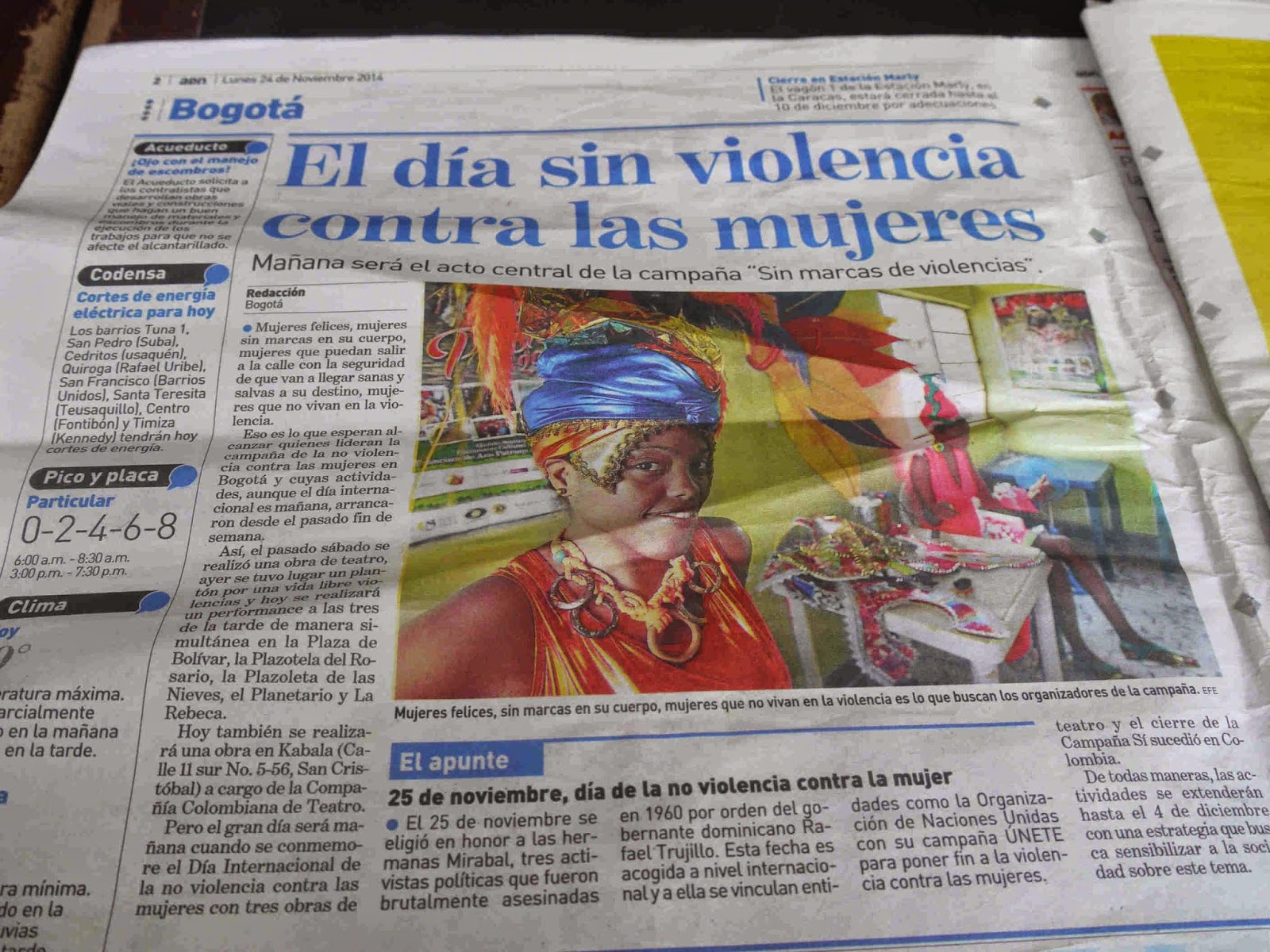
IADB website, October 5 2016. Image caption/credit: "ADN newspaper reports that Nov. 25 is the 'day without violence against women." Mike Ceaser
- Log in to post comments