










































Ring the Bell (Bell Bajao)
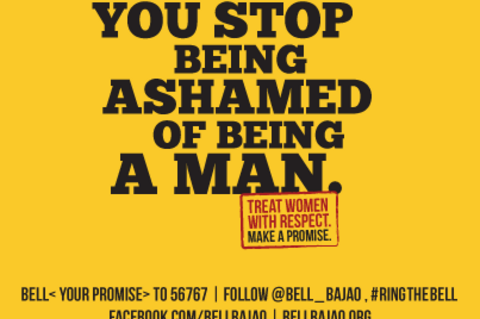
Bell Bajao uses media, education, and pop culture to urge men to take a stand against domestic violence. Zenobia Pithawala, Group Creative head, O&M, outlines the thought behind the campaign: "Domestic Violence is a subject where the man is always seen as the culprit. We wanted men to be our partners supporting the cause. Our campaign was conceived keeping that in mind. Also we wanted a strong call to action. A call to action that makes people say, this is all it takes, I can do it..." Messages are being disseminated across Doordarshan and private television channels, radio channels, newspapers, and the internet. The campaign website (no longer in operation) offers access to many of these campaign components, and is itself an edutainment-style platform designed to involve youth, in particular, in the push to speak out to stop domestic violence. To familiarise them with the issue, a variety of informational resources are offered, such as ideas for why men should care about domestic violence and the everyday things they can do to reshape attitudes. In addition, tools like a blog and interactive games are designed to engage and mobilise people - especially those who are filled with the zest for change. A message on the site says, "YOU could be the change that society needs. Explore. Talk. Exchange views with your peers on the issues of violence, gender sensitivity and changing attitude using these simple creatively designed educational tools." Amongst these tools are music videos, interactive group activities, communication tools, and ideas for action. [This venture has been supported by online partners such as the Viewspaper, Zapak, Contests2Win, Blogworks, IBIBO, and Foxymoron.]
In India, travelling video vans toured 6 districts over 150 days to foster on-the-ground activation and to build awareness on issues of domestic violence and women's vulnerability to HIV/AIDS. The Bell Bajao video van, complete with audio, video, and entertainment facilities, made its debut at Nirala Bazar, one of the most popular areas in the city. Specifically, the van housed all sorts of information on domestic violence, HIV/AIDS, and women's right to safe shelter. Games and street plays, performed by Breakthrough's young Rights Advocates along with partnering non-governmental organisations (NGOs) such as Men Against Violence and Abuse (MAVA) and the Aurangabad Network of Positive People, are designed to attract attention, raise awareness, and convince passers-by that "Your speaking out against domestic violence will give a voice to one out of every three women who face domestic violence behind closed doors."
In honour of International Women's Day 2013, Ring the Bell undertook a specific social media strategy in an attempt to galvanise at least 1 million committed men around the world and to garner at least 1 million promises to take concrete action to make the world safe for women and girls. Organisers launched a call to action in Dehli, India, Johannesburg, South Africa, New York (NY), United States (US), and Rio Di Janeiro, Brazil. Viral digital and physical media campaigns - via Facebook, Twitter [@bell_bajao (#ringthebell)], text messaging (SMS: BELL
Women, Rights.
According to Breakthrough, globally, at least one in three women and girls is beaten or sexually abused in her lifetime. More than 600 million women live in countries where domestic violence is not a crime. Intimate partners commit almost 1/3 of all female homicides. A woman is battered, usually by a partner, every 15 seconds. Women 15 to 44 are more at risk of rape or domestic violence than cancer, car accidents, war, and malaria combined. Domestic violence costs the US over US$9 billion annually.
The global expansion of this originally India-based campaign was announced at the Clinton Global Initiative 2010. UN Secretary General Ban Ki-moon is the campaign's first Global Champion. China, Vietnam, and Malaysia have adapted Bell Bajao, and more countries are joining the campaign. As of 2013, Ring the Bell has received 23 awards globally, including the Cannes Silver Lion. Over 130 million people have been reached by multimedia campaign. Millions of men, women, boys, and girls have taken action to stop violence.
Breakthrough, The Ministry of Women and Child Development, UNIFEM, the UN Trust Fund, O&M. For a complete list of various partners and supporters, click here.
- Log in to post comments