










































Through Our Eyes

This project draws on the power of participatory video to effect social change. According to C4C, the video medium surmounts the barrier of illiteracy and generates excitement, both because it is an inherently dynamic form and because people tend to be keen to see their own community and its members on screen. Applied to the prevention of gender violence, organisers say, local video helps amplify voices for change from within the community, expands ARC's outreach activities in an organic way, and fosters peer-to-peer education in a context of collaboration and self-empowerment.
"Through Our Eyes" in Guinea and Liberia
In early 2006, a two-week workshop at Lainé refugee camp in Guinea’s Forest Region brought together ARC field staff, refugee women, and other community members. Participants gained practical skills in community video production and interpersonal communication, and shared essential information on gender-based violence, its root causes, and related health issues.
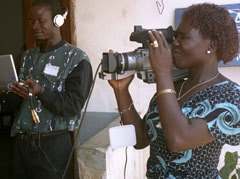
Over the first days of training, participants familiarised themselves with the equipment (mini-DV camcorder, microphones, headsets, battery-operated field monitor, VCRs, TV monitors, small generator, video tape supplies, and accessories) and viewed examples of video work that promoted health, human rights, and gender justice goals. As the workshop progressed, participants were guided in interpersonal communication and interviewing skills; they then practiced shot identification and storyboarding, and undertook increasingly challenging filming exercises. In particular, participants developed team skills in programme planning and sequential filming, considered to be essential for the "in-camera" editing approach adopted for the project. By the second week, participants were carrying out interviews with community members and developing plans for their first productions. Filmed during the final days of the workshop, these initial programmes included a documentary on early/forced marriage and short dramas on rape and community responses to domestic abuse. (Subsequent project workshops have continued to follow this integrated two-week training format.)
Following the workshop, participants formed the first “Through Our Eyes” video teams: one based in N’Zerekore, Guinea, and the other in Bong County, Liberia. Based on their deep familiarity with the issues facing their communities, the teams began to produce video dramas and documentaries on such subjects as rape, forced marriage, and the links between alcohol abuse and spousal violence. Shared with local audiences through community "playbacks" (screening/ discussion sessions), the videos helped spark dialogue around topics rarely discussed in public settings. Viewers shared their experiences and offered their ideas on how to address gender-based violence, HIV/AIDS, and related issues within the community. They also gained information about ARC and partner agencies’ services, including legal aid, counselling, and skills training programmes that foster women’s economic independence.
The arrival of peace in Liberia triggered a mass return of refugees from Guinea. Gender-based violence, however, has continued to pose a critical threat to women and girls in the post-war period. The scope of project activities has grown and evolved in response to need. Many early productions provided specific information on care for survivors of rape, prosecution of perpetrators, and treatment of sexually-transmitted infections. More recent productions have focused on themes of women’s rights, girls’ education, and shared decision-making between spouses. To date, the Liberia video team has produced more than 25 programmes in various local languages.
Community playback sessions have prompted many individuals to seek ARC’s services immediately. In Liberia - where an estimated 40% of all women are survivors of conflict-related sexual violence - field staff noted increased numbers of adult women coming forward to report assaults and seek counselling following the start of the video project. This suggests that the video scenarios resonate with viewers in such a way as to lessen their concerns about social stigma and encourage them to seek appropriate care.
The self-representational nature of participatory video enables survivors of gender violence to play an active role in promoting change within their communities. Some survivors choose to speak out directly. The refugee woman featured in the team’s first tape, a documentary on the consequences of forced/early marriage, wanted to share her story on-camera, and urge parents to abandon the practice that had such harmful effects on her own life.
Many survivors of gender violence take part in project activities in other ways - by assisting on a production, for example, or by helping develop a drama that reflects their experiences in a fictional form. For many survivors, speaking out against gender violence is a deeply empowering act, and a step in the gradual process of healing.
The Liberia team has partnered with many local, national, and international agencies to produce and screen films, including the LIGHT Association for People Living with HIV/AIDS, JFK Hospital, the Fistula Rehabilitation Center, and the Sexual Exploitation and Abuse Taskforce.
"Through Our Eyes" in southern Sudan
In August 2007, "Through Our Eyes" activities were initiated in Yei, southern Sudan. Yei, one of ARC’s central programme sites in southern Sudan, has seen a vast influx of returnees since the signing of the 2005 Comprehensive Peace Accord (CPA) that marked the end of more than two decades of regional conflict.
"Through Our Eyes" activities in southern Sudan focus on providing vital information on HIV/AIDS prevention, care, and treatment, and on raising awareness about gender-based violence and its consequences. A related aim is to build awareness of links between attitudes and practices that contribute to women’s disempowerment, gender violence, and heightened risk of HIV/AIDS infection.
The organisation Widows, Orphans, and People Living with HIV/AIDS (WOPHA) is the local partner group for project activities. WOPHA members have taken part in community video training workshops along with ARC field staff and have been involved in planning and filming productions.
Several WOPHA members - especially women who have survived AIDS-related stigma and discrimination, and who now work as peer educators and counsellors - have embraced community video as a powerful medium for sharing their stories and sensitising others. They have helped create videos on such issues as voluntary counselling and testing, care of family members with HIV, widow inheritance, and the needs of orphans.
"Through Our Eyes" in Rwanda
"Through Our Eyes" activities in Rwanda enable Congolese Tutsi refugees and field staff to carry out sensitisation on gender violence, HIV/AIDS, harmful practices, and related issues. The first project training workshop, held in September 2008, brought together participants from Gihembe and Nyabiheke refugee camps. Both camps are managed by ARC, which also runs programmes on reproductive health and gender-based violence prevention and response.
Since the initial training, the Rwanda team has created videotapes on diverse themes, including forced/early marriage and HIV infection; sexual exploitation; beneficial traditional practices versus harmful customs; and the importance of girls’ education.
"Through Our Eyes in Uganda
In September 2009, “Through Our Eyes” training was carried out in Gulu, Northern Uganda. The new team, composed of ARC staff and members of diverse local partner agencies, created two videos: a drama on the role of men in promoting family well-being and a documentary about living positively with HIV/AIDS. Future video programmes will address HIV/AIDS prevention and treatment, gender-based violence, and harmful traditional practices.
"Through Our Eyes" in Thailand
In October 2009, a “Through Our Eyes” workshop was completed at the Nu Po refugee camp in northwestern Thailand. The first videotape produced by the training participants - Karen and Burmese refugees from the conflict in Myanmar - focused on harmony in the home based on equality between husbands and wives.
Gender, Conflict, Children, Women, Health, Rights.
Because media channels are often scarce in humanitarian settings, locally-made video can be especially compelling for community members. "Through Our Eyes" teams have found that audiences become immediately and deeply involved in stories that reflect their daily reality. This engagement helps spark dialogue and exchange on issues that are rarely addressed in other settings. Further, the medium of video is accessible to everyone, regardless of educational level, vital consideration in areas where illiteracy rates are high.
A corollary aim of "Through Our Eyes" is to build participatory communication skills at regional as well as local levels, and to enable the sharing of skills across national borders. To this end, the project has enabled an exchange of videos across sites, country-to-country technical support calls, and numerous cross-training visits: Liberian team members co-facilitated trainings in Rwanda and Sudan; Sudanese team members co-facilitated training in Uganda; and a Ugandan team member co-facilitated the first project workshop in Thailand.
Anticipated future activities include participatory assessments of project outcomes and a gathering of participants from diverse sites to exchange experiences and develop a toolkit of "best practices" in the use of community media for outreach on gender violence and related issues.
“Through Our Eyes” activities in Liberia, Rwanda, Uganda, Thailand, and southern Sudan are supported by the Women in Development Office of the United States Agency for International Development (USAID). Other funders of project-related activities have included the Bureau of Population, Refugees, and Migration (BPRM), the President’s Emergency Plan for AIDS Relief (PEPFAR), and Art Action (formerly Art Venture).
The American Refugee Committee (ARC) International is a non-profit, nonsectarian organisation based in Minneapolis, Minnesota (United States) that has provided humanitarian assistance and training to millions of women, men, and children over the last 29 years. ARC currently works with refugees, internally displaced persons, and others affected by armed conflict, natural disasters, and complex emergencies in seven countries around the world. ARC works with local actors to build capacity and provide shelter, clean water and sanitation, health care, skills-training, microcredit education, protection, and whatever support it can to enable people to rebuild their lives, families, and communities.
Communication for Change (C4C) is a non-profit organisation based in New York, New York (United States) that provides training in the use of participatory video to support social development, health, and human rights goals. Over the past 25 years, C4C has collaborated with non-governmental organisations and community groups in many countries to develop projects that enable members of traditionally under-represented groups to represent their own experiences and needs. The majority of these projects focus on women's rights and socio-economic status, community and reproductive health, and the prevention of various forms of gender violence and abuse.
American Refugee Committee International (ARC), Communication for Change (C4C).
Emails from Lauren Goodsmith to Soul Beat Africa on August 10 2006, and to The Communication Initiative on May 3 2007 and to Soul Beat Africa on November 10 2009.
- Log in to post comments