










































Uganda Health Information Network (UHIN)

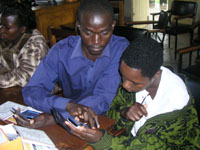
According to UHIN organisers, Uganda has one of the highest burdens of disease in the world but also some of the best cellular telephone coverage in Africa. The project uses a wireless network that is built around the country's cell phone network, handheld computers, and wireless servers. Health workers use the PDAs to collect public health data at the community level. They then upload the data and emails they need to send to AAP via infrared, Bluetooth, or wi-fi at a rural health facility. The AAP sends the data and messages over the cellular network to the server in the capital, which routes them to the correct recipients and sends back the messages, data, and health information that clinicians need. The idea is to use the technology to allow health care workers to access and share information in remote facilities without fixed telephone lines or regular access to electricity.
District health offices receive data from various levels of health centres using the UHIN, including: monthly Health Management Information System (HMIS) reports; disease surveillance data; reports related to HIV/AIDS, tuberculosis, and malaria; and data for monitoring drug usage and stocks, which are used for ordering medicines. Additional tools for electronic data collection of non-routine sources of information - especially in relation to community-based health care, nutrition, and environmental sanitation programmes - have been developed, and rural health facilities are using the network for data capture and reporting to district health offices and the Ministry of Health. In this way, the idea is that the UHIN technology can improve health care administration - organisers say it will reduce the time taken to submit, analyse, and respond to reports and requests for supplies. Rural hospitals also use the PDAs for capturing data on daily register forms that include statistics related to prevention of mother-to-child transmission (PMTCT) of HIV, inpatient, lab, HIV counselling, antiretroviral (ART) administration, and so on.
Organisers say that part of the strategy for improving Uganda's capacity to treat patients and combat the spread of disease involves providing health practitioners with updated information and guidance. Continuing Medical Education (CME) for doctors, senior nurses, and senior clinical officers ("tier-1") and community health workers ("tier-2") is regularly broadcast though the UHIN. Both tiers of health workers receive content 3 times a week via PDA pertaining to diagnosis, treatment, and prevention of major health problems such as diarrhoea, pneumonia, malaria, HIV/AIDS, and tuberculosis. In addition, health workers receive daily news from mainstream media on a daily basis through the network.
Technology, Health.
Cost-effectiveness study of UHIN conducted by independent consultants in 2004/5 showed that the network delivered a 24% savings per unit of spending over traditional manual data collection and transmission approaches.
As of October 2009, there were approximately 600 health workers in Rakai, Mbale, Manafwa, Lyantonde, and Bududa districts using UHIN to facilitate data and information exchange.
AED-SATELLIFE, Uganda Chartered HealthNet (UCH), the Faculty of Medicine of Makerere University, the International Development Research Centre (IDRC), and District Health Services of 5 districts. UHIN has been supported financially through the Canadian International Development Agency (CIDA).
Global Knowledge Development (GKD) e-newsletter, September 25 2003; and AED-SATELLIFE website, January 7 2010.

- Log in to post comments