










































WeFarm
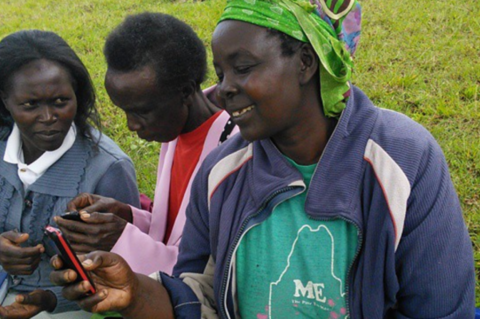
WeFarm is a worldwide peer to peer knowledge sharing network, building a bank of the world's farming knowledge, then making it available to anyone anywhere, in any language, and on any device - even the most basic mobile phone. This collaborative community of small-scale farmers in rural communities uses SMS [text] messaging to share questions and solutions to their peers around the world. The knowledge network of 270,000 coffee, tea, and cocoa producers from 13 countries in the developing world - even those without access to the internet - use WeFarm to:
- Strengthen their farming practices and livelihoods by accessing relevant information from other smallholders.
- Showcase practices and products developed within their community and strengthen links with potential partners.
- Share, learn, and benefit from experiences and innovative solutions.
- Create networks and uses for this technology such that, in the process, the project will gain a life of its own and become self-sufficient.
As of this writing, WeFarm is available in 3 languages and 3 countries: Kenya, Tanzania, and Peru. Created for farmers, by farmers, WeFarm uses technology to share fast and innovative solutions to problems such as how to control coffee rust disease. The vast majority of WeFarm users live in isolated areas, with few opportunities to access valuable information or advice. An example of a typical interaction would be a farmer in Kenya asking a question about starting a micro-business on rearing rabbits, then not only receiving answers back from other farmers in Kenya, but also from farmers in Peru who might have been keeping rabbits for years and have knowledge and experience to share. WeFarm instantly and automatically sends out a farmer's question via SMS to a selection of people in their local or national area. This means he or she can receive locally appropriate answers in terms of climate and market conditions within a short period of time. However, WeFarm also has the capability of having these questions translated and shared with farmers in other countries or even continents. The idea is that that farmer who asked the question can receive a selection of both locally relevant information as well as new insight and ideas from afar. WeFarm allows users to peer rate and review answers.
Sponsorship, or on-boarding farmers, is a one-off process of registering farmers to be able to access all WeFarm services. A selection of lead farmers attend a "WeFarm Ambassador training workshop" to receive training from a WeFarm staff member on how to use the system and how to teach other farmers to use the system. Because women face so many challenges in agriculture, WeFarm ensures that 40% of the ambassadors train are female, so that they can go out into their communities and encourage other women to sign up to the platform. To ensure WeFarm is a truly international platform, volunteer translators play a crucial role in the process: translating every question in to multiple languages, which means WeFarm is available to anyone anywhere and in any language.
Provided in monthly or quarterly reports, WeFarm Insights are designed to help businesses make better decisions regarding their supply chain. WeFarm collects all data shared by SMS in order to analyse the real challenges faced by smallholder farmers and map trends and issues such as drought, disease, or crop diversification. By disaggregating this information, they can help organisations provide appropriate support and drive sustainable change. WeFarm Reach enables businesses to communicate with isolated farmers without access to Internet. WeFarm Reach can be linked to WeFarm Insights to allow farmers to engage with suppliers by tailoring the content of SMS to address the issues identified in the monthly reports, sharing tips and best practices from successful farmers, supporting training programmes with SMS, and raising awareness of key issues.
Natural Resource Management, Economic Development
According to WeFarm, there are 500 million smallholder farmers in the world, most of whom live on less than US$1 a day. Small-scale farmers are highly vulnerable to the effects of climate change, and they face many challenges including lack of access to traditional markets, agricultural inputs, and finance. Every day, small-scale farmers develop a diverse range of innovative, low-cost solutions in response to the many challenges that they face. But with the majority of farmers living in remote areas without internet access, they cannot share this information with other farmers.
Here is a case study suggesting the impact WeFarm can have: "One female farmer called Clara used WeFarm to get advice about her cow who couldn't stand up properly. She found out that her cow had a mineral deficiency which was making her bones weak, and was advised to feed the cow with feeds rich with calcium and phosphorus. A farmer on WeFarm even offered Clara the opportunity to visit his farm to learn about how growing hydroponic fodder could help to substitute minerals in her cow feed. Clara ordered the correct feeds and a few days later also learned how to grow hydroponic fodder for her cows, which has ensured that her cows could continue having all lacking minerals at a cheaper cost. Clara now has two healthy cows that are producing lots of milk, which substitutes her income. As a single parent of 5 children, the advice she has received has been crucial for her and her family."
WeFarm was piloted and developed as a project of the Cafedirect Producers' Foundation (CPF), a United Kingdom (UK) charity, between 2010 and 2014. These pilots were designed to ensure that farming communities were involved in each stage of the design in order to supply feedback on each iterative stage and ensure that the final system had been developed with farmers for farmers. In January 2015, WeFarm launched both the scalable version of the system in Kenya and was incorporated as a social enterprise subsidiary of CPF. WeFarm is now an independently run social enterprise.
WeFarm, March 31 2016; and "For Farmers, By Farmers: An Interview with WeFarm on their Community-Building Technology", by Sarah Small, August 7 2015, Food Tank.
- Log in to post comments